
🎥 TikTok vs Instagram Reels: Global Dominance Map 2025
TL;DR / AI Summary
- TikTok vs Instagram Reels: The Global Battle for Short-Video Dominance in 2025 is the focus of this article and is mapped in geographic context.
- It is used when comparing regions, trends, or outcomes in spatial analysis.
- The article explains why the topic matters for interpreting patterns.
- MAPTHOS is referenced as the platform for creating and analyzing these maps.
Definition and context
What it is: TikTok vs Instagram Reels: The Global Battle for Short-Video Dominance in 2025 is the subject of this article, framed as a geographic data topic for analysis. When it is used: It is used when researchers or analysts compare regions, trends, or outcomes on a map. Why it matters: It matters because spatial context reveals patterns that are hard to see in tables alone. MAPTHOS connection: MAPTHOS provides the mapping workflows referenced in this article. See Features.In 2025, short videos have become the new universal language — faster than text, more emotional than photos, and infinitely viral. But the question remains: who owns the world’s attention — TikTok or Instagram Reels?
This new MAPTHOS data visualization takes us across continents, showing how regulation, culture, and platform strategy are redrawing the digital map of influence.
🌍 Global Dominance: TikTok, Reels, or a Mixed World?
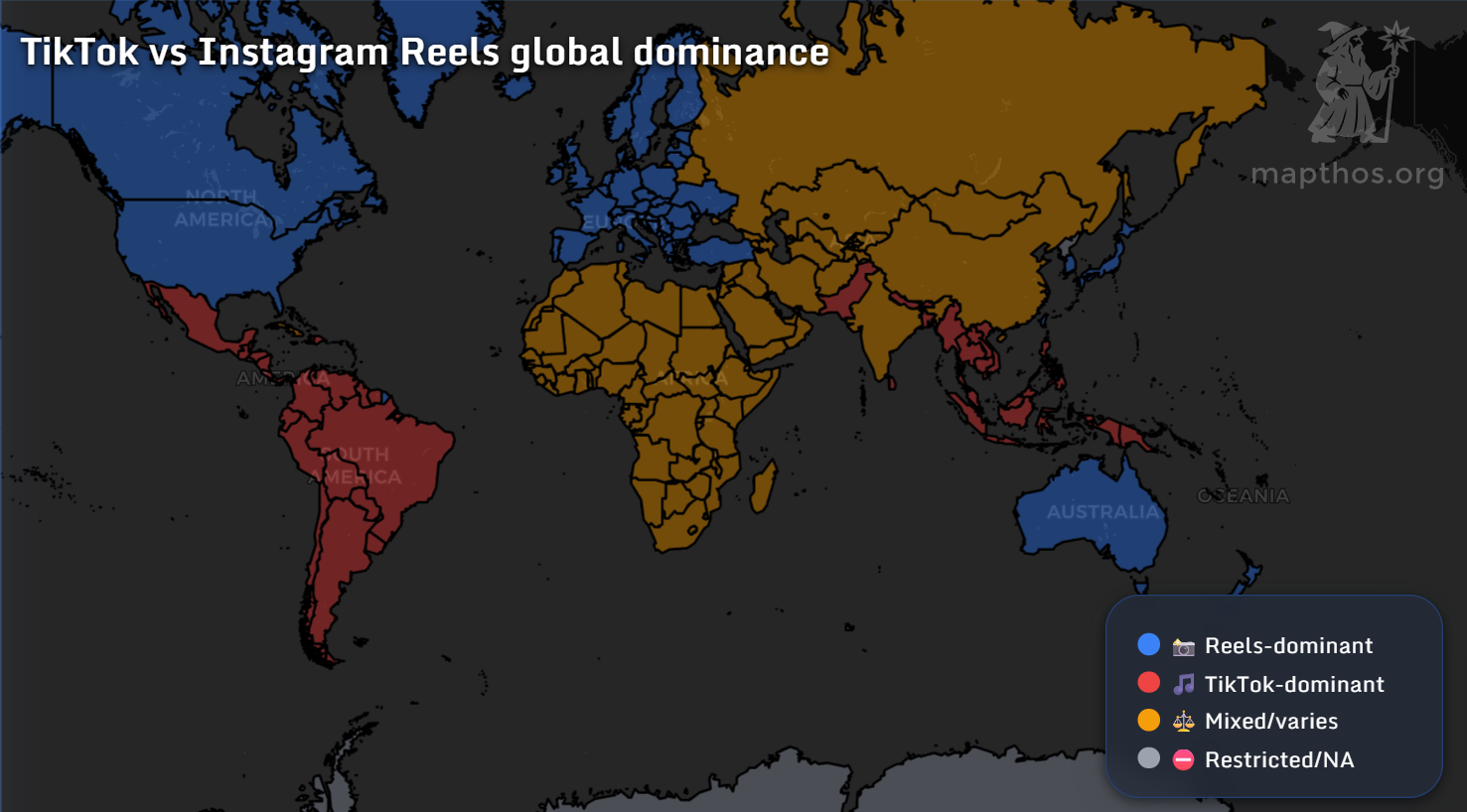
In 2025, the short-video landscape is divided into distinct cultural blocs:
- TikTok-dominant countries (red) span South America, Southeast Asia, and parts of Africa, where creativity and sound-driven trends thrive. Brazil, Indonesia, and Nigeria remain hotspots of TikTok culture.
- Reels-dominant regions (blue) include North America, Western Europe, and Australia, where Meta’s ecosystem and integration with Instagram’s social graph give it the edge.
- Mixed or varied usage (orange) covers much of Eurasia and Africa, suggesting users fluidly switch between platforms depending on content style and algorithmic reach.
- Restricted or NA zones (gray) include nations where local bans, network policies, or domestic alternatives (like Douyin in China) dominate.
🚫 The Politics of Virality: Countries That Ban or Restrict TikTok
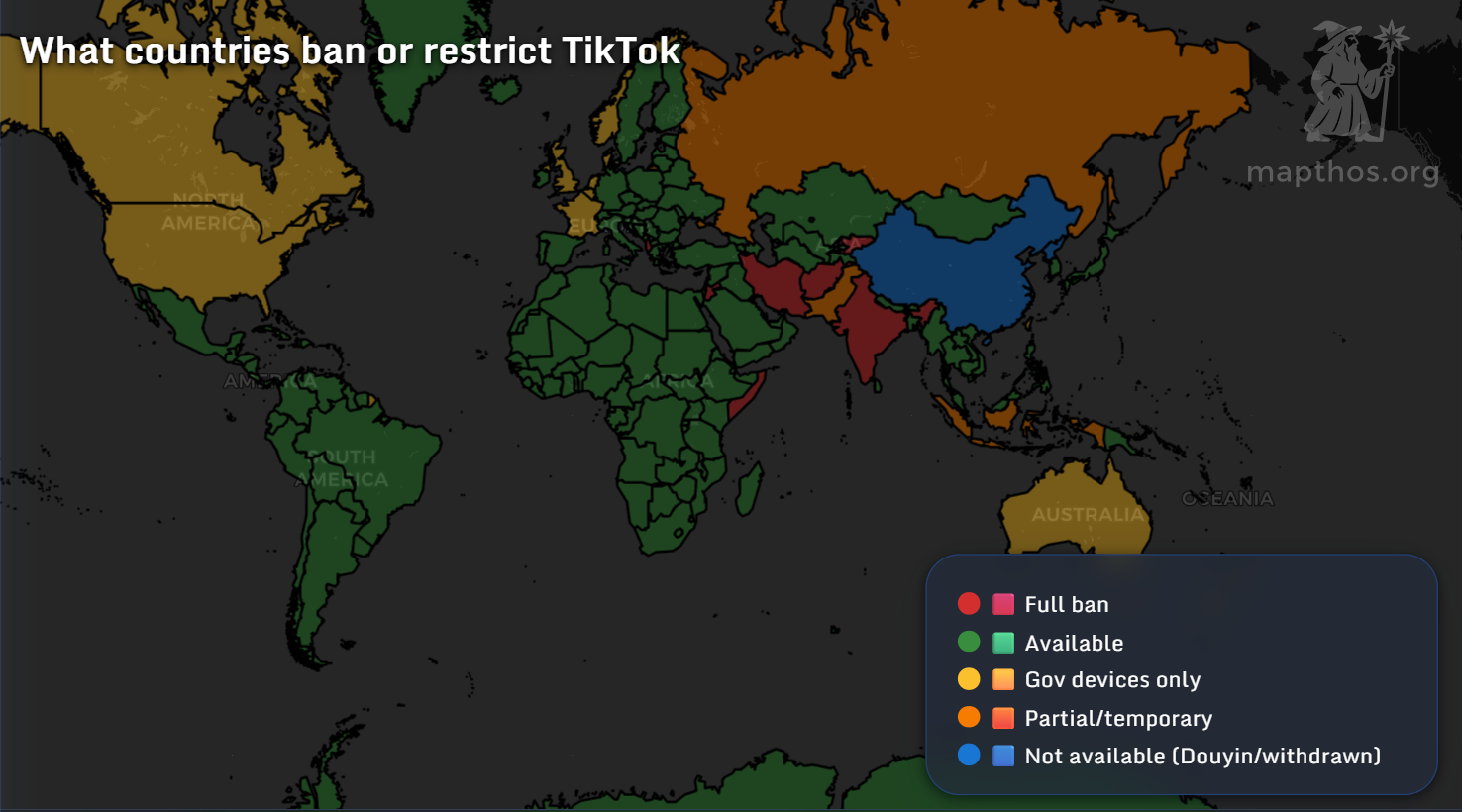
The second map tells a parallel story — one of policy, privacy, and power.
- Full bans (red) persist in countries like India and Afghanistan, cutting off millions from TikTok’s ecosystem.
- Partial or temporary restrictions (orange) appear across Russia, Pakistan, and parts of Europe, often tied to election seasons or data privacy concerns.
- Government device bans (yellow) now extend across the U.S., Canada, and much of Europe, reflecting security anxieties over Chinese tech influence.
- Meanwhile, China (blue) remains a unique case: TikTok is absent, replaced by Douyin, its domestic twin — an entirely different world behind the same format.
📊 Beyond Entertainment: What the Map Reveals
These maps highlight more than just platform preference. They show how digital ecosystems mirror political borders, cultural affinities, and even linguistic patterns. Reels dominates in places where Meta’s infrastructure is mature. TikTok flourishes where youth populations are large, English isn’t dominant, and creators crave global visibility.
It’s not just about fun — it’s about who gets to define the global culture feed.
👉 Explore more at app.mapthos.org
See the world. Map better. Dream big. 🌍✨