
🧭 Legal Ages in Europe 2026: When Does Adulthood Really Begin?
Adulthood does not arrive on one birthday.
A person may be old enough to face criminal responsibility, but not old enough to buy alcohol. They may make certain medical decisions independently while still needing parental approval for marriage. Online, the threshold may be lower than in the physical world — or not clearly defined at all.
These legal age maps of Europe in 2026 show that adulthood is not a single legal status. It is a sequence of permissions, protections and responsibilities that countries assemble in very different ways.
> Data note: This article reproduces the categories and values visible in the supplied MAPTHOS maps. Legal rules often contain exceptions based on maturity, parental approval, judicial authorization, age differences, product strength, licensing, offense type or medical urgency. The maps are comparative overviews, not legal advice.
Abortion Consent Age: Fixed Thresholds vs Capacity-Based Rules
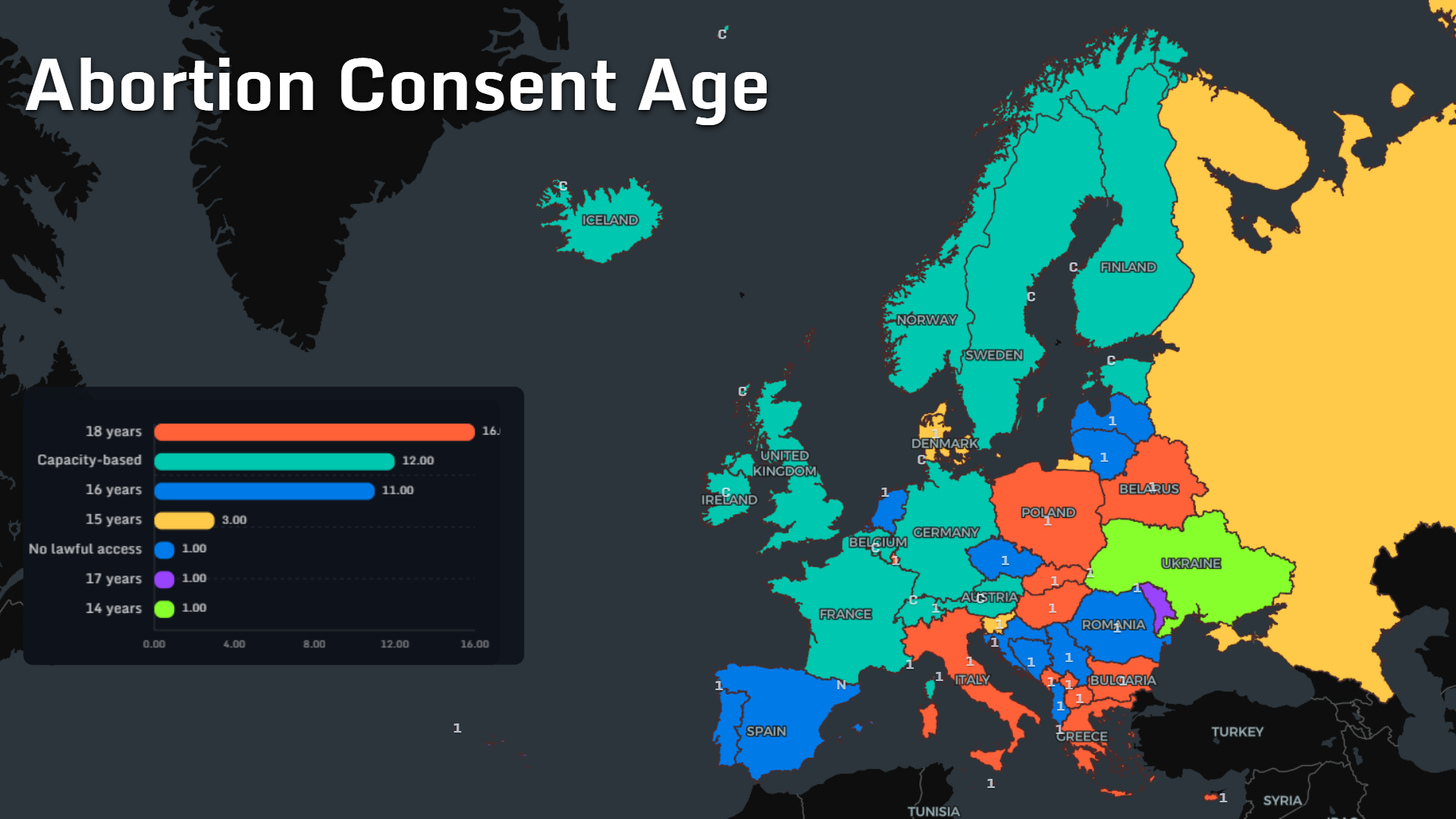
The abortion consent map shows one of the clearest divides between fixed-age law and capacity-based decision-making.
The largest category is 18 years, covering 16 jurisdictions in the mapped dataset. Another 12 jurisdictions use a capacity-based framework, where legal autonomy depends less on a single birthday and more on whether the patient can understand the procedure and its consequences.
The remaining categories are more fragmented:
- 16 years: 11 jurisdictions
- 15 years: 3 jurisdictions
- 17 years: 1 jurisdiction
- 14 years: 1 jurisdiction
- No lawful access: 1 jurisdiction
This is more than a technical distinction. A fixed threshold prioritizes legal clarity. A capacity-based system prioritizes individual competence. Both approaches attempt to balance bodily autonomy, medical safeguarding and parental involvement — but they begin from different assumptions about how maturity should be recognized.
Retail Alcohol Purchase Age: Eighteen Is the European Default
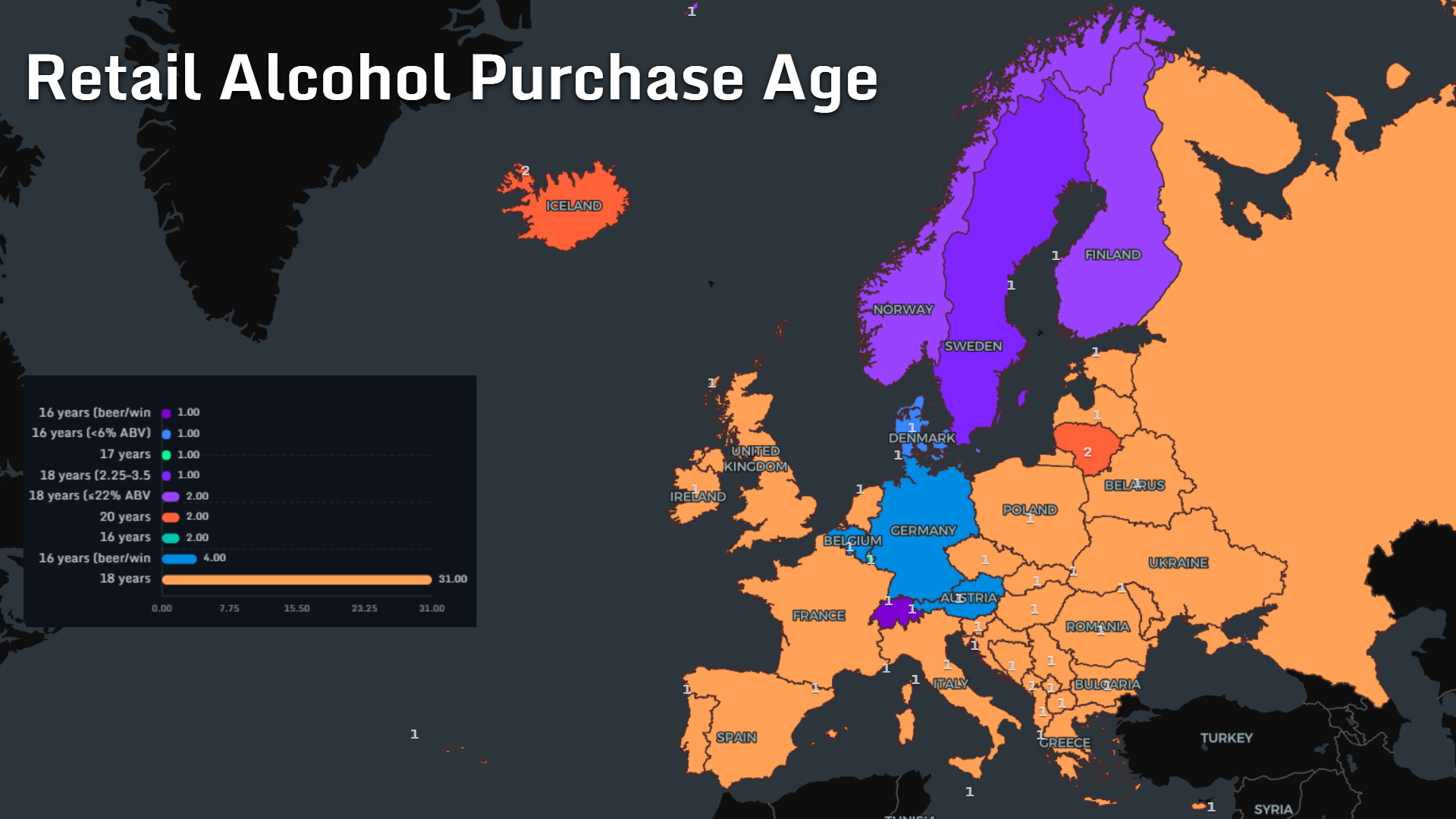
Alcohol law is one of the most standardized areas in the collection.
The map shows 18 years as the dominant retail purchase age in 31 jurisdictions. Yet the exceptions reveal how alcohol policy is often tied to beverage strength rather than alcohol as a single category.
The mapped categories include:
- 18 years: 31 jurisdictions
- 16 years for beer or wine: 4 jurisdictions
- 16 years: 2 jurisdictions
- 20 years: 2 jurisdictions
- 18 years for drinks up to 22% ABV: 2 jurisdictions
- 18 years for drinks around 2.25–3.5% ABV: 1 jurisdiction
- 17 years: 1 jurisdiction
- 16 years for drinks below 6% ABV: 1 jurisdiction
The broader European pattern is therefore simple but not uniform: 18 is the norm, while exceptions are usually designed around alcohol strength and retail channel.
Contraception Access Age: Autonomy Often Depends on Capacity
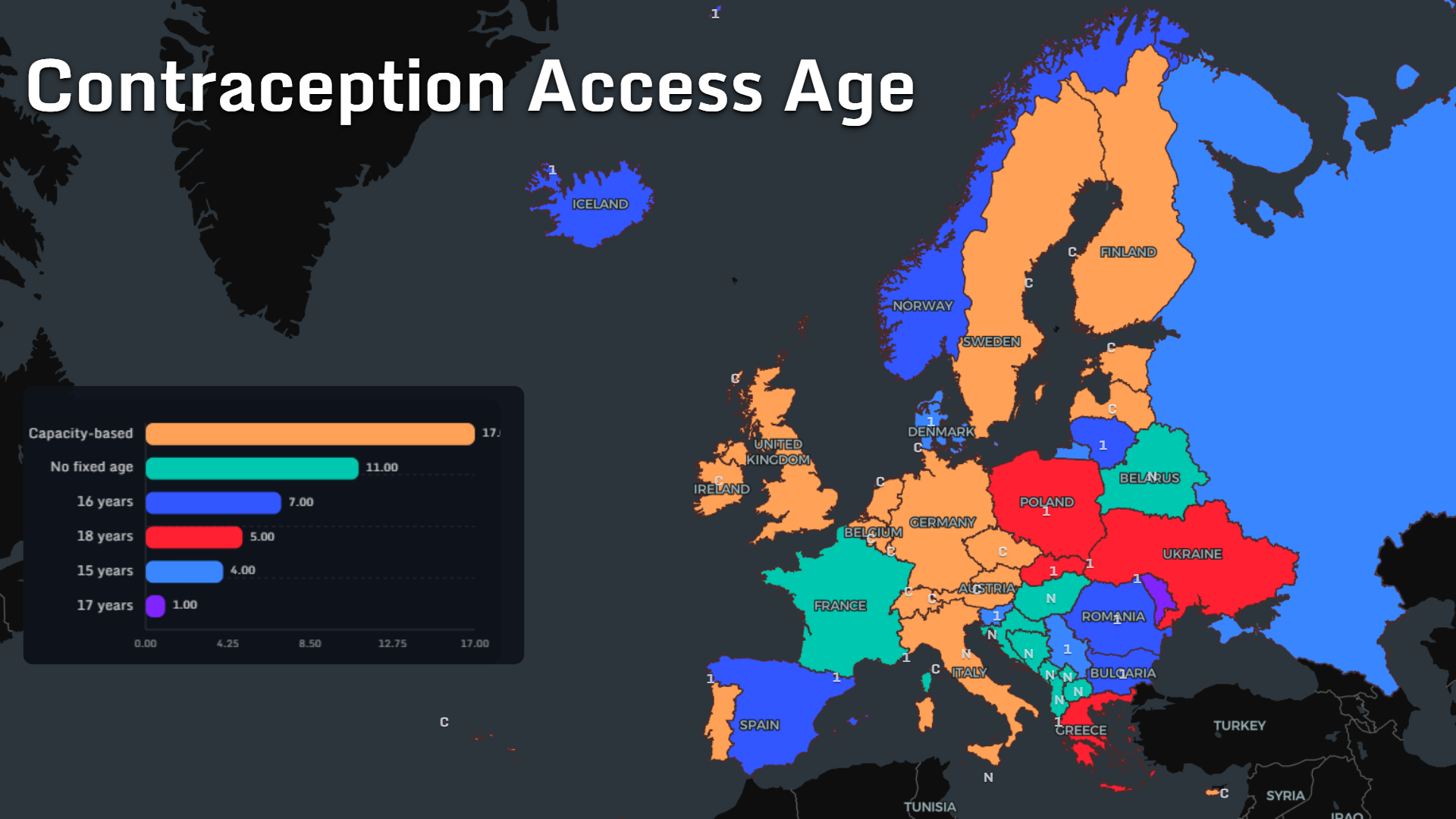
Contraception access is one of the least standardized legal-age questions in Europe.
The largest category is capacity-based, covering 17 jurisdictions. Another 11 jurisdictions have no fixed age, meaning access may depend on clinical judgment, confidentiality rules or the specific contraceptive method.
Fixed-age systems are spread across several thresholds:
- 16 years: 7 jurisdictions
- 18 years: 5 jurisdictions
- 15 years: 4 jurisdictions
- 17 years: 1 jurisdiction
This map shows how reproductive autonomy is often governed differently from retail or criminal law. Instead of asking only “How old is the person?”, many systems ask “Can this person understand the decision, its risks and its consequences?”
That makes contraception law closer to medical-consent law than to a simple age gate.
Age of Criminal Responsibility: Europe Ranges from 10 to 16
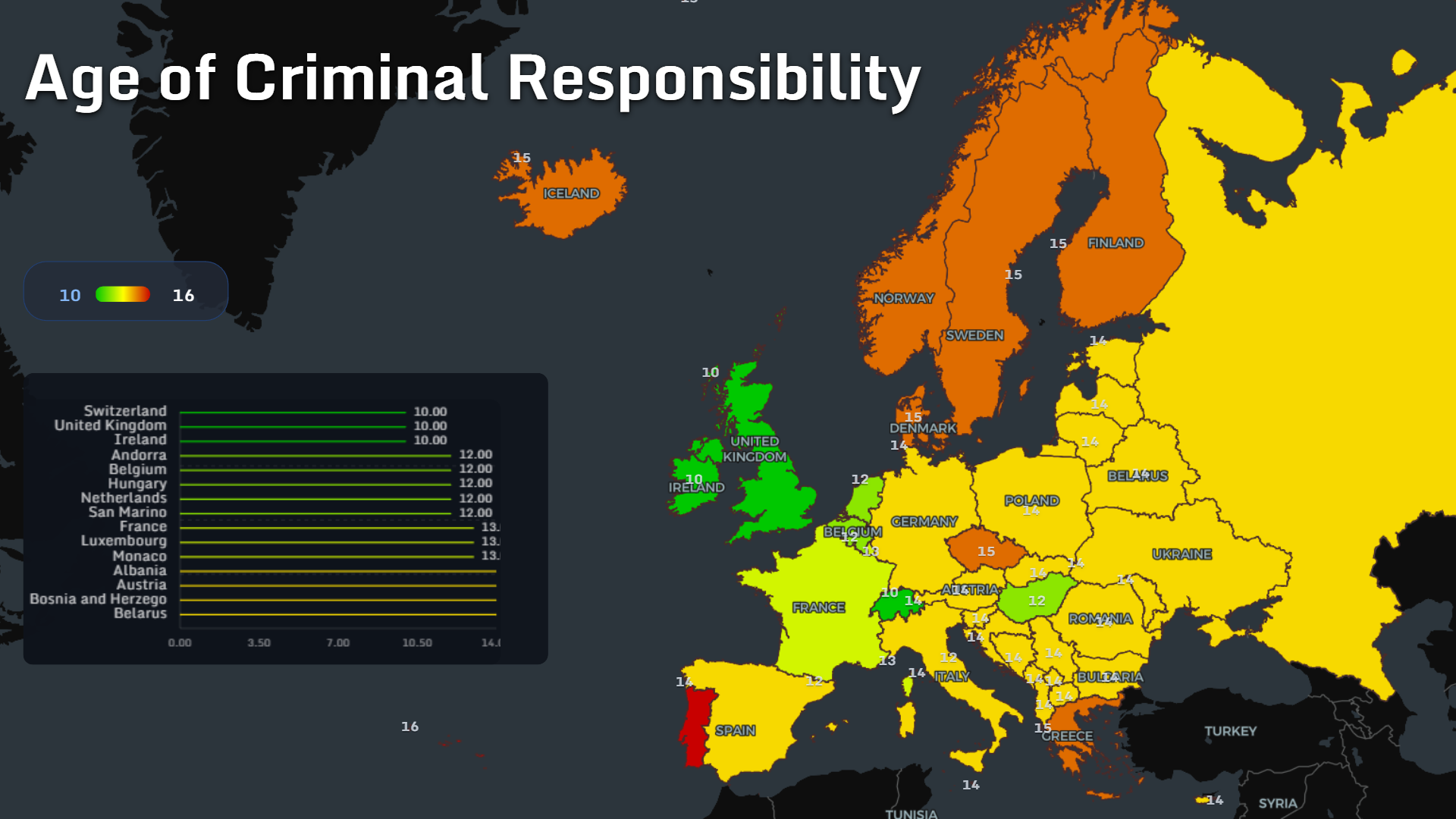
The age of criminal responsibility in Europe varies sharply, from 10 to 16 years in the supplied map.
The lowest mapped threshold is 10, shown for:
- Switzerland
- United Kingdom
- Ireland
This is one of the most consequential maps in the collection because the threshold marks the point at which the state can treat a child as legally accountable for a criminal act.
But even here, the number is only the beginning. Juvenile justice systems may still apply special courts, reduced sentences, diversion programs, welfare interventions or limits based on offense severity.
The map therefore measures the formal entry point into criminal responsibility — not the full design of juvenile justice.
Digital Consent Age: Europe’s Online Thresholds Are Fragmented
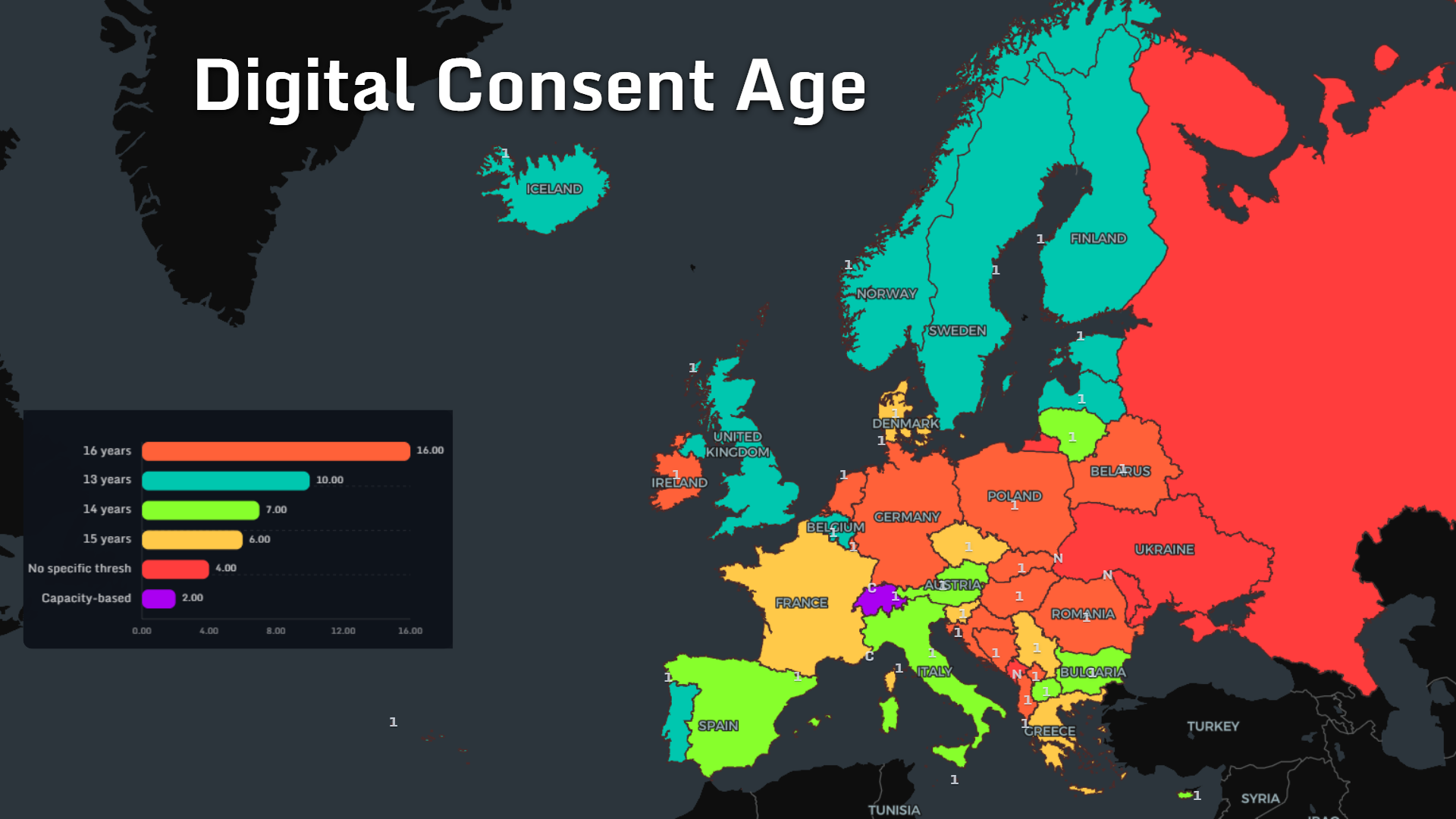
Digital consent law is where Europe’s age architecture becomes especially fragmented.
The most common threshold is 16 years, used in 16 jurisdictions. But a substantial group sets digital consent at 13, while others use 14 or 15.
The categories shown are:
- 16 years: 16 jurisdictions
- 13 years: 10 jurisdictions
- 14 years: 7 jurisdictions
- 15 years: 6 jurisdictions
- No specific threshold: 4 jurisdictions
- Capacity-based: 2 jurisdictions
These thresholds usually concern a child’s ability to consent independently to online data processing, rather than a universal right to use every platform.
That distinction matters. A platform may impose a higher minimum age than national law, and national rules may still require parental authorization below the stated threshold.
The result is a digital Europe where legal adulthood is not only fragmented by country, but also by service, platform policy and data-protection regime.
Civilian Firearm Purchase Age: Eighteen Dominates, but Not Everywhere
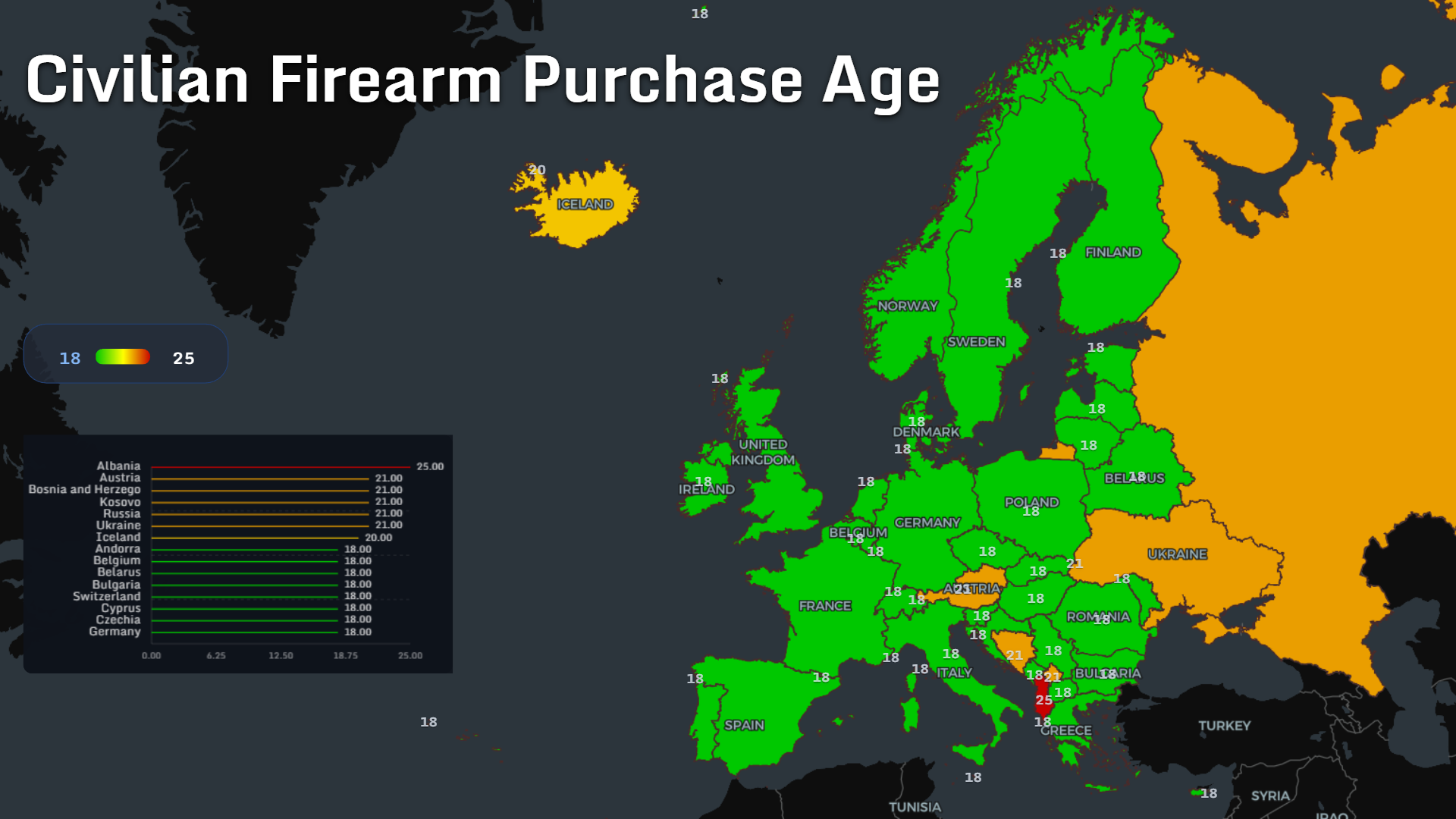
The firearm purchase map is visually one of the most uniform.
Across most of Europe, the minimum age is 18. The exceptions are concentrated in a smaller set of countries:
- Albania: 25
- Austria: 21
- Bosnia and Herzegovina: 21
- Kosovo: 21
- Russia: 21
- Ukraine: 21
- Iceland: 20
Yet age alone does not describe firearm access. Licensing, background checks, training, storage rules, medical certification and firearm category can all impose additional restrictions.
The map therefore shows the minimum age gate, not the practical ease of purchase.
Still, it reveals a broad European consensus: firearms are treated as an adult-only purchase, with some countries applying an additional waiting period beyond the general age of majority.
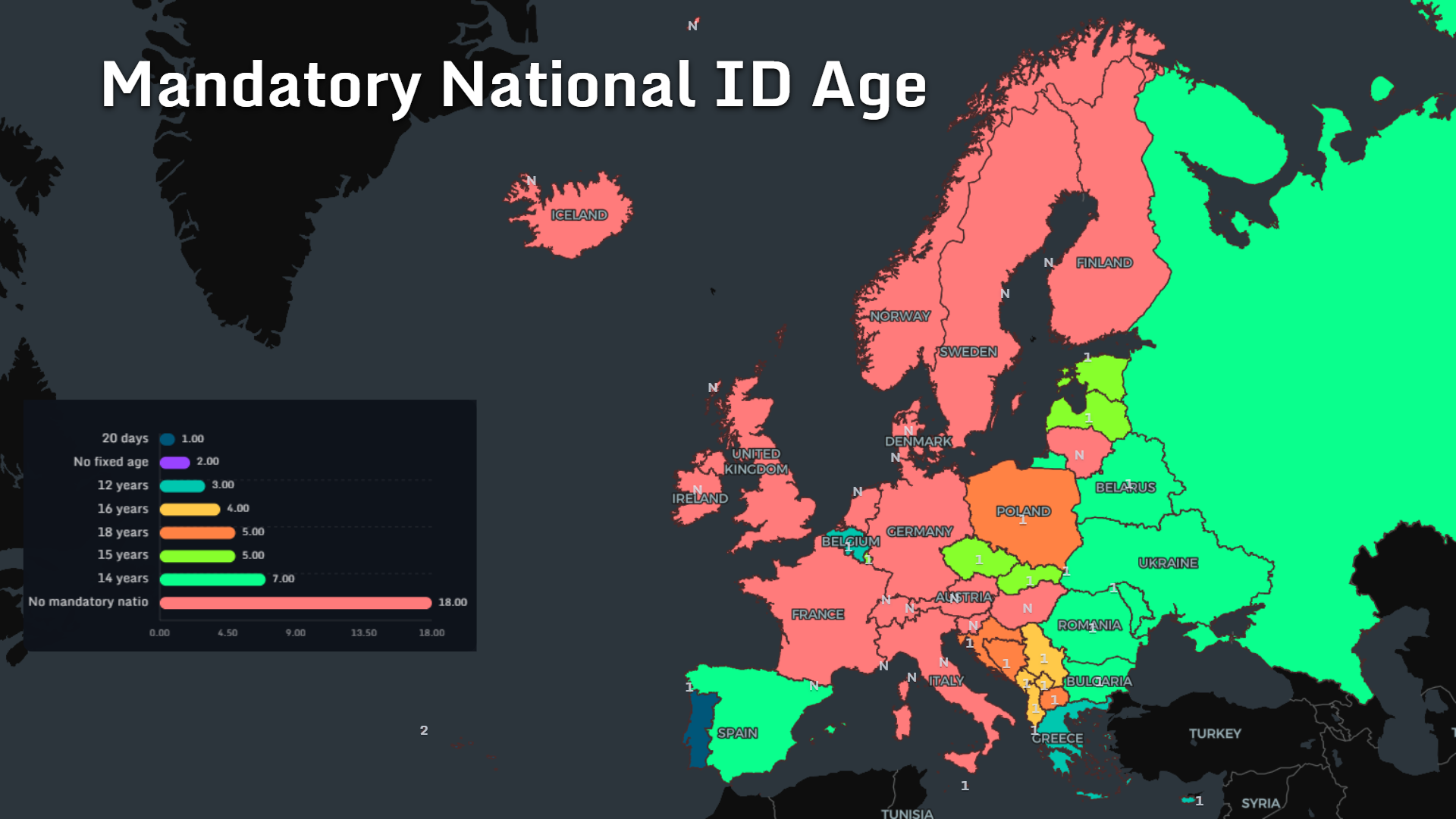
Mandatory National ID Age: Many Countries Have No Fixed Requirement

National ID rules create one of the largest institutional divides between European countries.
The biggest category is no mandatory national ID, covering 18 jurisdictions in the map. This includes much of Western and Northern Europe.
Elsewhere, identity cards become mandatory at very different ages:
- 14 years: 7 jurisdictions
- 15 years: 5 jurisdictions
- 18 years: 5 jurisdictions
- 16 years: 4 jurisdictions
- 12 years: 3 jurisdictions
- No fixed age: 2 jurisdictions
- 20 days: 1 jurisdiction
This map is not simply about when a card can be issued. It is about when the state requires an individual to possess formal proof of identity.
That difference reflects administrative culture. Some countries rely heavily on mandatory identity cards in everyday interactions. Others use passports, driving licences, tax records or digital systems without requiring a universal card at a particular age.
Marriage with Parental or Judicial Consent: Sixteen Is the Most Common Exception
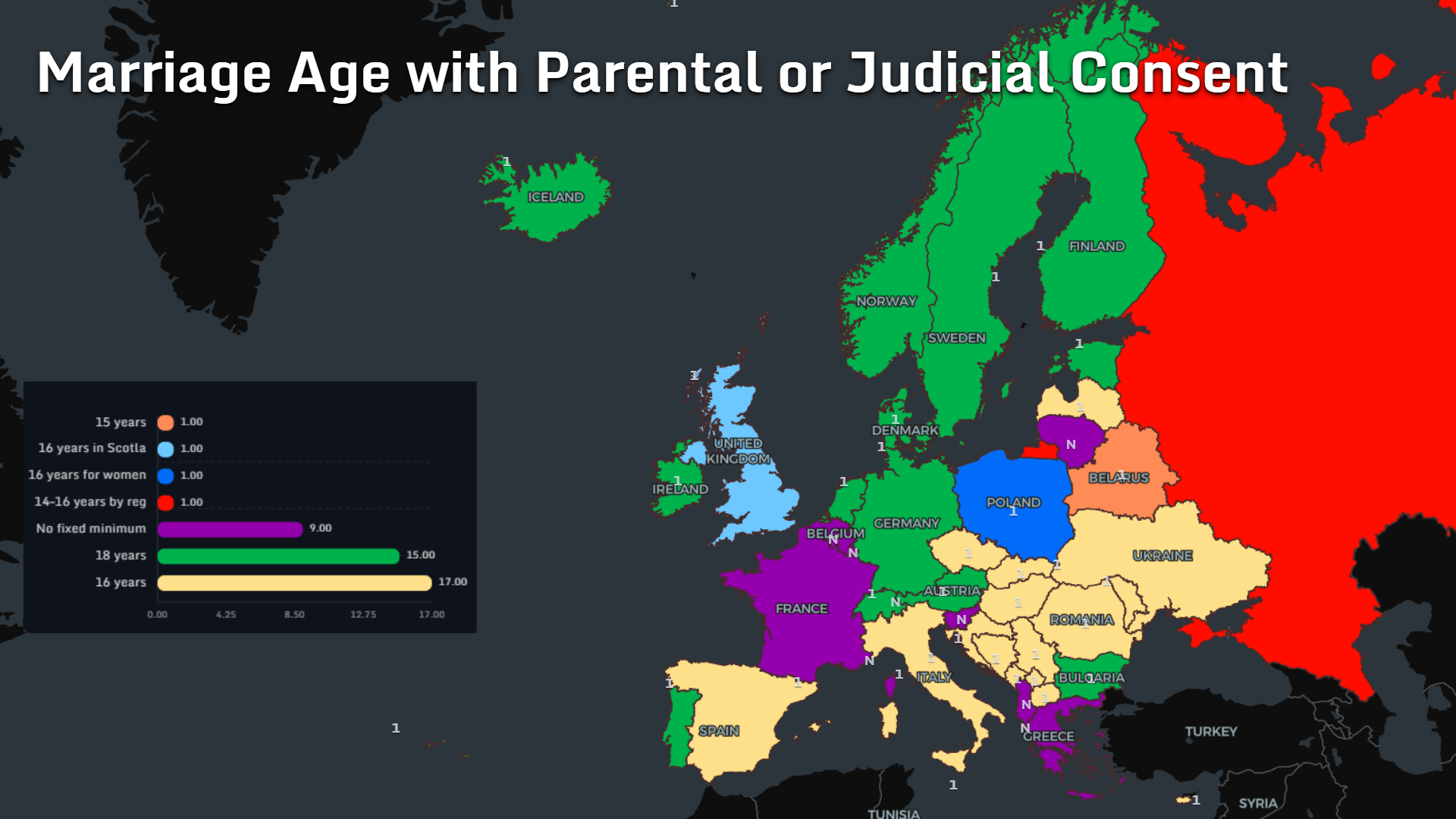
Marriage law shows how exceptions can complicate the meaning of the standard age of majority.
The most common mapped minimum with parental or judicial approval is 16 years, appearing in 17 jurisdictions. Another 15 jurisdictions set the threshold at 18, even where approval is available.
The remaining systems include:
- No fixed minimum: 9 jurisdictions
- 15 years: 1 jurisdiction
- 16 years in Scotland: 1 jurisdiction
- 16 years for women: 1 jurisdiction
- 14–16 years depending on region: 1 jurisdiction
“No fixed minimum” does not necessarily mean unrestricted child marriage. It may indicate that the legal framework relies on judicial discretion, exceptional circumstances or other statutory conditions rather than a single explicit number.
Marriage law is therefore one of the clearest examples of how a headline age can hide a second legal layer beneath it.
Medical Consent Age: Maturity Can Matter More Than Birthdays
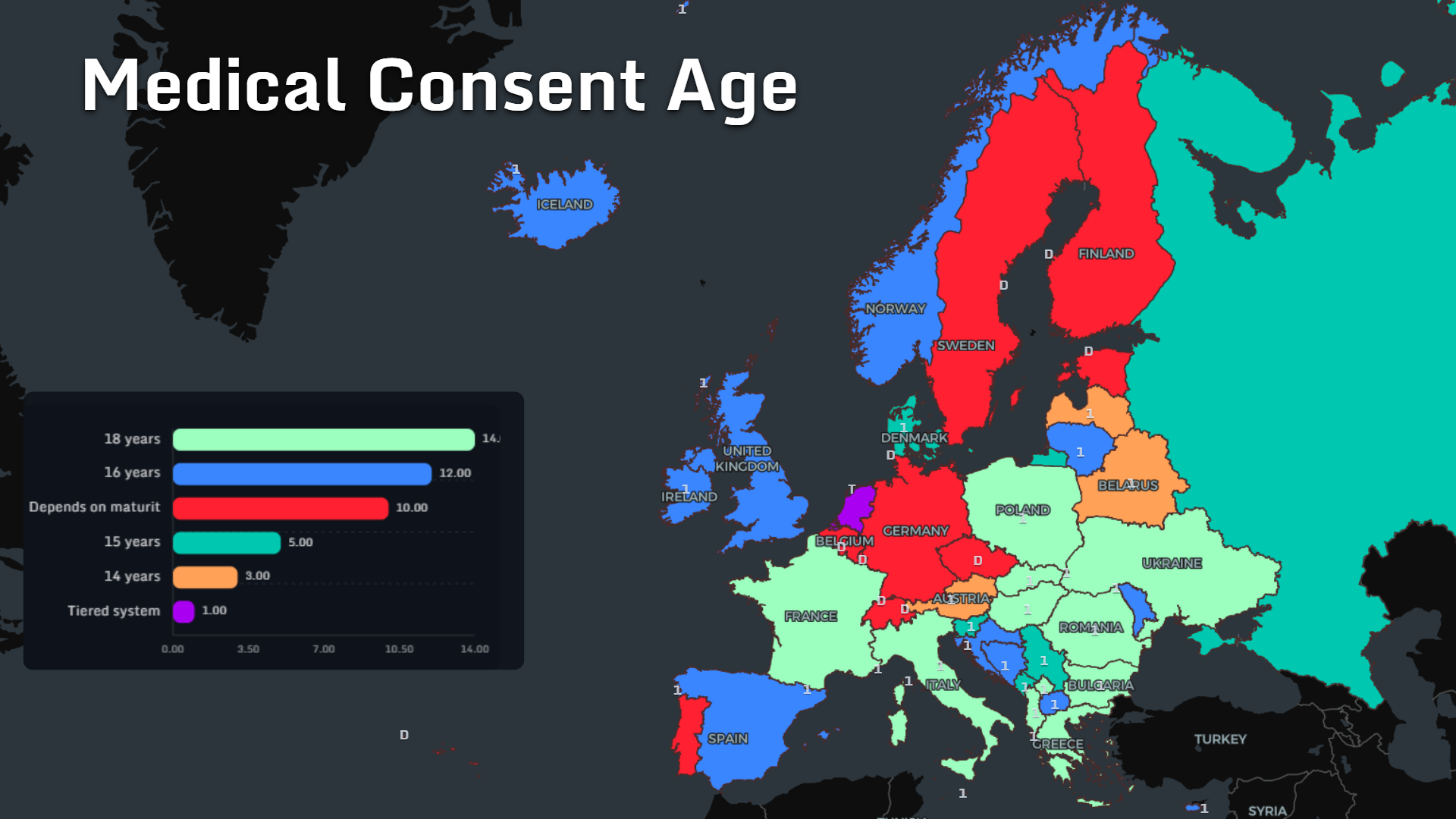
Medical consent is perhaps the most philosophically complex map in the set.
The largest fixed category is 18 years, covering 14 jurisdictions, followed by 16 years in 12. But 10 jurisdictions use a system where consent depends on maturity.
Other categories include:
- 15 years: 5 jurisdictions
- 14 years: 3 jurisdictions
- Tiered system: 1 jurisdiction
The underlying question is fundamental: should medical autonomy begin automatically at a certain age, or should it expand as a young person demonstrates understanding?
Maturity-based systems offer flexibility, especially for urgent or sensitive care. Fixed-age systems offer clearer boundaries for clinicians and families. Tiered systems attempt to combine both.
Across Europe, healthcare law appears to recognize that decision-making ability does not develop at exactly the same pace for everyone.
Age of Sexual Consent: The Narrowest Numerical Range
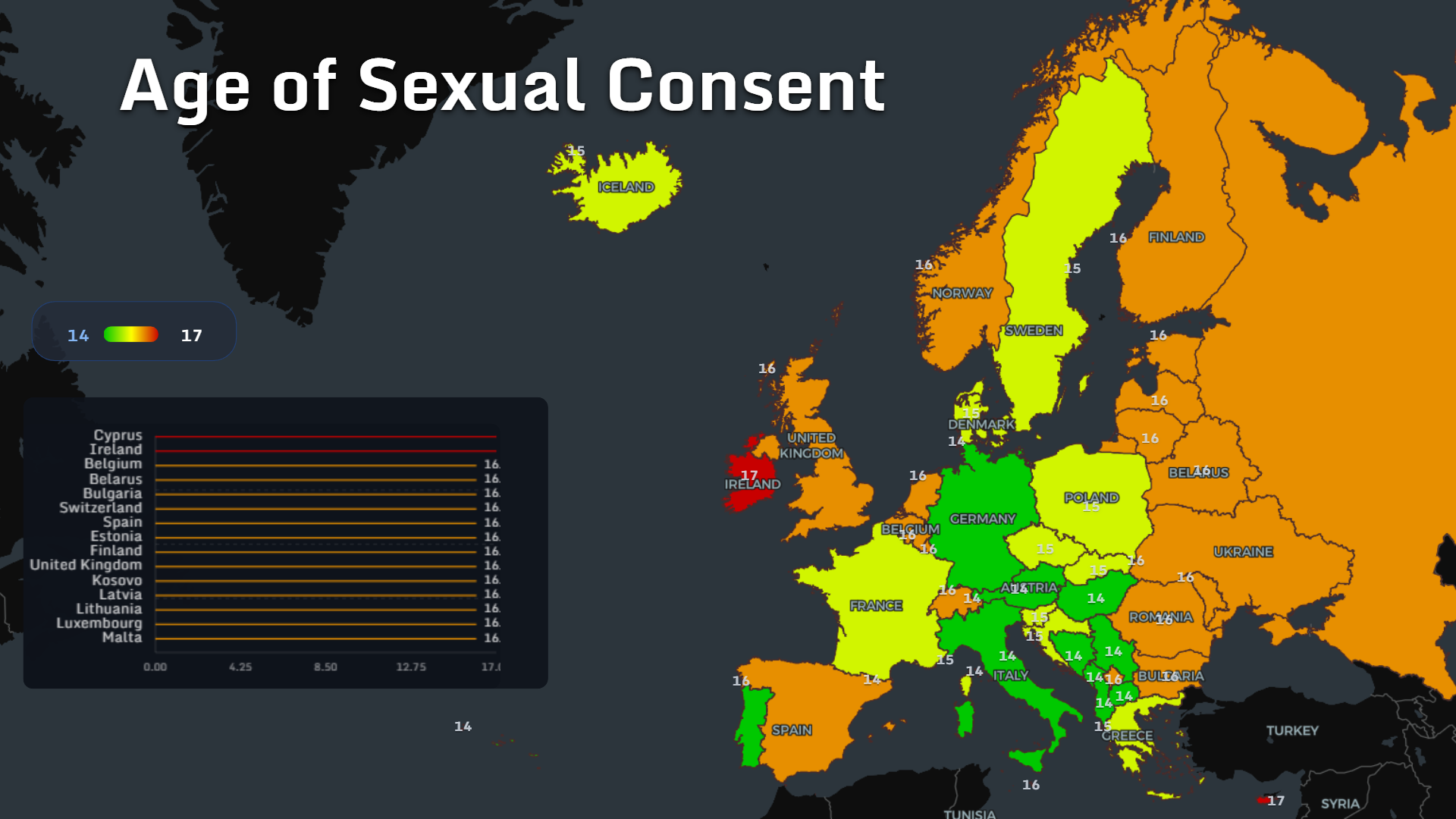
The age of sexual consent in Europe falls within a relatively narrow range of 14 to 17 years.
The lowest threshold, 14, appears across parts of Central and Southern Europe, including Germany, Austria, Italy and several Balkan countries. A large group uses 15, including France, Poland, Sweden, Denmark and Iceland.
The most common higher threshold is 16, covering much of Northern and Eastern Europe as well as Spain, Belgium, Switzerland and the United Kingdom. Ireland and Cyprus appear at 17.
This numerical range is narrower than in criminal responsibility or marriage law, but the legal detail behind it is often more complex.
Close-in-age exemptions, positions of authority, exploitation, coercion and age differences can substantially change how the law applies. A nominal age of consent is therefore not a universal permission line detached from context.
What the map does show clearly is that Europe has converged around the middle teenage years — but not around one single standard.
Social Media Minimum Age Laws: Policy Is Moving Faster Than Legislation
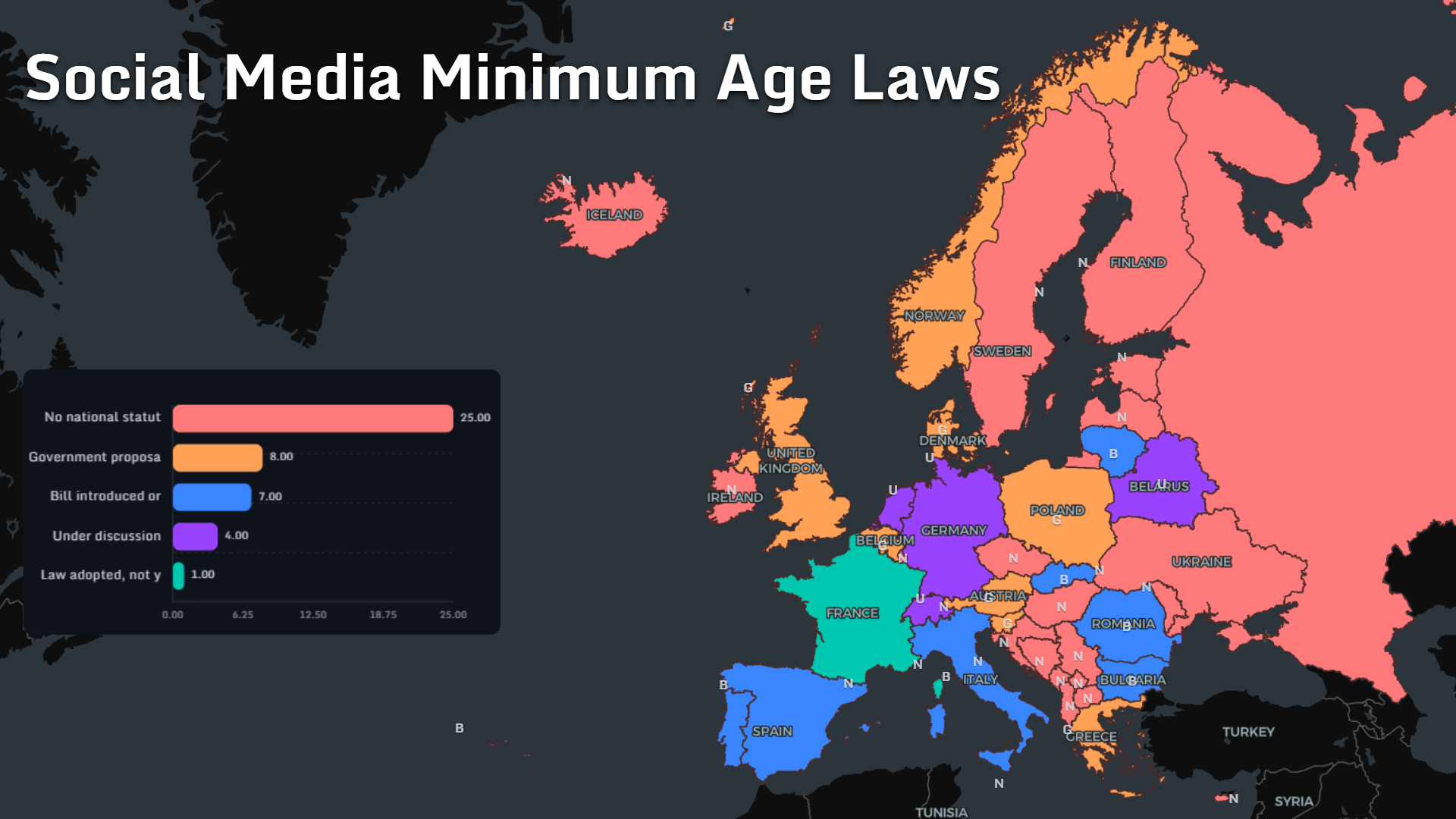
Unlike the other maps, this one tracks legislative status rather than a single age.
The largest group — 25 jurisdictions — has no national statute establishing a dedicated social media minimum age. But political movement is visible across much of Europe.
The mapped categories are:
- No national statute: 25 jurisdictions
- Government proposal: 8 jurisdictions
- Bill introduced or moving through legislation: 7 jurisdictions
- Under discussion: 4 jurisdictions
- Law adopted but not yet active: 1 jurisdiction
The pattern suggests a regulatory transition.
For years, children’s access to social platforms was governed mainly through platform terms of service and data-protection rules. European governments are now considering a more direct model: explicit national age gates, parental consent systems or age-verification obligations.
This may become one of the fastest-changing maps in the entire collection.
What Europe’s Legal Age Maps Reveal
Taken together, these maps show that Europe does not have one age of adulthood.
It has many.
A young person may become criminally responsible at 10, 12, 14 or 16, depending on the country. They may consent to digital data processing at 13, but need to wait until 16 or 18 for medical autonomy. They may buy beer at 16 in one jurisdiction, but wait until 20 for certain alcohol purchases elsewhere. They may legally purchase a firearm at 18, while marriage rules, reproductive healthcare and national identity obligations follow entirely different timelines.
Three wider patterns stand out.
First, 18 remains Europe’s default age for high-risk adult transactions, especially alcohol purchase, firearm access and some medical or reproductive decisions.
Second, capacity-based law is becoming a major alternative to fixed thresholds, especially in healthcare, contraception and abortion consent. These systems treat maturity as something that can be assessed rather than assumed from age alone.
Third, digital life is creating a new legal frontier. Digital consent is already fragmented, while dedicated social media age laws remain under active political development across much of the continent.
The deeper lesson is that legal age is never only about age.
It is about how societies understand protection, autonomy, responsibility and risk. Every threshold marks a judgment about when a person should be trusted, restricted, protected or held accountable.
MAPTHOS turns those judgments into a comparative visual language — one map at a time, country by country.
👉 Explore more at app.mapthos.org
See the world. Map better. Dream big. 🌍✨