
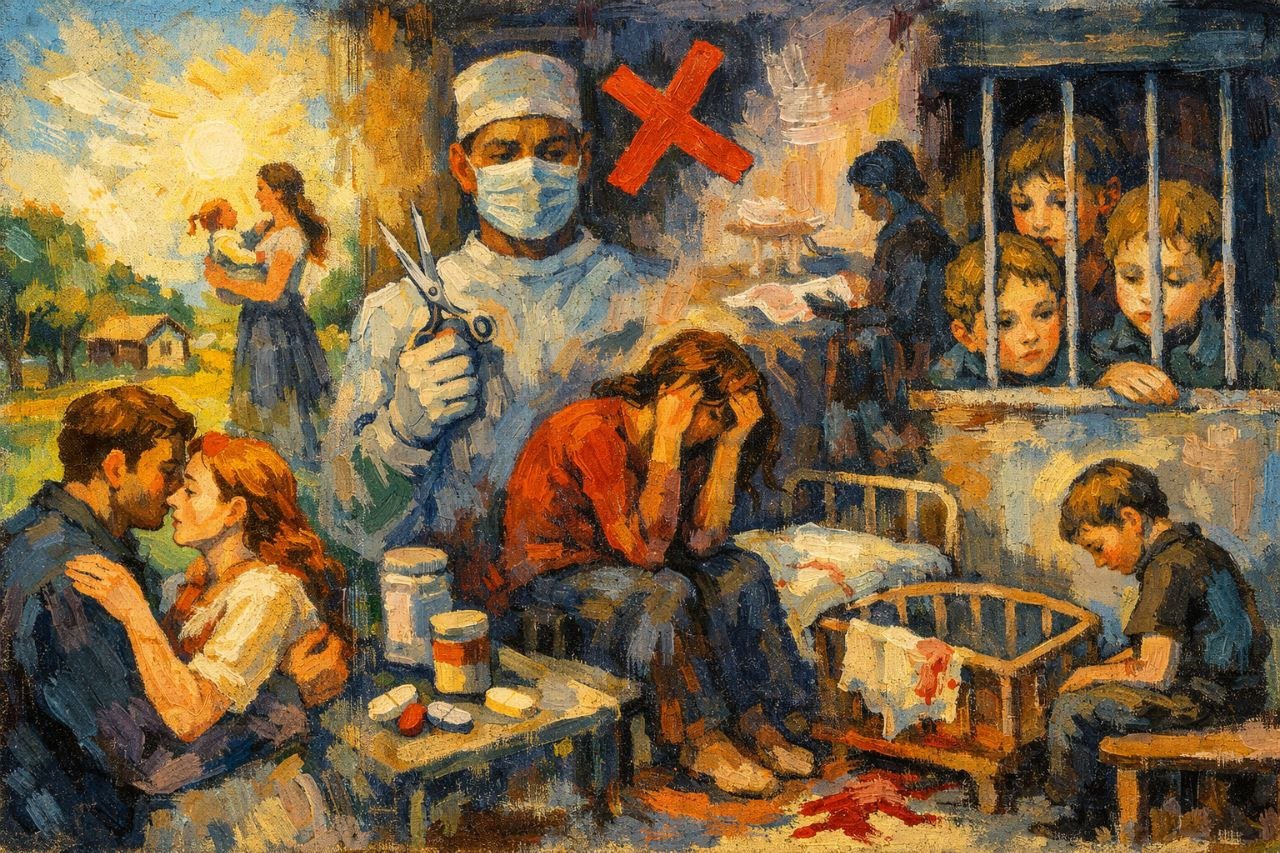
🩺 Global Reproductive Rights in 2026
There are few subjects where geography feels more intimate than reproductive rights. A border on a map can mean the difference between choice and restriction, between healthcare and delay, between public support and private burden. In 2026, these lines still shape some of the most personal decisions people make.
This MAPTHOS story brings together a wider data visualization of global reproductive rights — not as one issue, but as a system. Sterilization, vasectomy, abortion, contraception, IVF, surrogacy, and children without parental care all reveal how states regulate bodies, families, and futures.
Female sterilization laws: where access is open, restricted, or medicalized
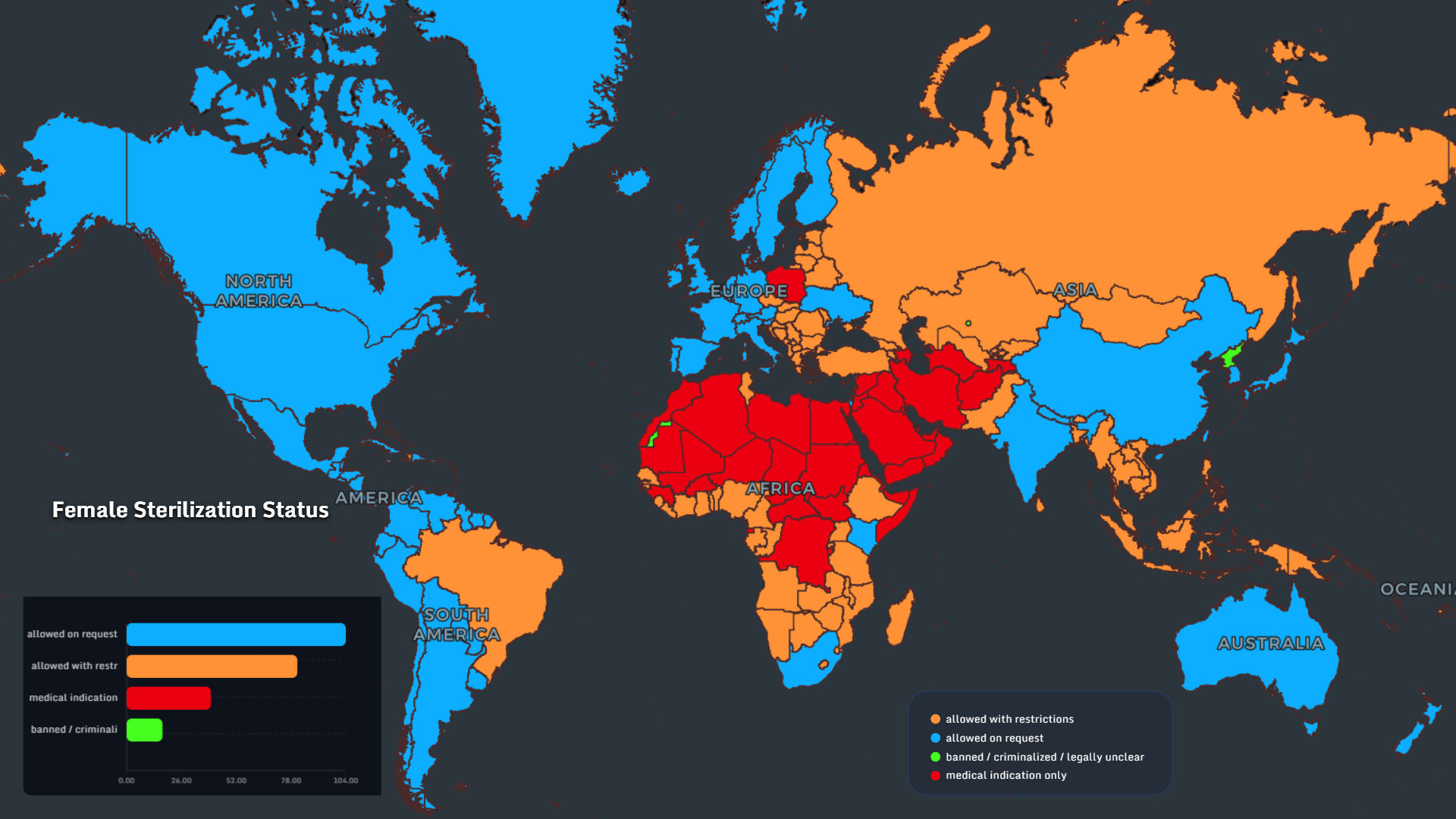
The first map shows a striking split in female sterilization legal status by country. Much of North America, parts of Europe, China, and Australia fall into the more open category, where sterilization is generally available on request. Across large parts of Africa, the Middle East, and sections of Asia, the picture shifts toward medical indication only or legal uncertainty.
What stands out is not only prohibition, but conditional access. In many places, the right technically exists, yet only under restrictions, approvals, or narrow medical criteria. On a map, that difference is just a color. In real life, it can mean months of delay, refusal, or no access at all.
Vasectomy laws reveal a similar but not identical pattern
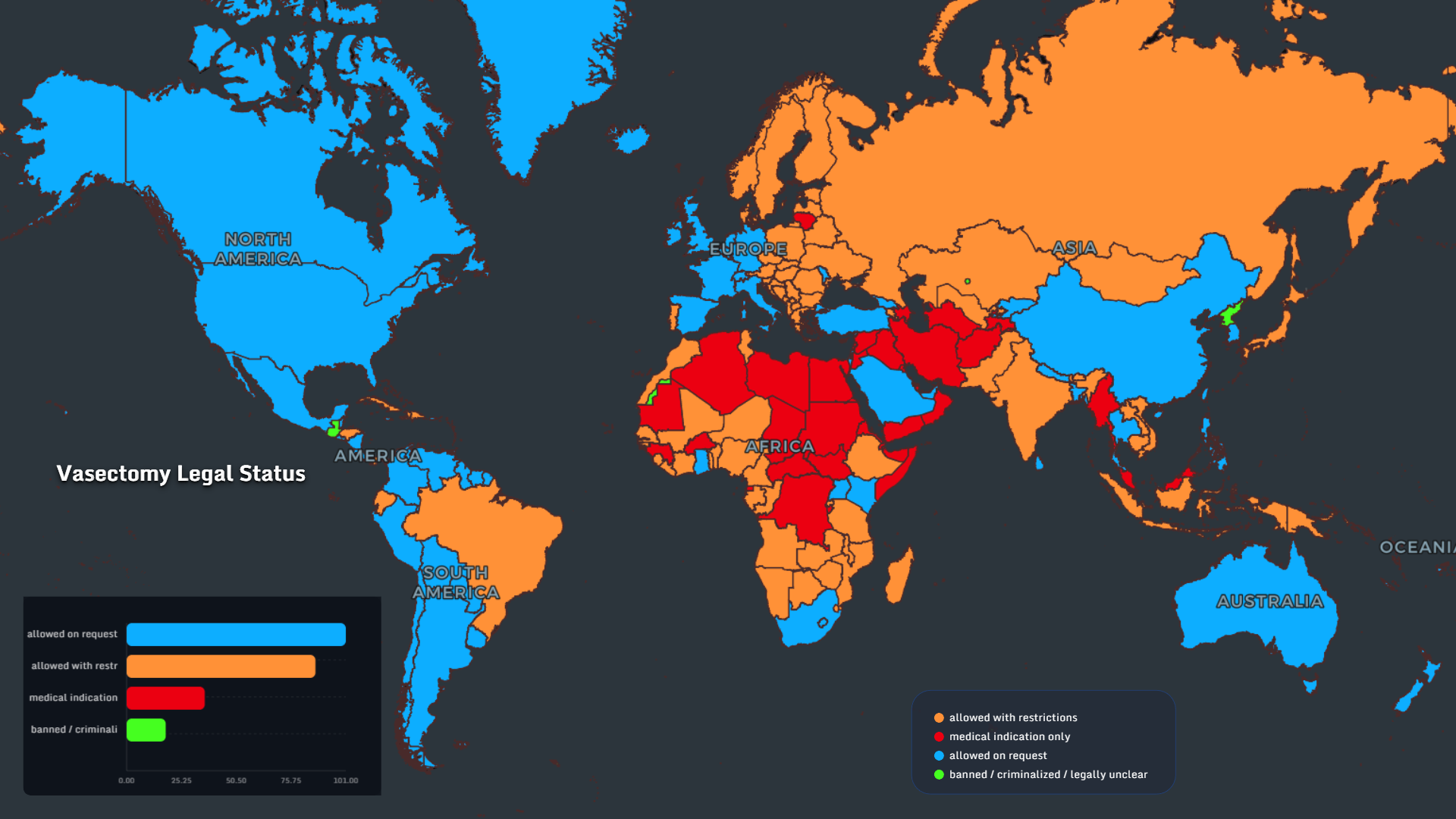
The vasectomy legal status map looks broadly similar, but not perfectly mirrored. In many countries where female sterilization is tightly controlled, vasectomy also remains restricted or limited to medical need. Yet the regional balance is not always symmetrical.
This matters because reproductive autonomy is often discussed through women’s rights alone, while male contraception and sterilization remain politically quieter. The map suggests that legal systems still regulate permanent contraception as a matter of state oversight rather than personal agency in many parts of the world.
Abortion law remains one of the clearest global fault lines
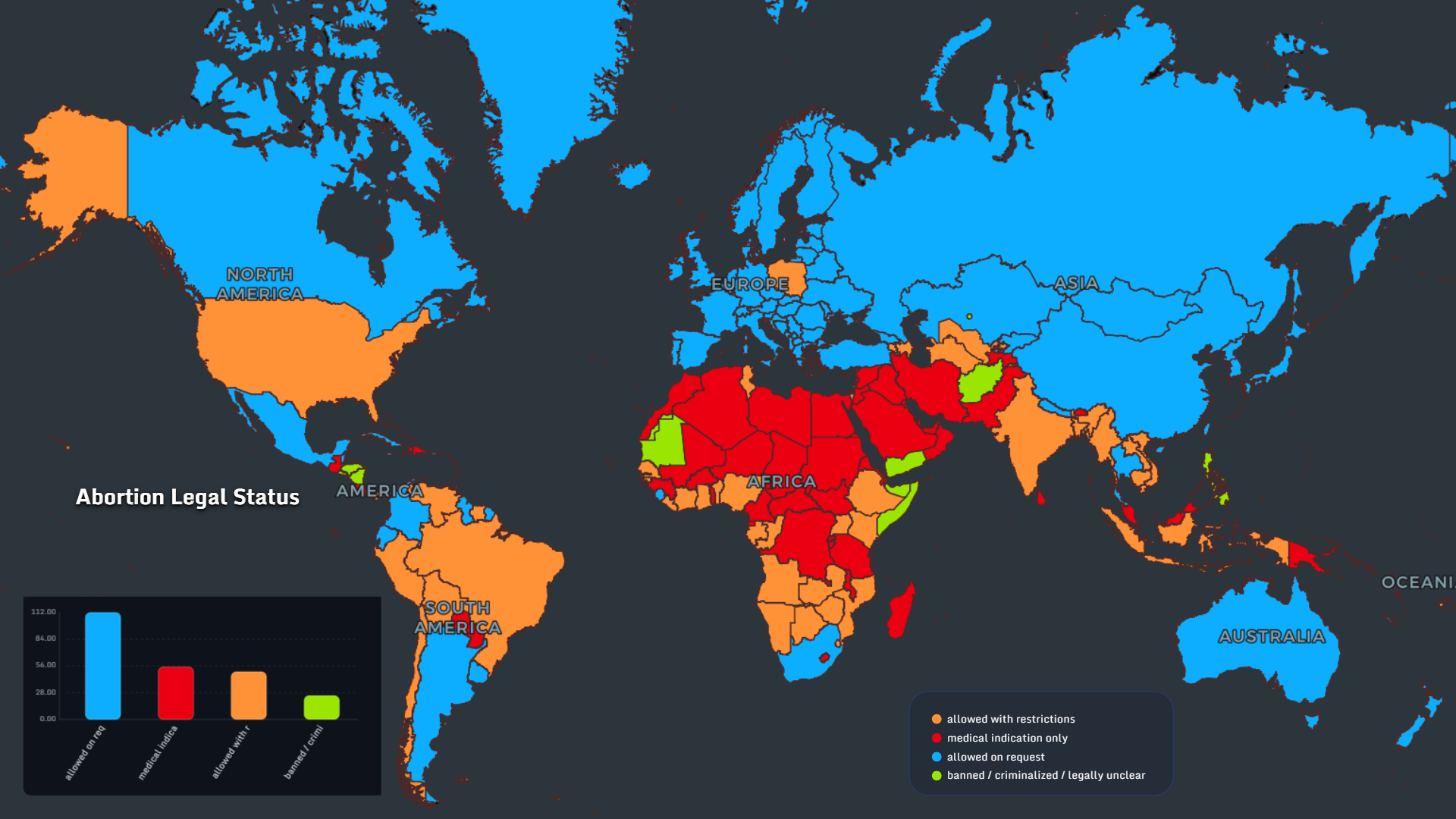
Among all the maps in this article, the abortion legal status by country view may be the most familiar — and still one of the most polarizing. Large parts of Europe, North America, and several countries in East Asia and Oceania appear in the more permissive categories. Across much of Africa and parts of Latin America, abortion remains limited, highly restricted, or tied to medical indication.
The geography is telling. Abortion is not simply divided between “legal” and “illegal.” It exists on a spectrum of state tolerance: allowed on request, allowed with restrictions, permitted only for medical reasons, or effectively criminalized. That layered reality is exactly why maps matter here. They show that reproductive rights are not one policy debate, but thousands of different legal environments.
Contraception access is far wider than other reproductive freedoms — but still uneven
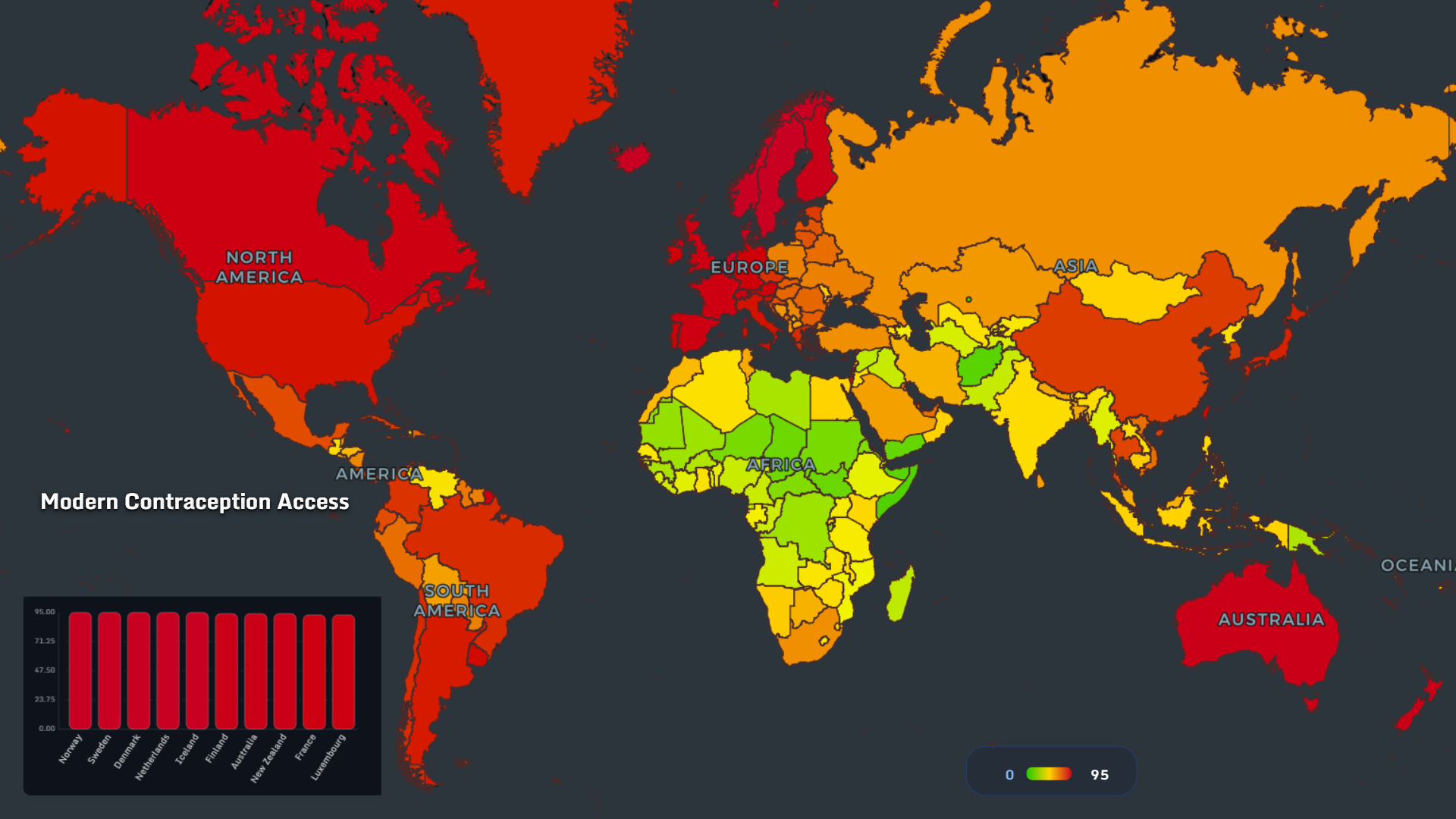
The modern contraception access map offers a different kind of story. Here, much of Europe, Australia, and parts of the Americas cluster toward the top end, with several countries reaching the highest visible values on the chart. Large areas of Africa and parts of Asia remain substantially lower.
That contrast matters. Contraception is often the most normalized and least publicly contested part of reproductive healthcare, yet its global distribution is still unequal. Access is shaped by income, public health systems, education, supply chains, religion, and cultural norms — all layered onto policy itself.
In other words: legal permission is not the same as practical access.
Vasectomy prevalence remains highly concentrated
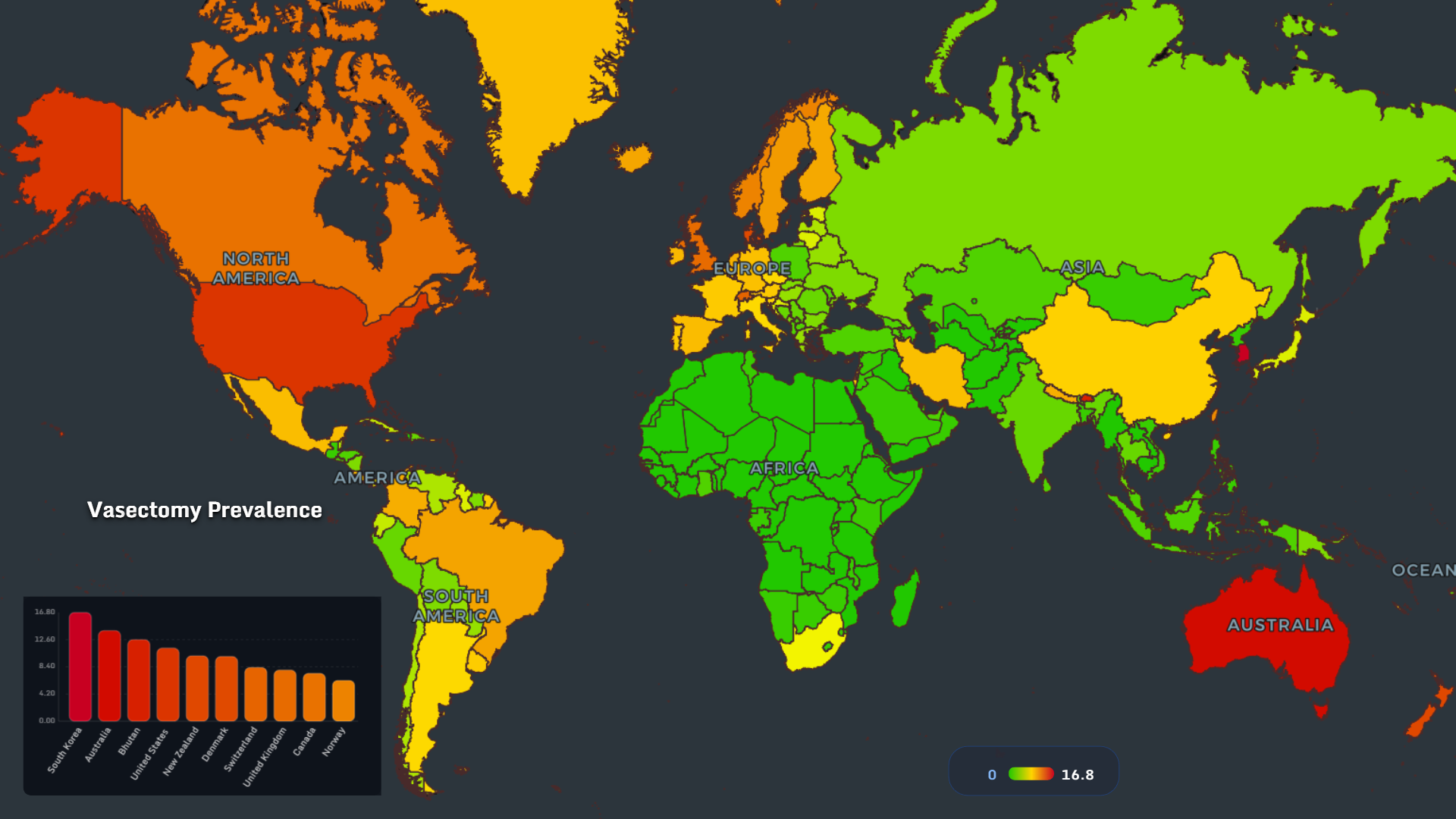
The vasectomy prevalence map shows one of the clearest regional concentrations in the entire dataset. A small group of countries stands far ahead, while much of the world remains near the floor.
That suggests something deeper than law alone. Even where vasectomy is legal, it may be culturally marginal, weakly promoted, or absent from mainstream public-health messaging. Some countries normalize it as a routine family-planning choice. Others barely register it in practice.
This is one of the quiet strengths of data visualization of global trends: it exposes the gap between formal legality and lived behavior.
Female sterilization prevalence tells a very different story
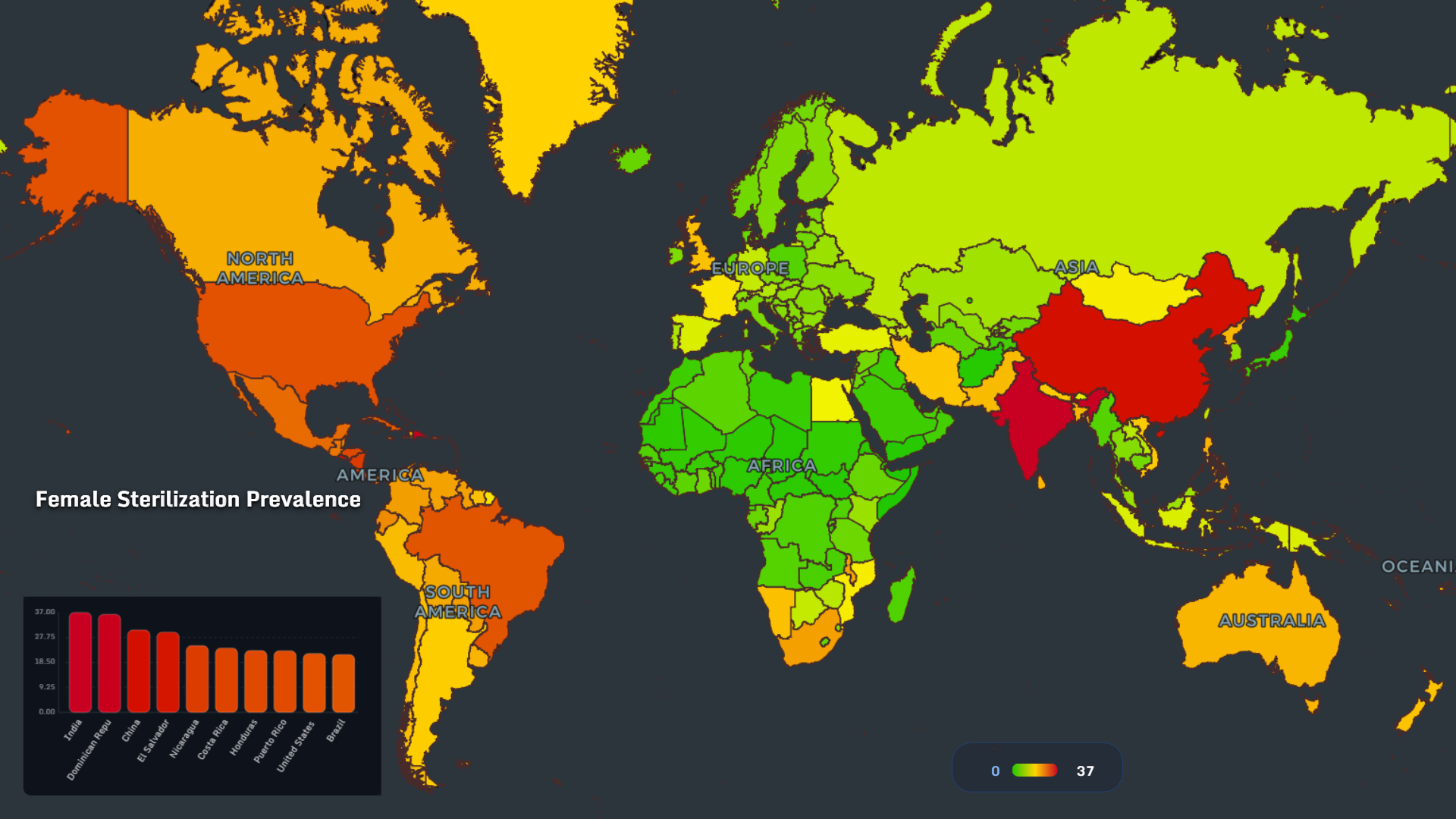
If vasectomy is regionally concentrated, female sterilization prevalence is much broader — and in some countries, dramatically higher. Several countries in South Asia and Latin America stand out in the red range, indicating much more widespread use.
This asymmetry between male and female permanent contraception is one of the most revealing patterns in the entire set. It suggests that even where both procedures exist legally, responsibility for long-term fertility control still falls disproportionately on women.
Maps do not explain why by themselves. But they show where to ask the question.
Children without parental care reveal the downstream social landscape
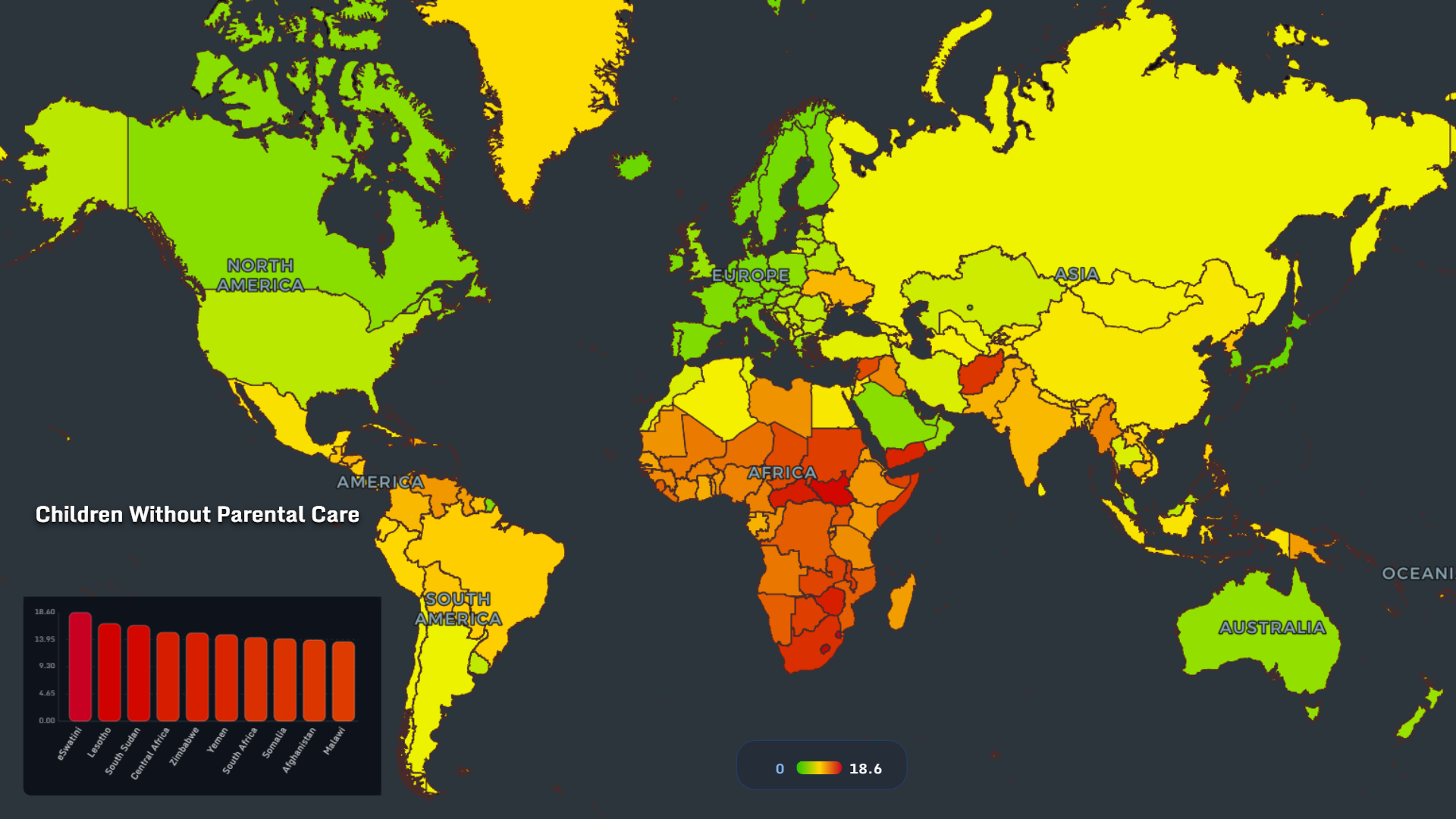
This map shifts from law to consequence. The children without parental care map highlights the heaviest concentrations across parts of Southern and Eastern Africa, with lower visible levels across much of Europe, North America, and Oceania.
It is not a direct measure of reproductive policy. But it belongs in the same conversation. Reproductive rights are never only about legality; they are also about systems of care, social support, poverty, public health, and institutional stability.
The map broadens the frame: who is supported, who is protected, and what happens when care structures fail.
IVF funding draws a line between private privilege and public support
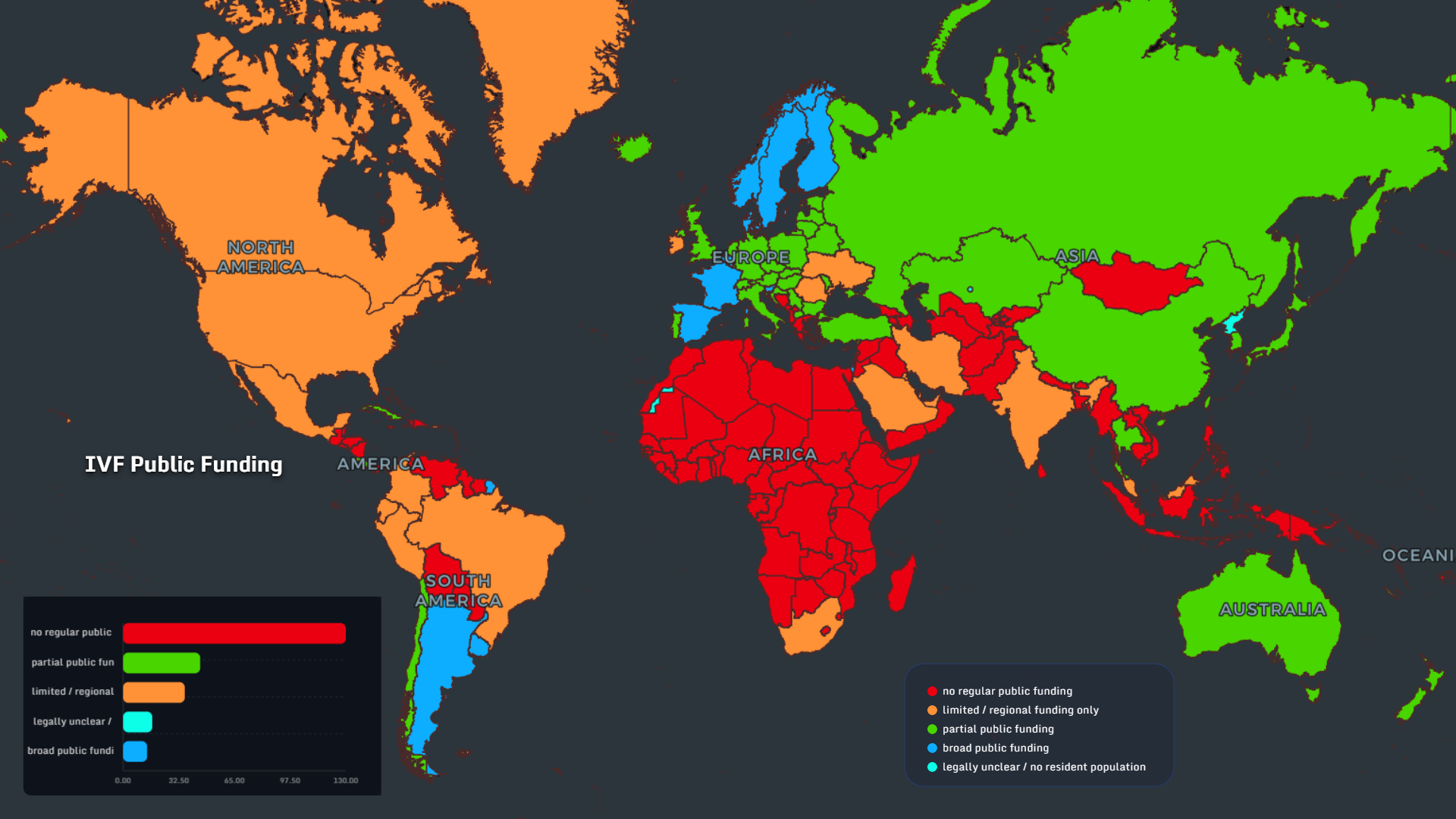
The IVF public funding map adds another dimension to reproductive rights: not just preventing pregnancy, but enabling it. Much of Africa appears in the “no regular public funding” category, while several countries in Europe, parts of South America, and Oceania show stronger public support.
This is a useful reminder that reproductive freedom works in both directions. A system that supports contraception but not fertility treatment, or fertility treatment but not abortion, is still fragmentary. True reproductive autonomy means giving people meaningful choices across the entire spectrum.
Surrogacy may be the most globally fragmented issue of all
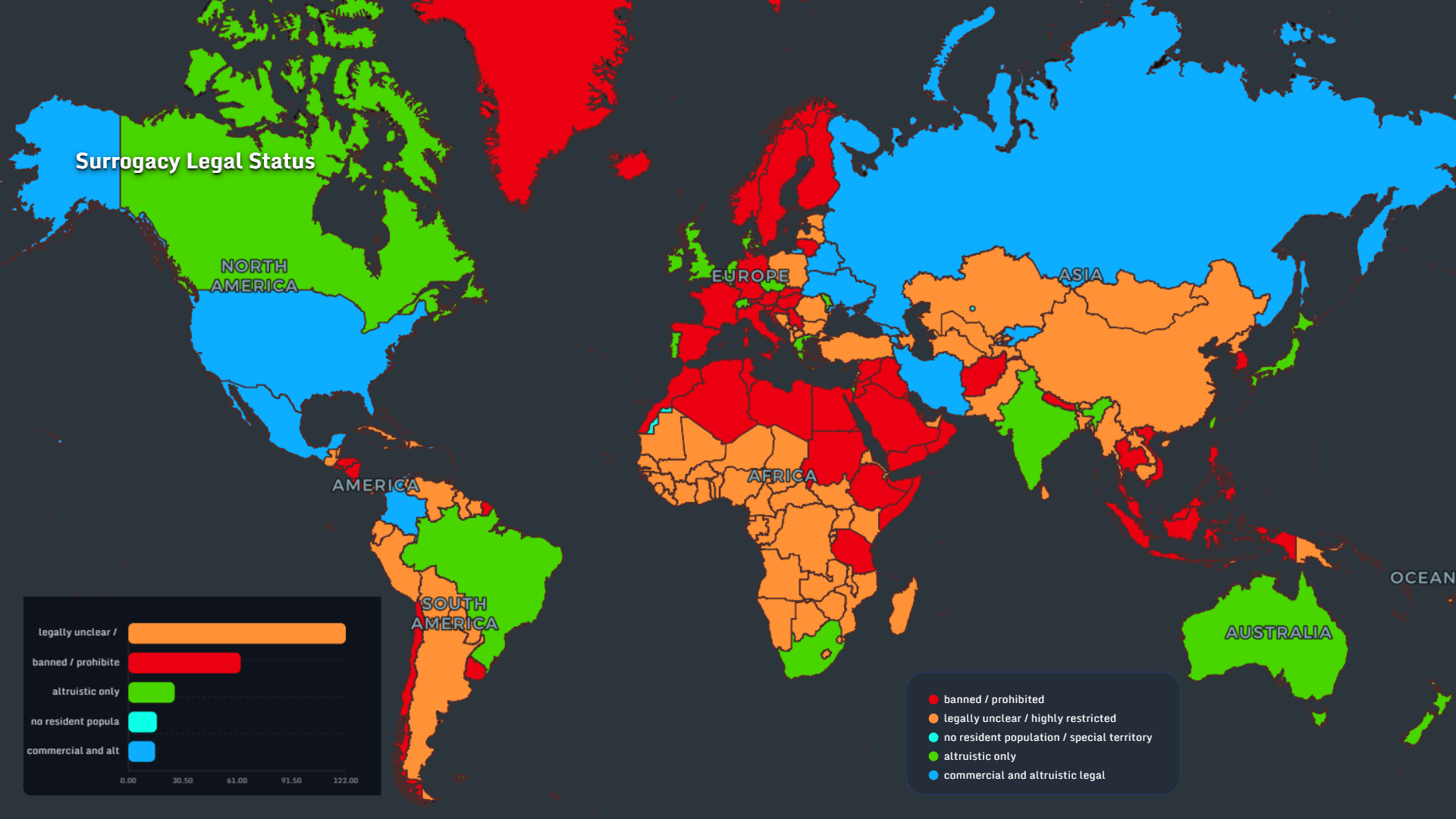
Finally, the surrogacy legal status map shows a world with almost no consensus. Some countries prohibit it entirely. Others allow only altruistic surrogacy. A smaller set permits both commercial and altruistic arrangements. Large parts of the map sit in legal gray zones — restricted, unclear, or highly conditional.
This is perhaps the clearest example of how reproductive policy reflects not only medicine, but ethics, economics, kinship, and politics. Surrogacy is where law struggles to keep up with both technology and human desire.
Reproductive rights are not one map — they are an ecosystem
Taken together, these maps tell a larger story. Reproductive rights in 2026 are not defined by a single law or a single ideology. They form an ecosystem of permissions, restrictions, funding models, cultural norms, and health outcomes.
One country may allow abortion but underfund IVF. Another may permit sterilization but offer poor contraception access. Another may support fertility treatment while banning surrogacy. The map of reproductive rights is not clean or linear — and that is exactly why mapping it matters.
MAPTHOS helps turn scattered legal and social realities into something visible: a world you can compare, question, and understand at a glance.
👉 Explore more at app.mapthos.org
See the world. Map better. Dream big. 🌍✨