
📚 The Global Learning Shift 2026: Reading, Math, Smartphones, AI and a Decade of Change
Something has changed in the classroom.
Across much of the world, reading and mathematics performance has weakened over the past decade. At the same time, the environment around students has transformed: smartphones became permanent companions, social media absorbed more attention, generative AI entered homework routines, and governments began experimenting with phone restrictions at school.
None of these maps proves that one trend caused another.
But placed side by side, they show a generation learning inside a very different information environment from the one that existed in 2015.
.png)
Student AI Use: Schoolwork Has Entered the Generative Era
The newest transformation is also the fastest.
The map of student AI use for schoolwork shows substantial adoption across many parts of the world, with particularly high values visible in parts of Southeast Asia, the Gulf and other digitally connected education systems.
Among the highest values shown in the ranking are:
- Vietnam: 68.6
- Singapore: 65.6
- United Arab Emirates: 64.3
- Brunei: 59.3
- Oman: 58.7
- Estonia: 58.4
- Bahrain: 57.4
- Mongolia: 57.2
- Kuwait: 56.9
- Malaysia: 56.3
Some of the strongest student usage appears in Asia and the Middle East.
That suggests the next phase of education technology may develop very differently from the laptop and smartphone eras. Generative AI requires little infrastructure beyond internet access and a device students often already own.
A tool that can explain equations, summarize chapters, translate text and draft essays has moved from novelty to everyday schoolwork remarkably quickly.
The educational question is therefore shifting from “Will students use AI?” to “How should schools teach students to use it?”
Reading Scores: A Decade of Decline
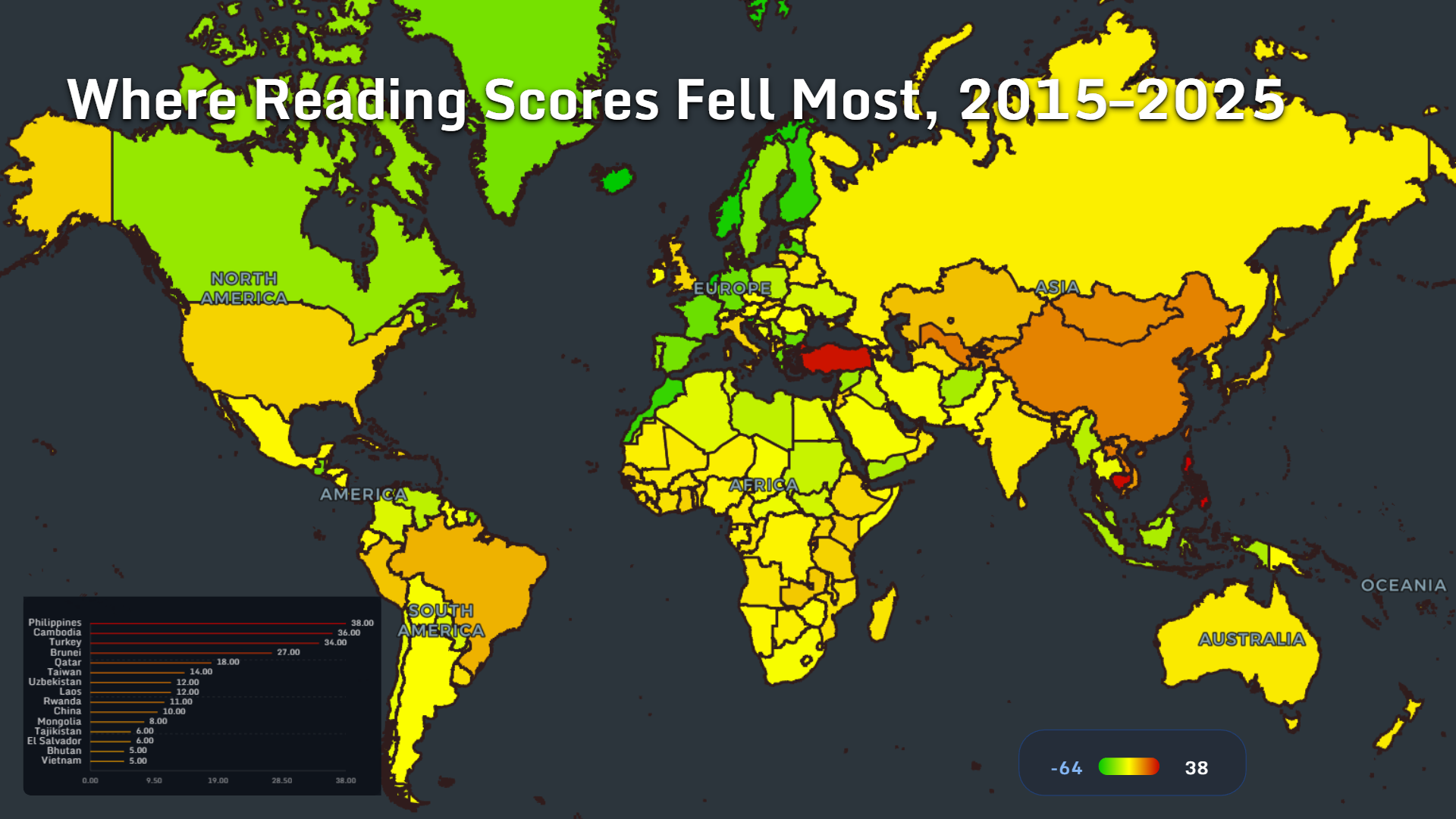
The reading map tells a very different story.
Across much of the world, reading performance between 2015 and 2025 moved downward.
The strongest positive changes visible in the ranking are concentrated in a small group of countries, while many education systems experienced declines.
Among the countries showing gains on the map are:
- Philippines: +38
- Cambodia: +36
- Türkiye: +34
- Brunei: +27
- Qatar: +18
- Taiwan: +14
- Uzbekistan: +12
- Laos: +12
- Rwanda: +11
- China: +10
Large areas of Europe, Asia and the Americas show flat or falling performance.
That matters because reading is not simply another school subject. It is the infrastructure beneath almost every other subject.
A student who struggles to extract meaning from text will also struggle with science instructions, history documents, word problems and increasingly with the flood of information encountered online.
Math Scores Fell Too
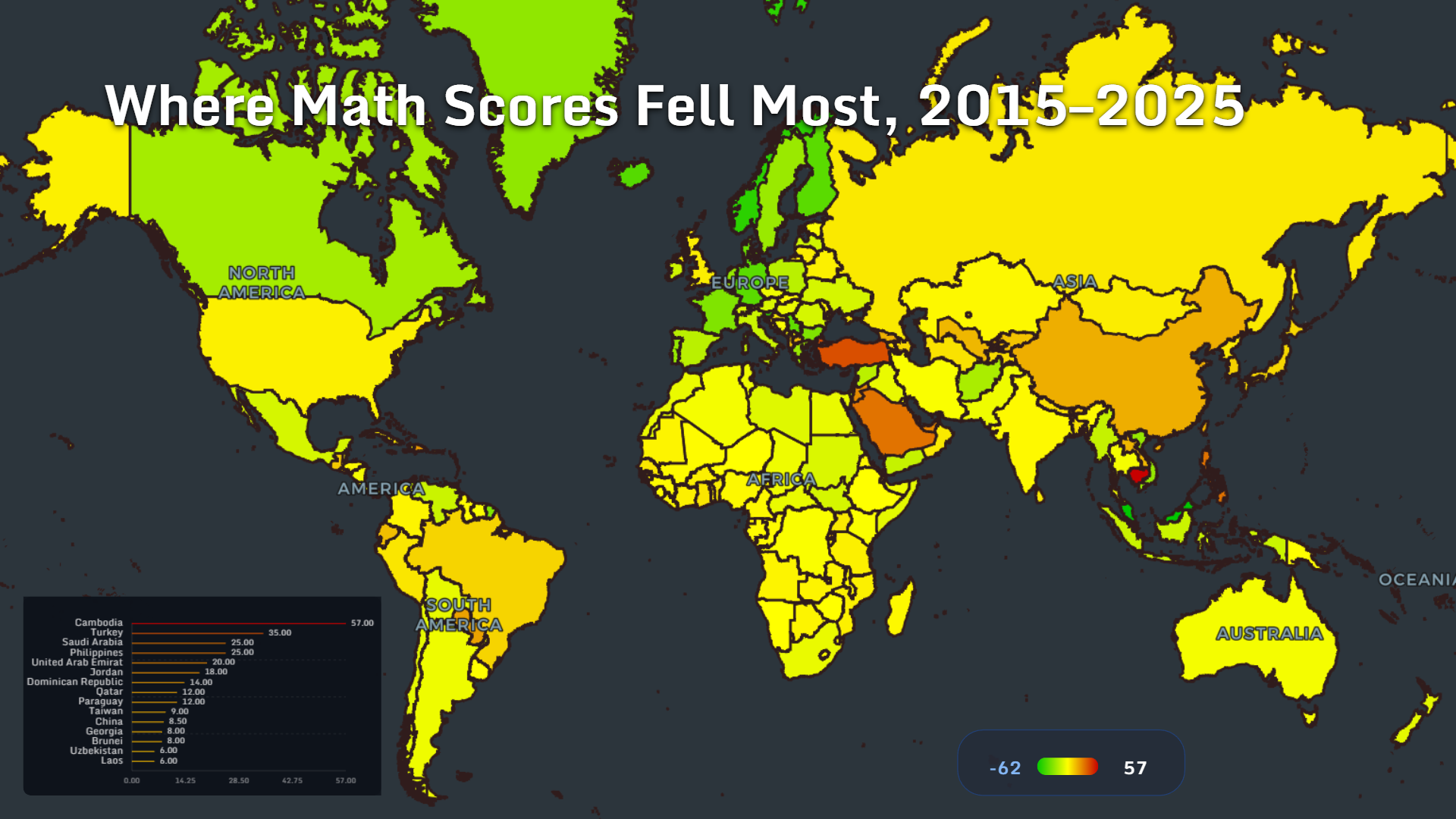
Mathematics follows a similar pattern.
The 2015–2025 math score map shows widespread deterioration, alongside a smaller group of countries recording meaningful gains.
The strongest improvements shown include:
- Cambodia: +57
- Türkiye: +35
- Saudi Arabia: +25
- Philippines: +25
- United Arab Emirates: +20
- Jordan: +18
- Dominican Republic: +14
- Qatar: +12
- Paraguay: +12
- Taiwan: +9
- China: +8.5
- Georgia: +8
Several countries that historically performed below the global leaders are improving quickly, while some mature education systems have stagnated or declined.
This creates a world in which educational convergence may come not only from lower-performing countries improving, but also from some historically stronger systems moving backward.
Even Advantaged Students Are Losing Ground
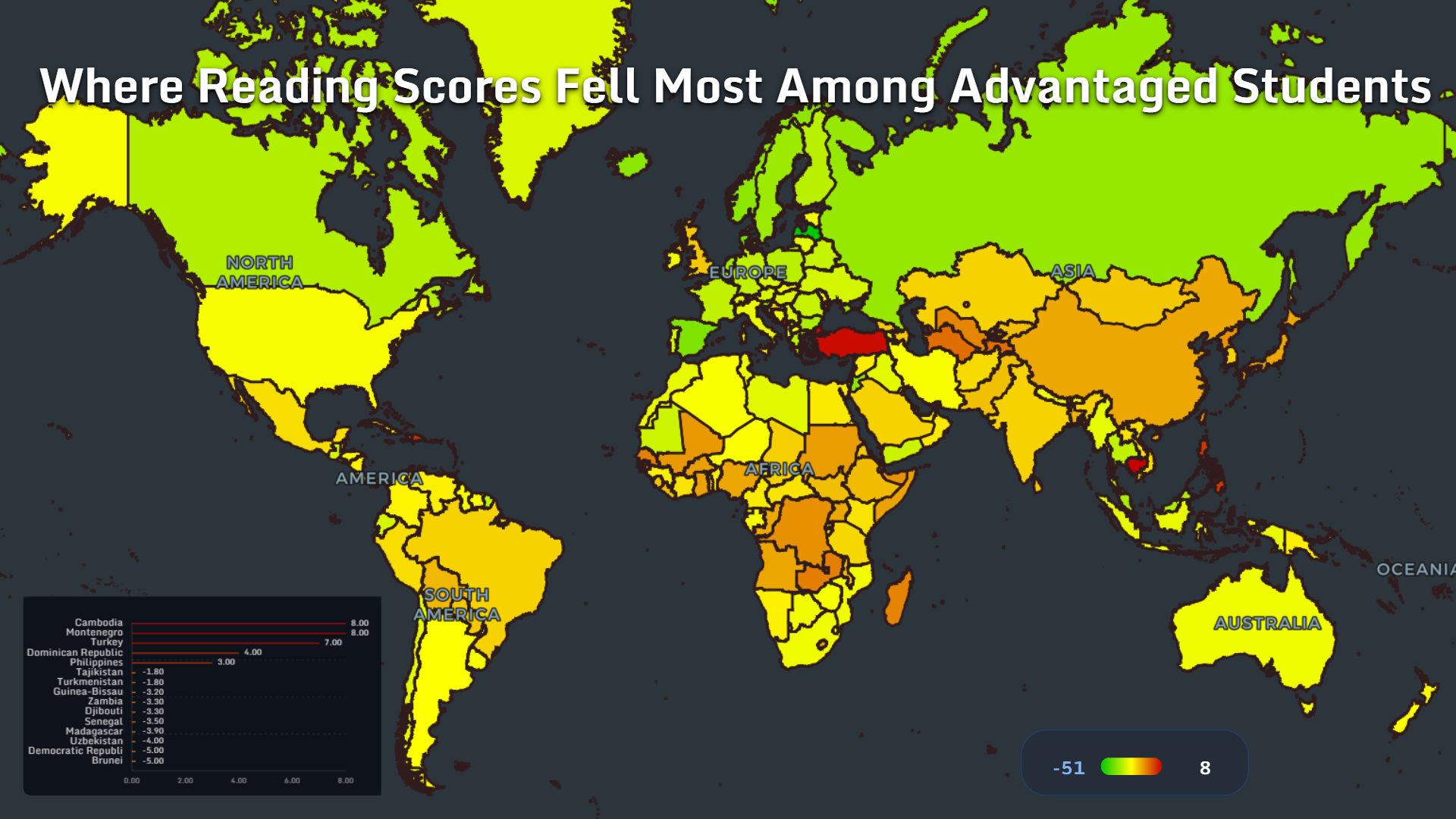
One of the most important maps in the collection focuses specifically on advantaged students.
If falling performance were purely a consequence of poverty, unequal school funding or lack of educational resources, we might expect wealthy students to remain largely insulated.
The map suggests otherwise.
Reading scores declined among advantaged students in multiple countries as well.
At the extreme end, the scale reaches declines of around 51 points, while only a small number of countries show clear positive movement.
This matters because it changes the question.
The learning decline may not be explained only by access to schools, books, teachers or household resources. Something broader may be changing in how young people consume information, concentrate and interact with text.
That does not automatically make smartphones or social media the cause.
But it makes the surrounding digital environment impossible to ignore.
Where 15-Year-Olds Fall Below Basic Reading Level
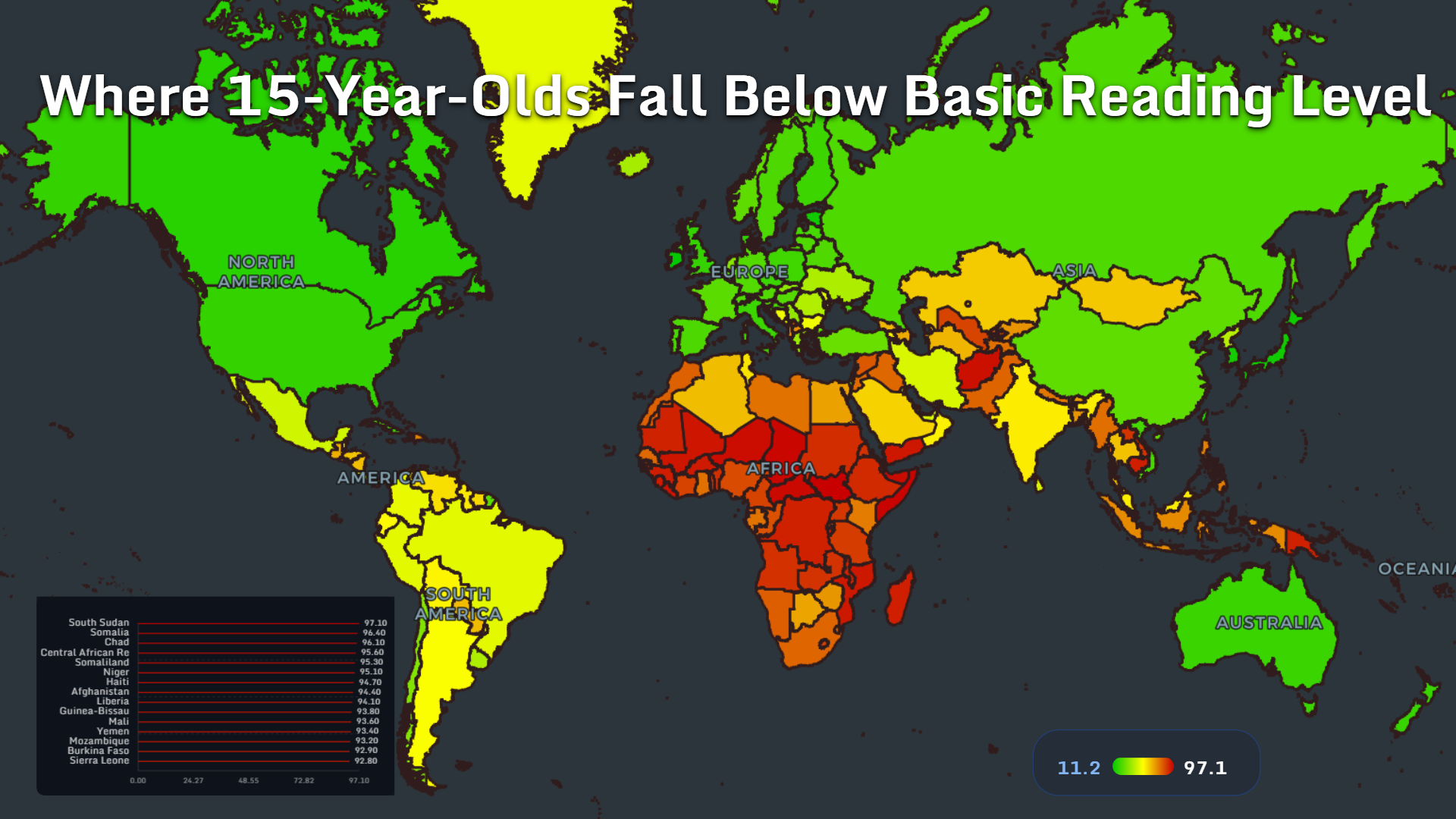
The global map of students falling below a basic reading level reveals one of the sharpest educational divides.
At the upper end of the map, more than 90% of 15-year-olds fall below the benchmark in several countries.
The ranking shown includes:
- South Sudan: 97.1%
- Somalia: 96.4%
- Chad: 96.1%
- Central African Republic: 95.6%
- Somaliland: 95.3%
- Niger: 95.1%
- Haiti: 94.7%
- Afghanistan: 94.4%
- Liberia: 94.1%
- Guinea-Bissau: 93.8%
- Mali: 93.6%
- Yemen: 93.4%
- Mozambique: 93.2%
- Burkina Faso: 92.9%
- Sierra Leone: 92.8%
Here the problem is very different from the modest score declines seen in high-income systems.
For millions of students, the issue is not losing a few points from an already strong baseline. It is reaching basic literacy in the first place.
That distinction matters whenever we talk about a “global learning crisis.”
There is no single crisis.
There are several overlapping ones.
Books Are Losing Ground in Parts of the World
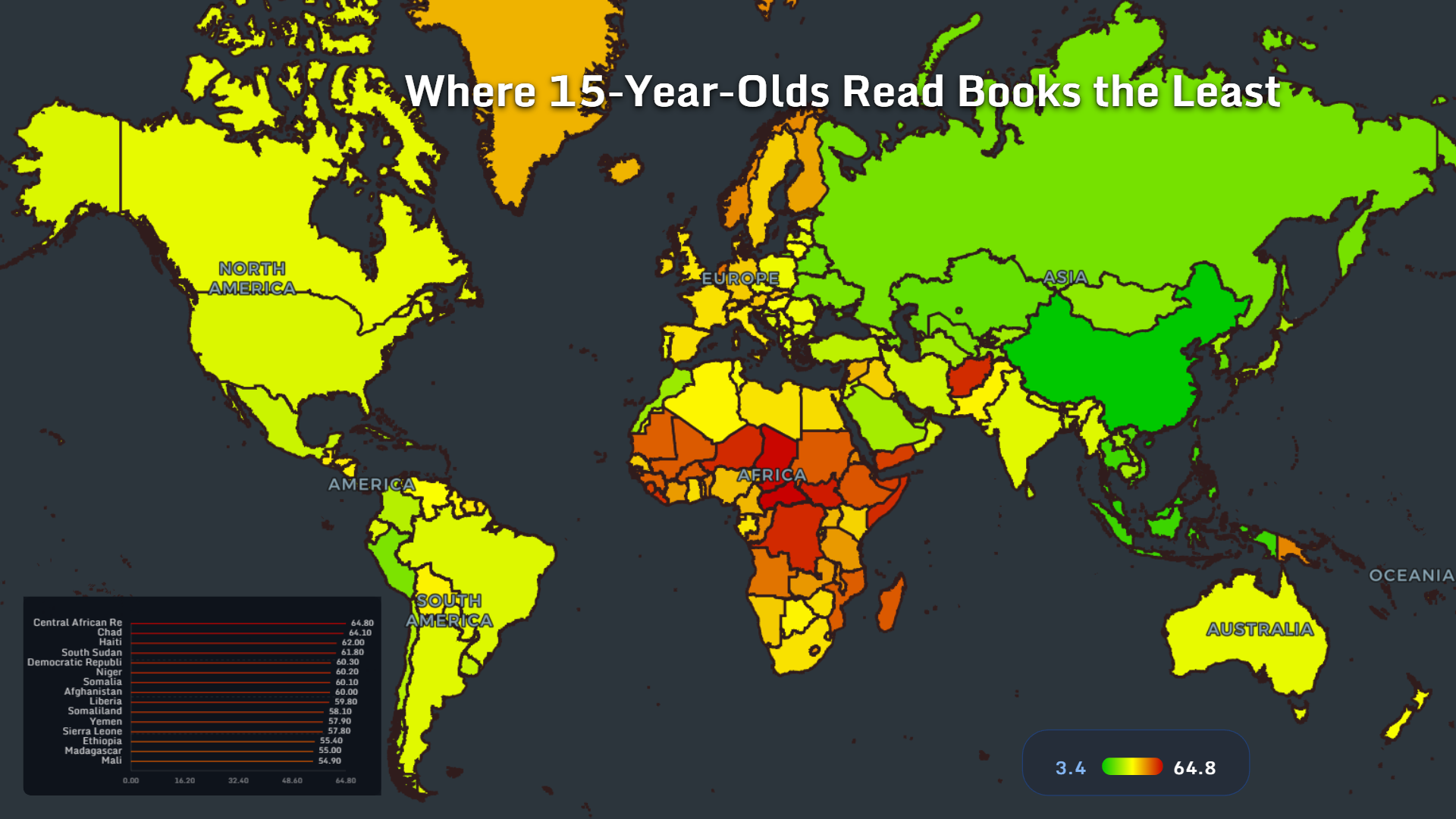
Another map shifts attention from test scores to behavior.
Where do 15-year-olds read books the least?
The highest values in the ranking are concentrated in parts of Africa and several fragile or lower-income education systems:
- Central African Republic: 64.8
- Chad: 64.1
- Haiti: 62.0
- South Sudan: 61.8
- Democratic Republic of the Congo: 60.3
- Niger: 60.2
- Somalia: 60.1
- Afghanistan: 60.0
- Liberia: 59.8
- Somaliland: 58.1
- Yemen: 57.9
- Sierra Leone: 57.8
- Ethiopia: 55.4
But in wealthier countries, another transformation is happening.
Young people have more text available to them than any previous generation — messages, captions, feeds, search results, subtitles and AI responses — while sustained book reading competes with an unprecedented number of alternatives.
The distinction between reading words and reading deeply may therefore become increasingly important.
Social Media Use Has Continued to Grow
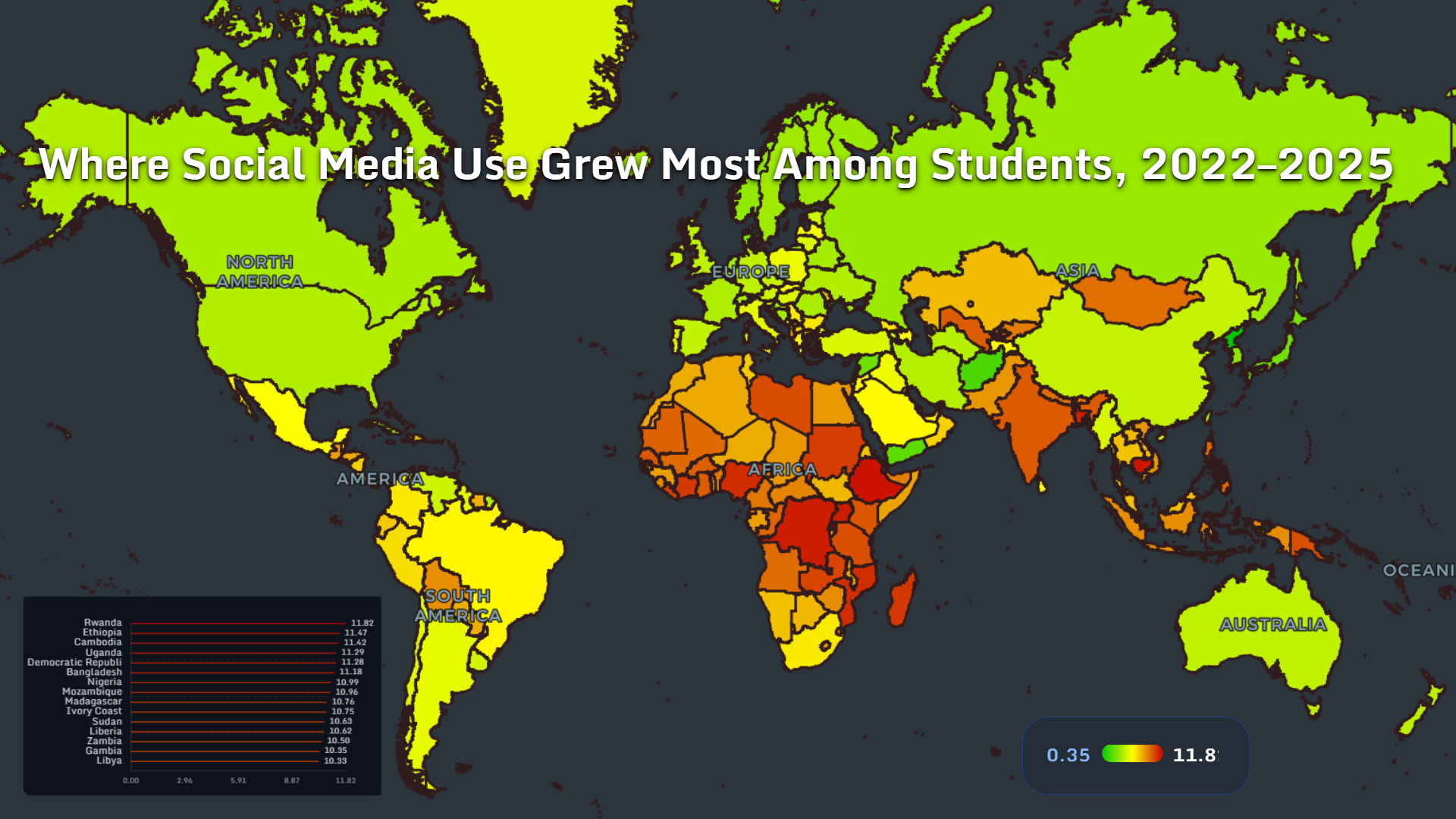
Between 2022 and 2025, student social media use continued to rise across much of the world.
The strongest increases shown in the ranking are concentrated heavily in Africa:
- Rwanda: +11.82
- Ethiopia: +11.47
- Cambodia: +11.42
- Uganda: +11.29
- Democratic Republic of the Congo: +11.28
- Bangladesh: +11.18
- Nigeria: +10.99
- Mozambique: +10.96
- Madagascar: +10.76
- Ivory Coast: +10.75
- Sudan: +10.63
- Liberia: +10.62
- Zambia: +10.50
In countries where smartphones and mobile internet are still spreading rapidly, social media adoption can rise faster than in markets that reached saturation years ago.
But the educational consequences are more complex.
Social platforms can provide access to knowledge, language learning, communities and news.
They can also fragment attention into short, rapidly changing pieces of information.
A student moving continuously between video clips, notifications, messages and short posts is interacting with language very differently from a student reading a chapter for thirty uninterrupted minutes.
Governments Are Starting to Restrict Smartphones at School
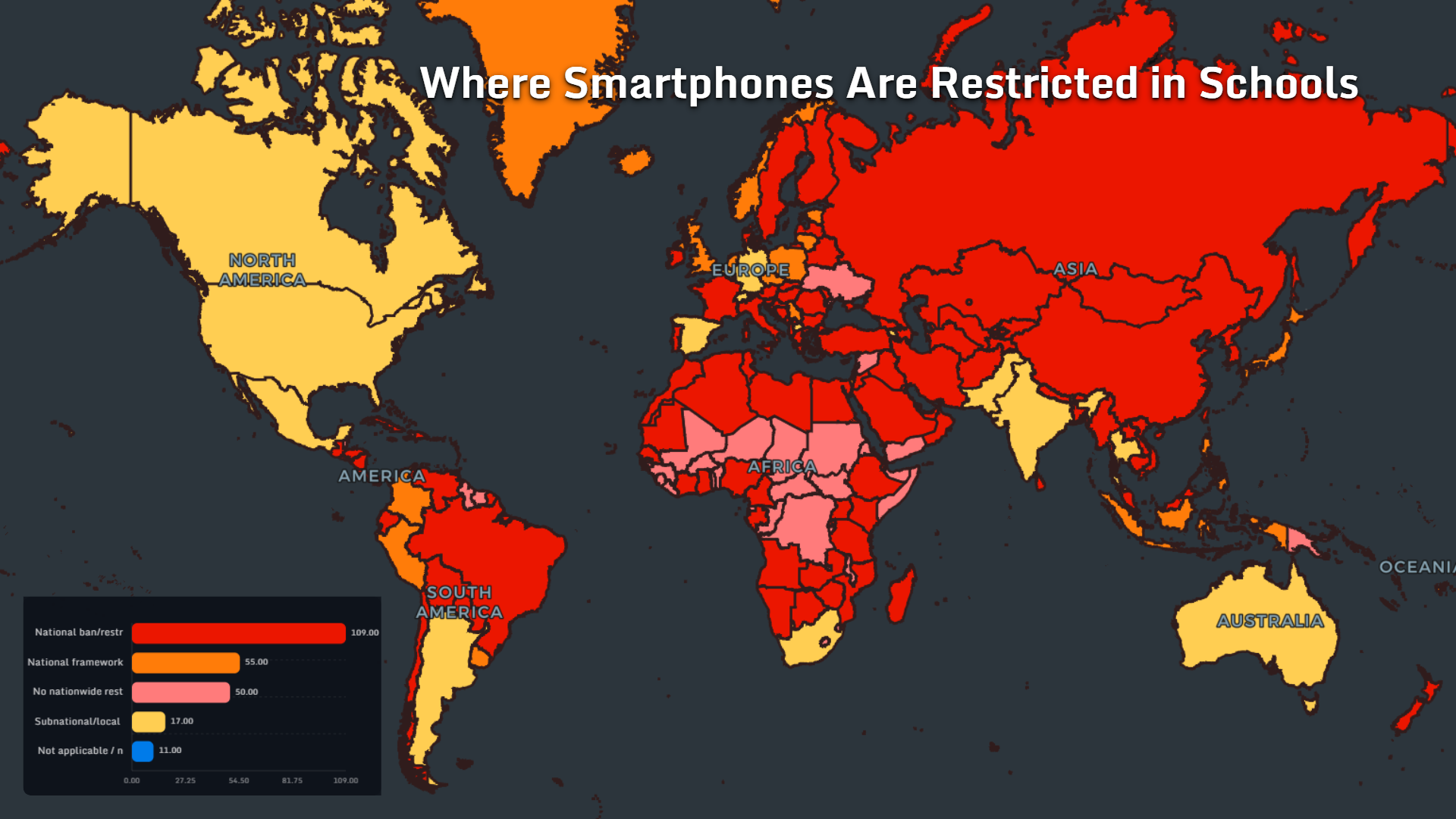
Governments have noticed.
The map of smartphone restrictions in schools shows that the policy response is already global.
The categories in the dataset include:
- National ban or restriction: 109 jurisdictions
- National framework: 55
- No nationwide restriction: 50
- Subnational or local rules: 17
- Not applicable / no comparable policy: 11
Europe is heavily represented, but the policy trend stretches far beyond it.
This is notable because smartphones were initially welcomed into education as access devices: calculators, dictionaries, cameras, research tools and communication platforms.
Now many education systems are asking whether permanent connectivity imposes costs that outweigh those benefits during the school day.
The interesting tension is that schools are restricting one generation of technology at almost exactly the moment another — generative AI — is entering classrooms.
The Paradox of Education in 2026
These maps create a strange picture.
Students have access to more information than any generation in history.
They carry the world's libraries in their pockets.
They can translate languages instantly.
They can watch a lecture from another continent.
They can ask an AI system to explain a concept in seconds.
Yet in many countries, reading and mathematics performance are declining.
That does not mean technology caused the decline.
The period from 2015 to 2025 also includes pandemic disruption, school closures, widening inequality, curriculum changes, teacher shortages and major social upheaval.
The maps cannot separate those effects.
But they do reveal a historical coincidence that is difficult to ignore:
the decade in which student life became permanently connected was also a decade in which many education systems stopped improving.The Global Divide Is Becoming More Complicated
For decades, international education comparisons were often framed around one simple divide:
rich countries performed well; poor countries struggled.
These maps show why that framework is becoming outdated.
Some lower-performing systems — including Cambodia, Türkiye, Saudi Arabia and the Philippines — show substantial improvements in reading or mathematics.
Meanwhile, several established education systems show declines.
At the same time, the poorest countries still face an entirely different scale of challenge, with overwhelming shares of teenagers unable to reach basic reading proficiency.
We are therefore seeing two movements at once:
convergence at the middle, but persistent extreme inequality at the bottom.And layered on top of both is a technological transformation affecting almost every student on Earth.
From Smartphones to AI: The Classroom Is Being Rewritten
The smartphone changed how students communicate.
Social media changed how they consume information.
Generative AI may change something deeper: how they produce knowledge itself.
A student can now ask an AI to solve a math problem, summarize a novel, generate flashcards, explain a scientific concept or draft an essay.
Used carefully, that can be an extraordinary educational tool.
Used passively, it may remove exactly the cognitive friction through which learning occurs.
That makes the next decade very different from the last one.
Schools spent years asking whether students should be allowed to bring the internet into the classroom.
Now the question is whether students should bring an always-available synthetic tutor, researcher and writer with them as well.
What the Maps Really Show
There is no single map that explains the state of global education.
Together, however, they reveal a transition.
Reading performance has weakened in many countries.
Math performance has followed.
Even advantaged students are not fully insulated.
Millions of teenagers still lack basic literacy.
Book reading competes with new forms of media.
Social media continues spreading.
Smartphones are increasingly restricted in schools.
And AI has already become part of student life.
The question is no longer whether education will change.
It already has.
The harder question is whether our institutions can adapt quickly enough to preserve the skills that matter — deep reading, reasoning, concentration and independent thought — while still using the extraordinary tools now available to students.
MAPTHOS makes those changes visible not as isolated statistics, but as geography: country by country, trend by trend, across a classroom that now spans the entire planet.
👉 Explore more at app.mapthos.org
See the world. Map better. Dream big. 🌍✨