
🌿 Global Hemp Maps 2026: The Crop, the Law and the Countries That Still Grow It
Hemp is one of those plants that carries more history than its leaves can hold.
For some countries, it is an old agricultural fiber. For others, a forgotten crop. For others still, it sits inside legal categories shaped by the wider politics of cannabis.
These maps show hemp not as a single global industry, but as a fractured geography of production, exports, law, medicine and memory.
Hemp Agriculture Loss: Where the Crop Disappeared, Survived or Returned
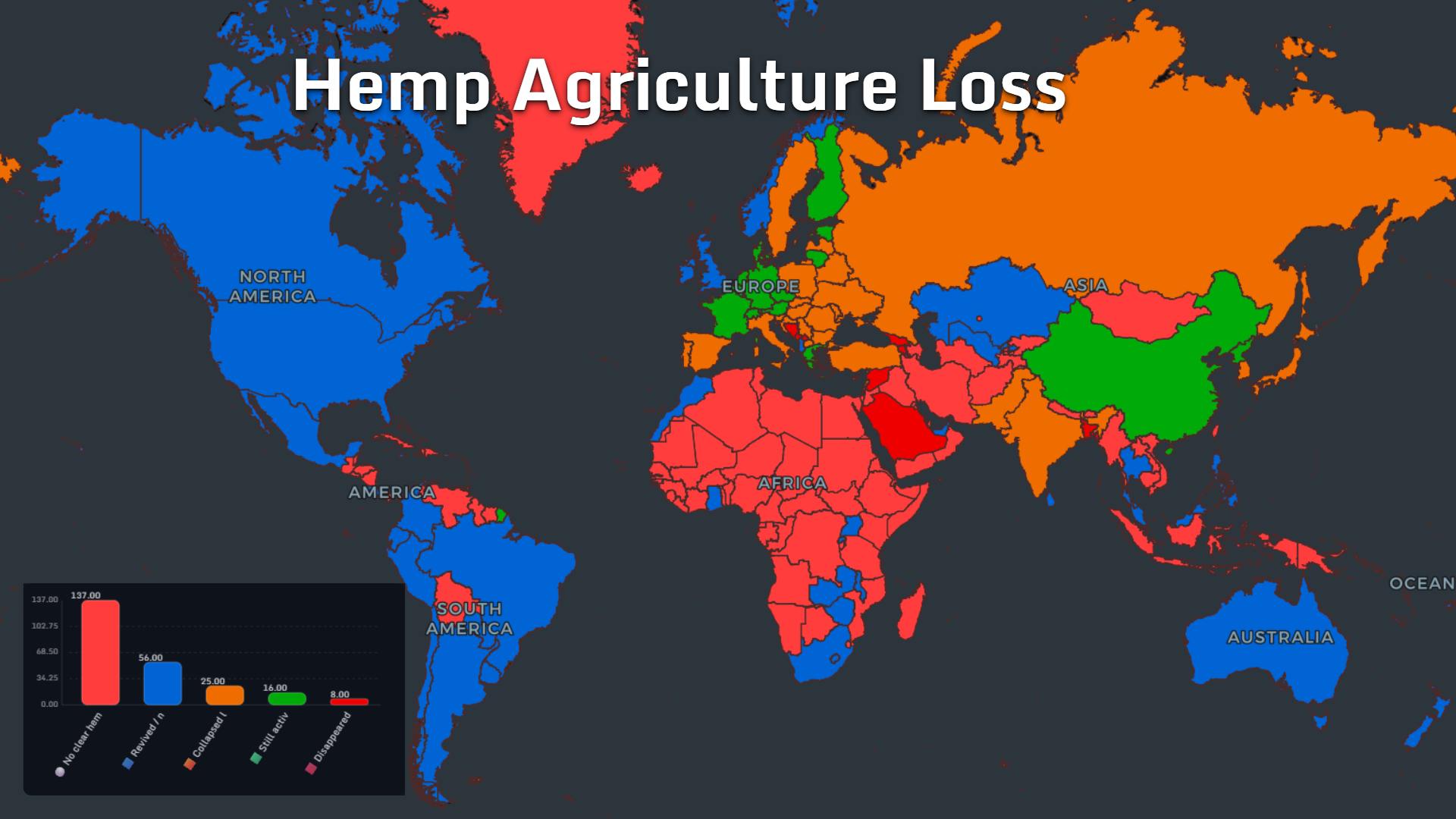
The first map shows the long shadow of hemp agriculture loss.
The dataset divides countries into several broad categories:
- No clear hemp: 137 mapped entries
- Revived / new: 56
- Collapsed: 25
- Still active: 16
- Disappeared: 8
That matters. Hemp was once a practical crop: fiber, rope, canvas, seed, oil, textiles. But in many places, the legal and cultural association with drug cannabis made the industrial crop disappear from public policy, farming systems and trade statistics.
The map shows a world where hemp did not simply “grow” or “not grow.” It was interrupted.
Some countries kept a continuous line of cultivation. Others lost it and later revived it. Others still have no clear modern hemp footprint at all.
This is the first lesson from the global hemp map: agriculture can vanish not only because of climate or markets, but because law changes what farmers are willing to plant.
Hemp Production in 1966: China Was Already the Center
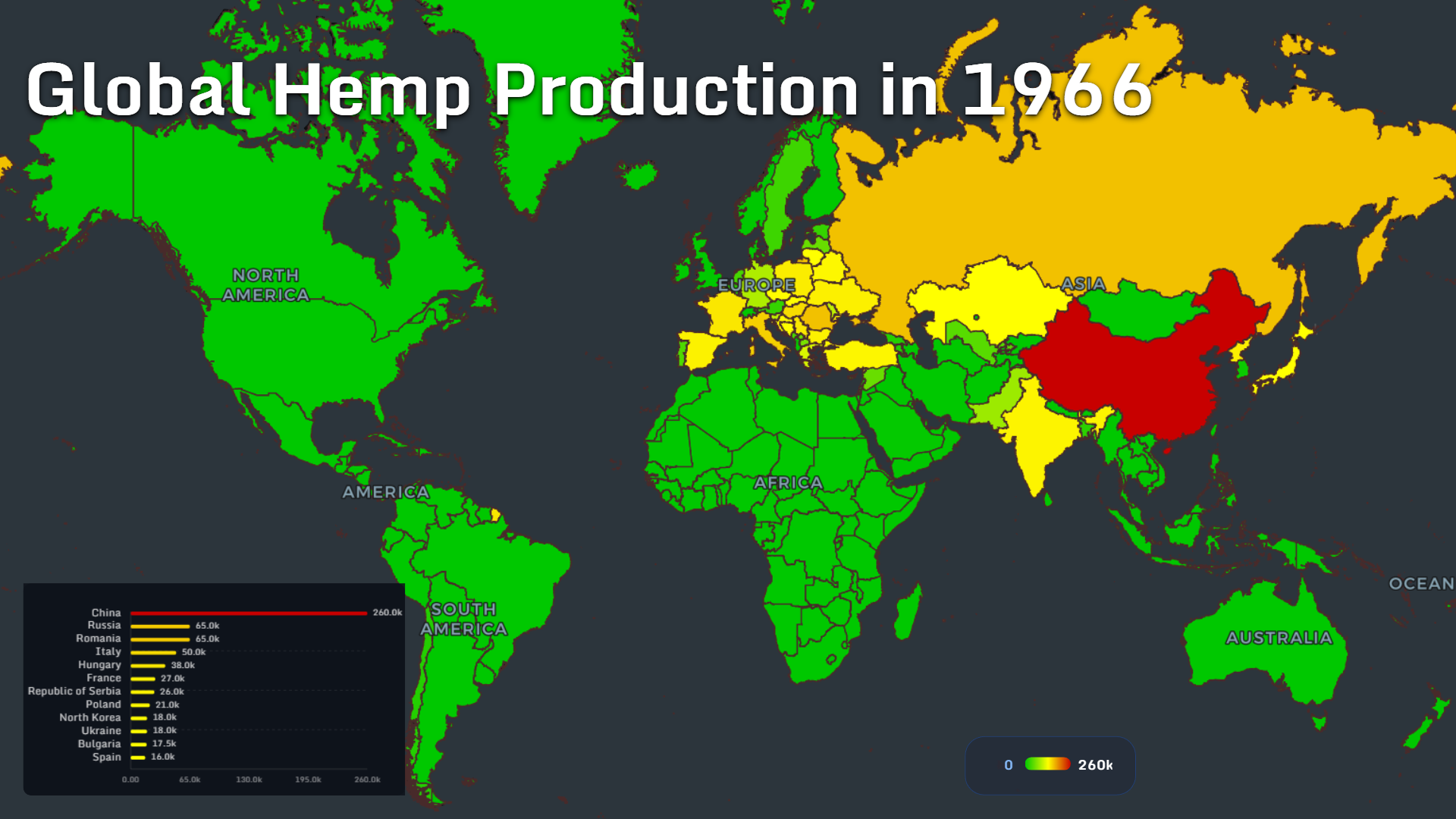
In 1966, China already dominated global hemp production.
The leading countries in the dataset were:
- China: 260k
- Russia: 65k
- Romania: 65k
- Italy: 50k
- Hungary: 38k
- France: 27k
- Republic of Serbia: 26k
- Poland: 21k
- North Korea: 18k
- Ukraine: 18k
- Bulgaria: 17.5k
- Spain: 16k
The map also shows how important Eastern Europe once was to hemp production. Russia, Romania, Hungary, Serbia, Poland, Ukraine and Bulgaria all appear in the leading group.
This was not a niche crop. It was part of a broad agricultural and industrial landscape.
The 1966 hemp production map feels almost like an older economic atlas: China at the top, Europe still deeply involved, and hemp treated as a practical material rather than a cultural controversy.
True Hemp Production in 1991: A Narrower World
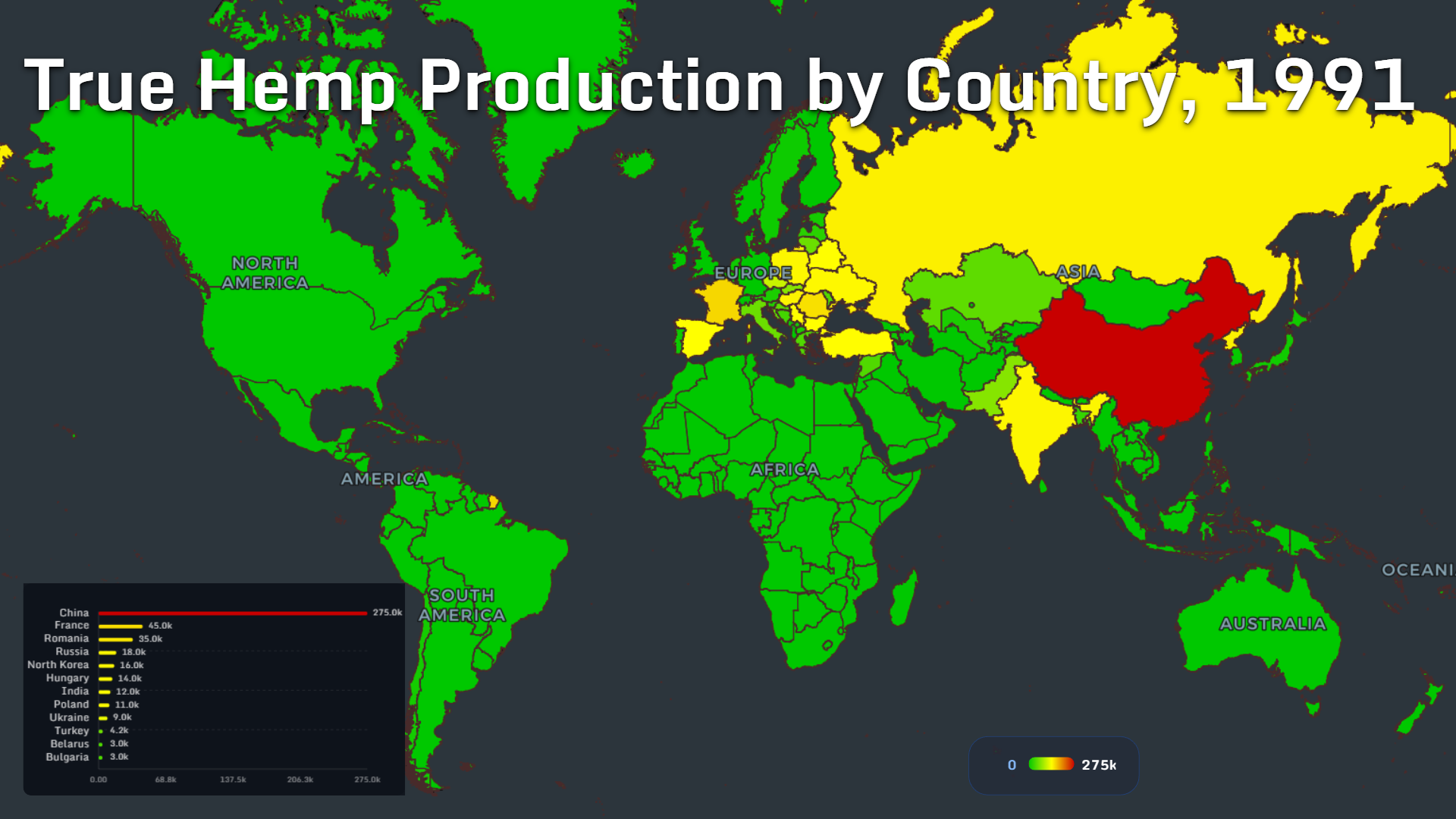
By 1991, the map had changed.
The leading values were:
- China: 275k
- France: 45k
- Romania: 35k
- Russia: 18k
- North Korea: 16k
- Hungary: 14k
- India: 12k
- Poland: 11k
- Ukraine: 9k
- Turkey: 4.2k
- Belarus: 3k
- Bulgaria: 3k
But many European producers shrank sharply.
Russia fell from 65k to 18k. Romania moved from 65k to 35k. Hungary dropped from 38k to 14k. Italy, once at 50k, no longer appears among the top values shown in 1991.
France moved in the opposite direction, rising from 27k in 1966 to 45k in 1991.
The result is a more concentrated map. China becomes even more central, while Europe shifts from a wide production belt into a smaller set of active producers.
This is where hemp history becomes visible as geography: the crop survived, but not evenly.
Hemp Cultivation Area: China, France, the U.S. and Canada Lead the Land Map
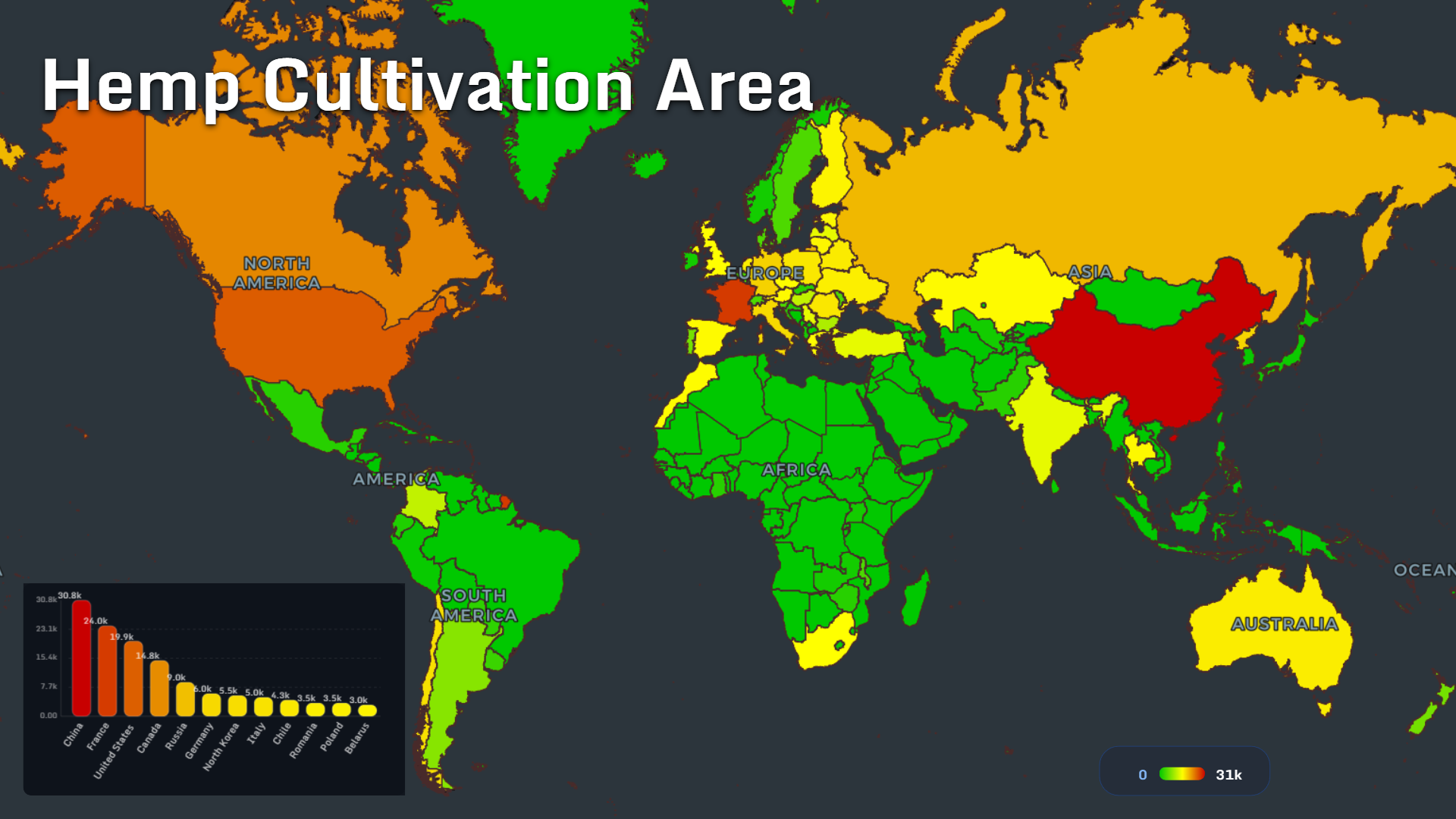
Cultivation area shows a different layer of the hemp economy.
The largest mapped areas are:
- China: 30.8k
- France: 22k
- United States: 19.9k
- Canada: 14.8k
- Russia: 9k
- Germany: 6k
- North Korea: 5.5k
- Italy: 5k
- Chile: 4.3k
- Romania: 3.5k
- Poland: 3.5k
- Belarus: 3k
This is an important shift from the older production maps. North America becomes much more visible in the modern cultivation landscape.
The United States and Canada do not dominate the historical production maps in the same way China does, but they appear strongly in cultivation area. That suggests a revived or restructured hemp economy—one shaped by changing laws, new product categories and renewed interest in industrial fiber, seed and biomass.
France also stands out as Europe’s most consistent hemp actor across the maps. It appears in the 1966 production map, grows stronger by 1991 and remains a major cultivation country.
Hemp Seed Production: China Leads Again
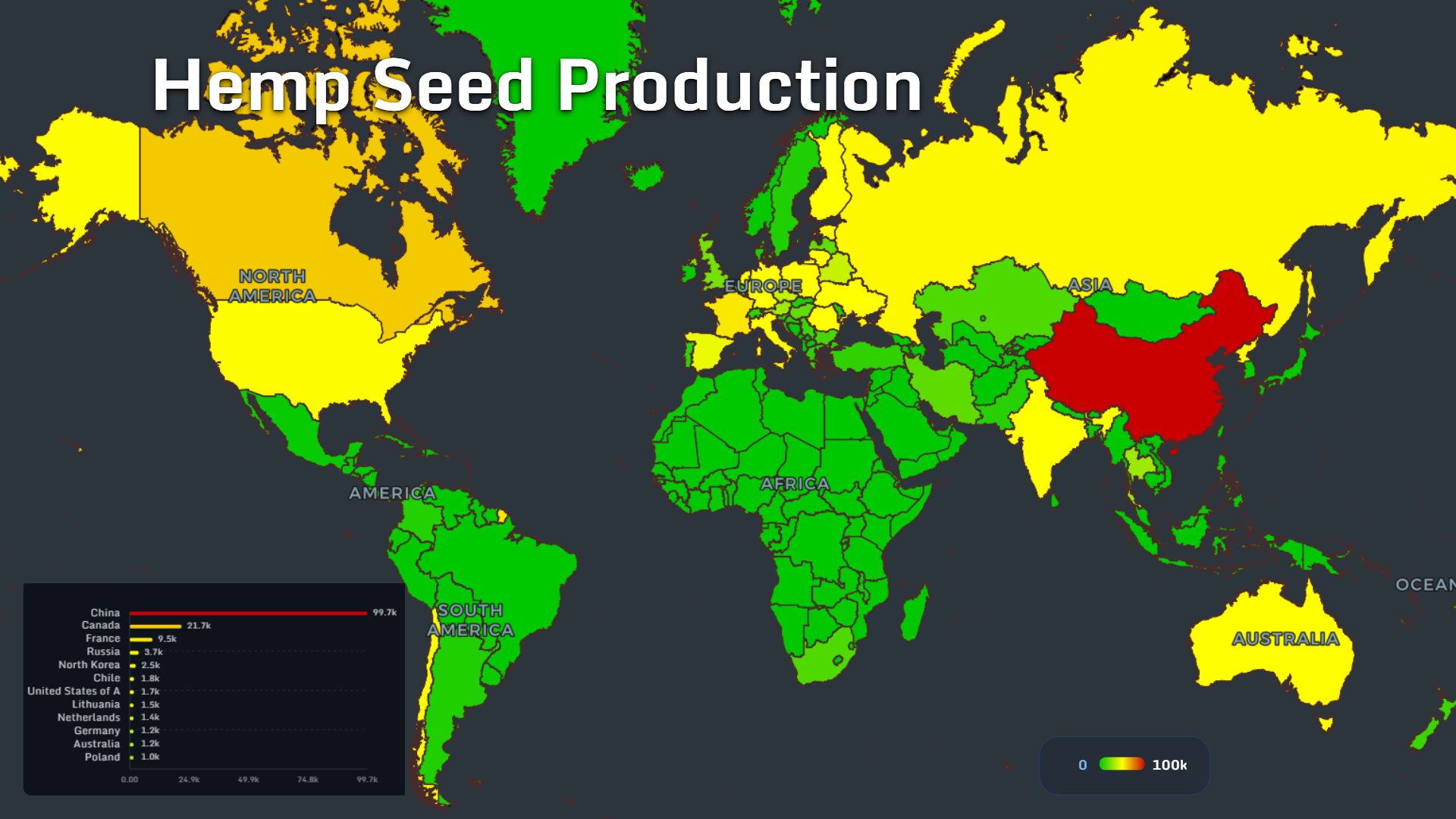
Seed production has its own geography.
The top values are:
- China: 99.7k
- Canada: 21.7k
- France: 9.5k
- Russia: 3.7k
- North Korea: 2.5k
- Chile: 1.8k
- United States: 1.7k
- Lithuania: 1.5k
- Netherlands: 1.4k
- Germany: 1.2k
- Australia: 1.2k
- Poland: 1k
Canada’s position is notable. It appears more strongly in hemp seed production than in historical hemp production. That points to a specific specialization: not simply growing hemp, but participating in the seed and food side of the market.
The map also shows a smaller but meaningful European network: France, Lithuania, the Netherlands, Germany and Poland all appear in the ranking.
Hemp seed is a reminder that the crop is not only about fiber. It is also food, oil, protein and agricultural input.
Hemp Fiber Exports: Europe Takes the Trade Lead
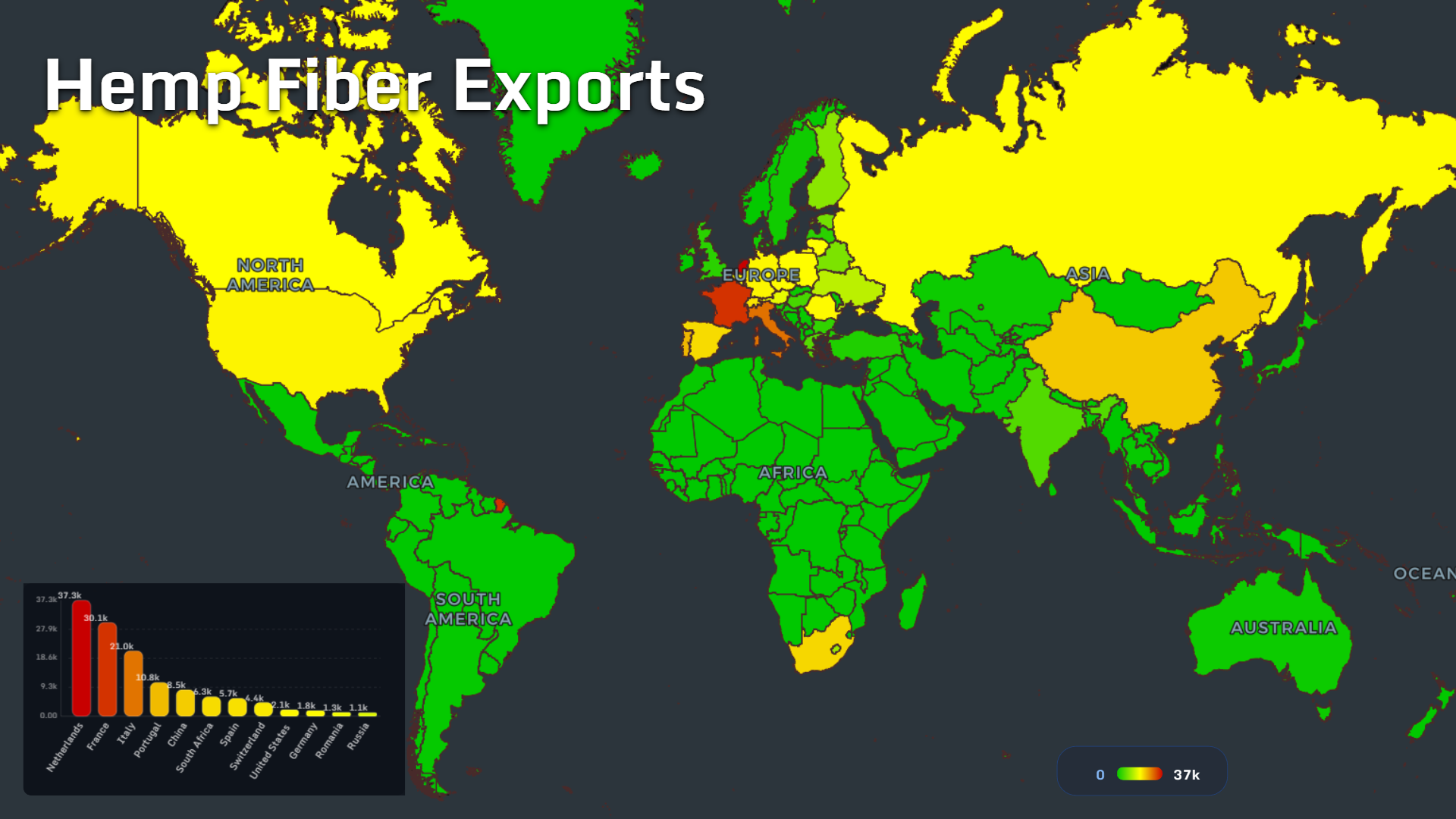
Exports tell a different story from production.
The leading hemp fiber exporters in the dataset are:
- Netherlands: 37.3k
- France: 30.1k
- Italy: 21k
- Portugal: 10.8k
- China: 8.5k
- South Africa: 6.3k
- Spain: 5.7k
- Switzerland: 4.4k
- United States: 2.1k
- Germany: 1.8k
- Romania: 1.3k
- Russia: 1.1k
The Netherlands ranks first, followed by France and Italy. Together, these three European countries account for 88.4k in the mapped export ranking.
That suggests a separation between production scale and export positioning.
A country may grow large volumes but consume or process much of it domestically. Another may become important as a trade, processing or logistics hub.
The Netherlands is especially interesting. It does not dominate the earlier production maps, but it leads the fiber export map. That is the geography of trade infrastructure: ports, processing networks, standards, buyers and cross-border supply chains.
Hemp fiber exports show how a crop becomes a market.
Industrial Hemp vs Drug Cannabis Laws: The Legal Split Is Still Not Universal
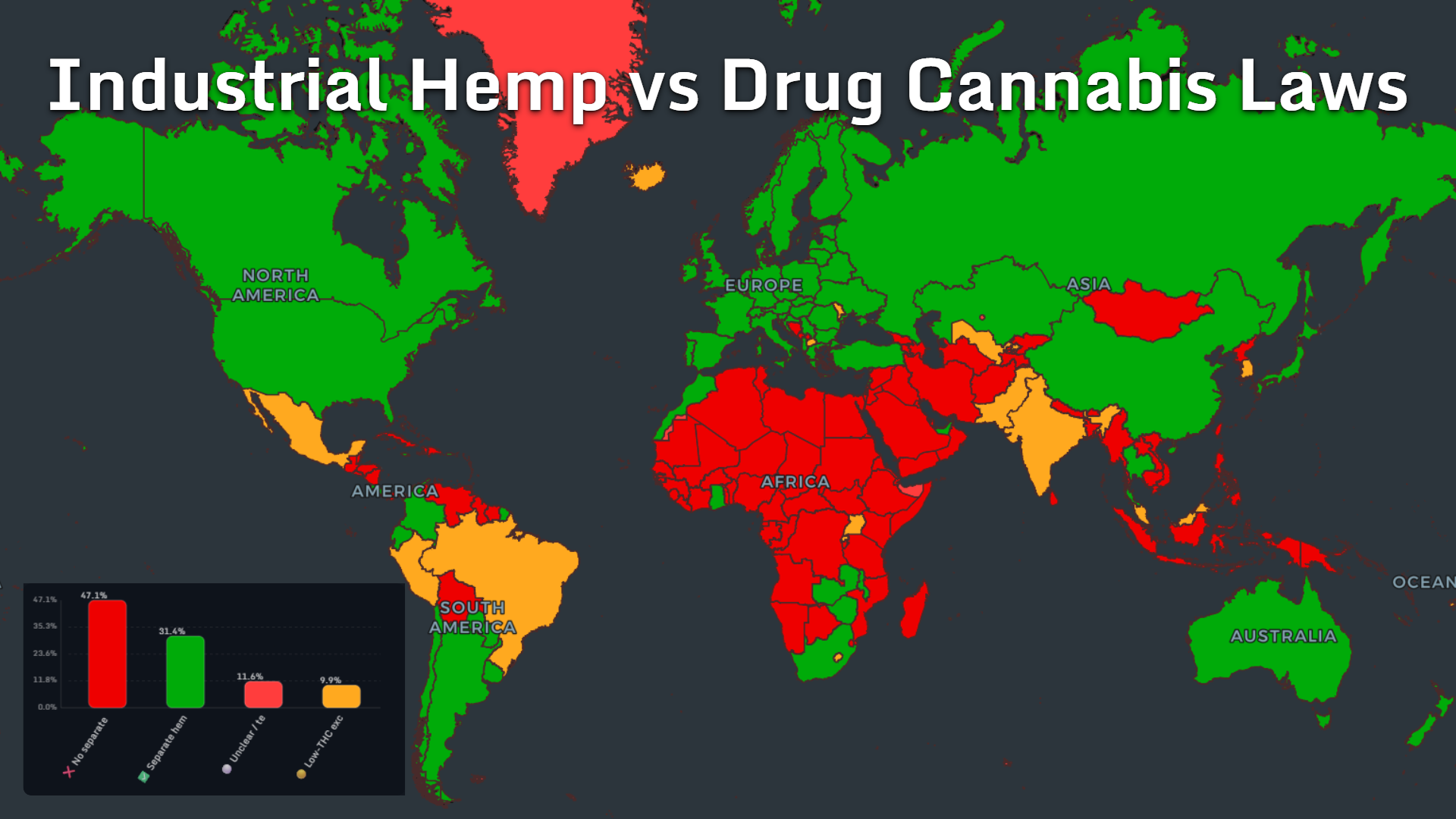
The legal map explains why hemp remains uneven.
The dataset shows:
- 47.1% of countries in the “no separate” category
- 31.4% with separate hemp rules
- 11.6% unclear or semi-defined
- 9.9% with low-THC exceptions
Industrial hemp and drug cannabis are not the same economic category. Hemp is grown for fiber, seed, oil and industrial use. Drug cannabis is regulated around intoxicating use.
But if a legal system does not clearly separate them, farmers, processors and investors face uncertainty.
The map shows that only about one third of countries clearly separate industrial hemp from drug cannabis. Nearly half do not.
That legal ambiguity shapes everything else: cultivation area, exports, seed production, research, investment and farmer adoption.
A crop cannot scale if the law treats it like a risk instead of an agricultural category.
Medical Cannabis Law: A Different Map Again
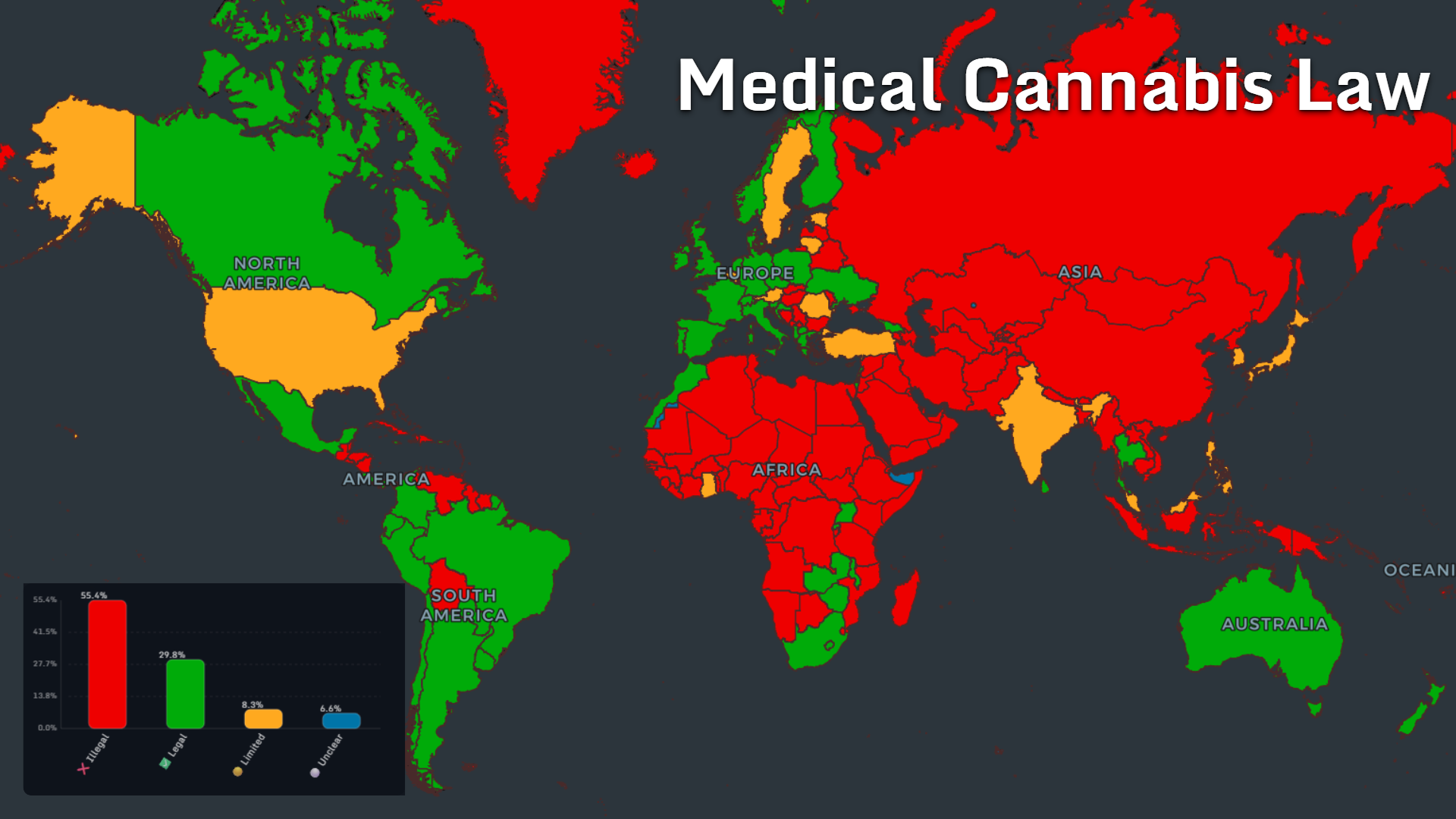
Medical cannabis law follows a different pattern from industrial hemp law.
The map divides countries into:
- Illegal: 55.4%
- Legal: 29.8%
- Limited: 8.3%
- Unclear: 6.6%
This matters because public debate often collapses hemp, medical cannabis and recreational cannabis into one conversation. The maps show why that is misleading.
A country can permit industrial hemp while restricting medical cannabis. Another can allow medical cannabis but still have weak industrial hemp infrastructure. A third can have traditional cannabis use but no modern legal category.
The plant is one. The legal geographies are many.
For analysts and journalists, this is where map-based comparison becomes useful. Looking at only one legal category gives an incomplete picture.
Traditional Cannabis Medicine: Memory Before Regulation
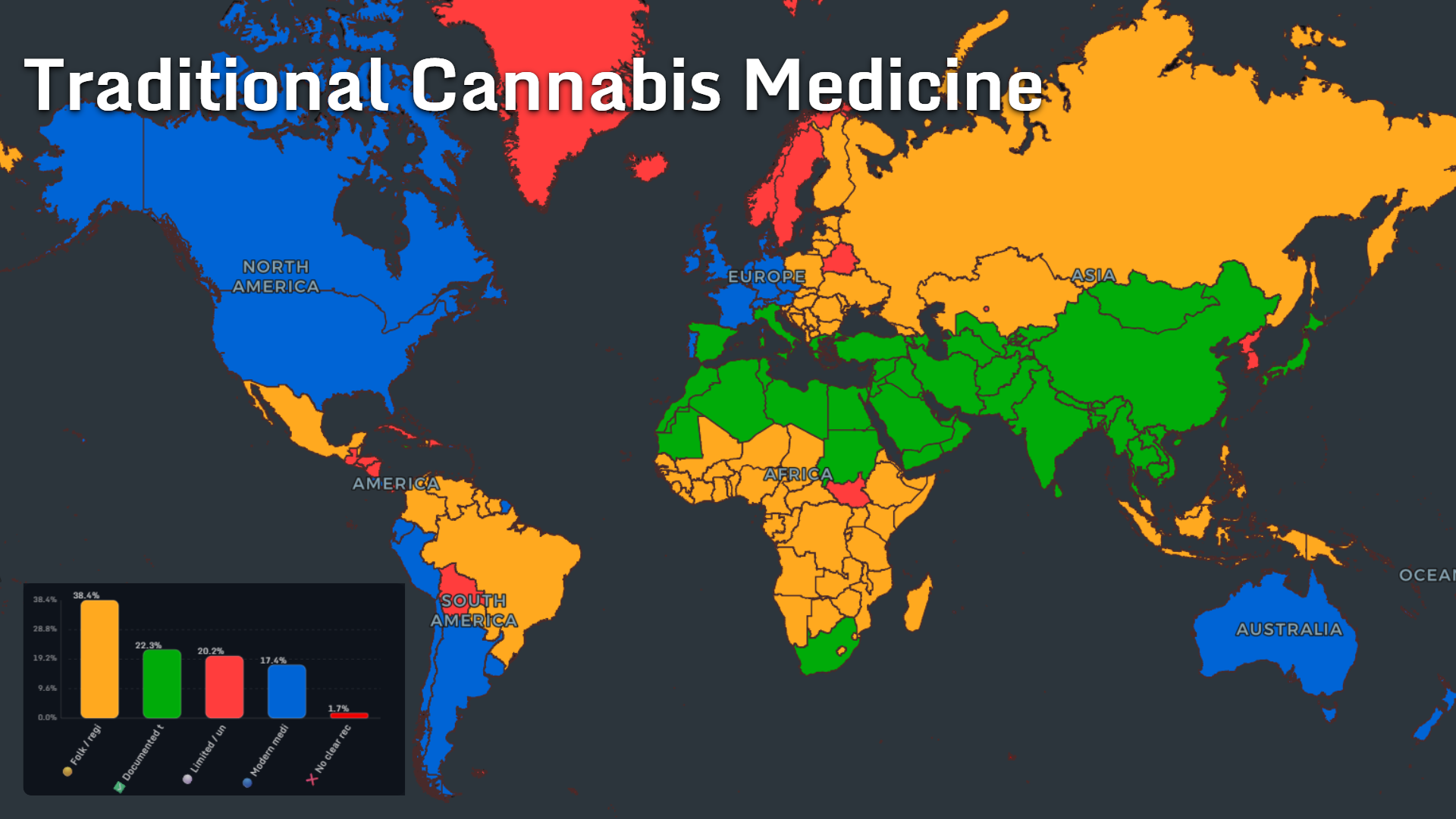
Before modern legal categories, cannabis existed in folk medicine, regional traditions and historical pharmacology.
The traditional cannabis medicine map shows:
- Folk / traditional: 38.4%
- Documented: 22.3%
- Limited / unclear: 20.2%
- Modern medical: 17.4%
- No clear record: 1.7%
It suggests that the cultural memory of cannabis is wider than modern legalization. Many countries show some kind of folk, documented or limited traditional relationship with the plant.
That does not mean modern medical legality. It means historical presence.
The distinction is important. Traditional use can survive in memory, texts, regional practice or informal culture even when contemporary law remains restrictive.
The map reveals a familiar pattern: policy often moves slower than culture, and culture often remembers what regulation later tries to simplify.
Cannabis Reclassification at the UN: A Narrow Global Split
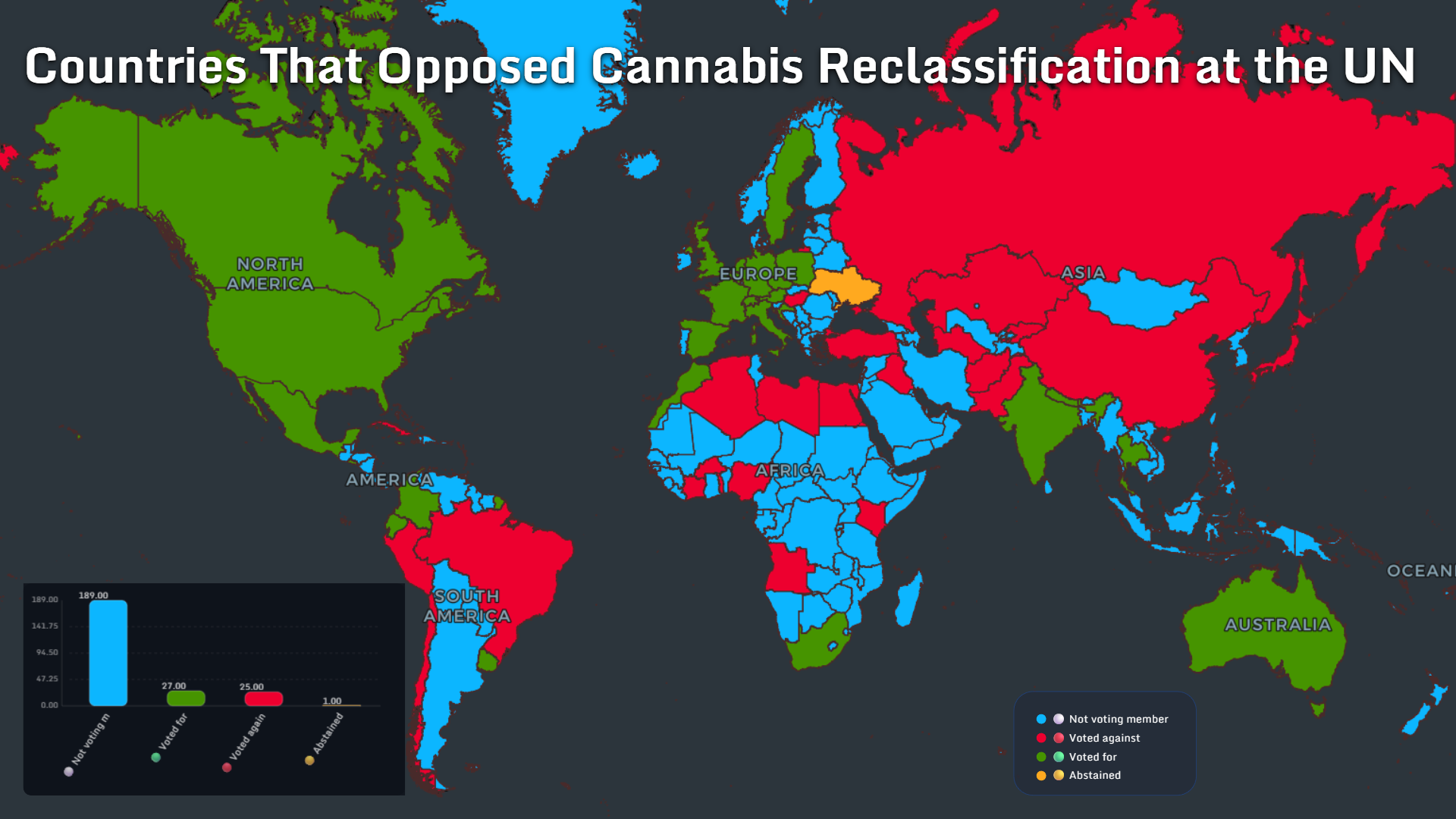
The UN reclassification map shows a sharp political divide.
The dataset records:
- Not voting member: 189
- Voted for: 27
- Voted against: 25
- Abstained: 1
That margin tells its own story.
Cannabis policy is not moving as a single global wave. It is contested, state by state and institution by institution.
Some countries approach reclassification through medicine and harm reduction. Others treat it through criminal law, social control or international treaty caution. Many are not voting members in the specific body represented by the map, but still live with the consequences of the global regulatory framework.
The map is less about hemp production and more about political temperature.
It shows why the hemp economy can be technically simple but legally complex. The same plant sits inside agriculture, medicine, trade, criminal justice and diplomacy.
What These Hemp Maps Reveal
Viewed together, the maps show a fragmented but fascinating global system.
China dominates production history, cultivation and seed output. Europe, especially the Netherlands and France, plays a major role in hemp fiber exports. North America appears strongly in modern cultivation. Many regions still lack clear separation between industrial hemp and drug cannabis.
The biggest insight is that hemp is not limited by agronomy alone.
It is limited by classification.
A country can have suitable land, farming knowledge and industrial demand, but if the law does not clearly distinguish hemp from intoxicating cannabis, the crop remains harder to grow, finance, process and export.
At the same time, the maps show revival. Hemp did not vanish permanently. It survived in China, persisted in parts of Europe and returned in countries where policy opened the door again.
This is why hemp is such a useful subject for data visualization. It connects agriculture, trade, law, medicine and cultural memory in one plant.
MAPTHOS helps turn that complexity into visible geography: where hemp is grown, where it was lost, where it is exported, and where law still decides what the crop is allowed to become.
👉 Explore more at app.mapthos.org
See the world. Map better. Dream big. 🌍✨