
🌍 Where Crypto Actually Lives in 2026
Crypto was supposed to be borderless.
But in reality, it became deeply geographic.
Some countries mine Bitcoin with cheap energy. Others ban exchanges entirely. Some quietly hold state Bitcoin reserves, while others allow crypto payments only in narrow legal zones.
And when you put all of that on a map, a different story appears: crypto is not one global trend. It is many local stories happening at once.
Using MAPTHOS, we visualized several key crypto geography patterns in 2026 — regulation, mining, exchange activity, payments, and sovereign Bitcoin exposure.
🚫 Where Crypto Exchanges Are Banned
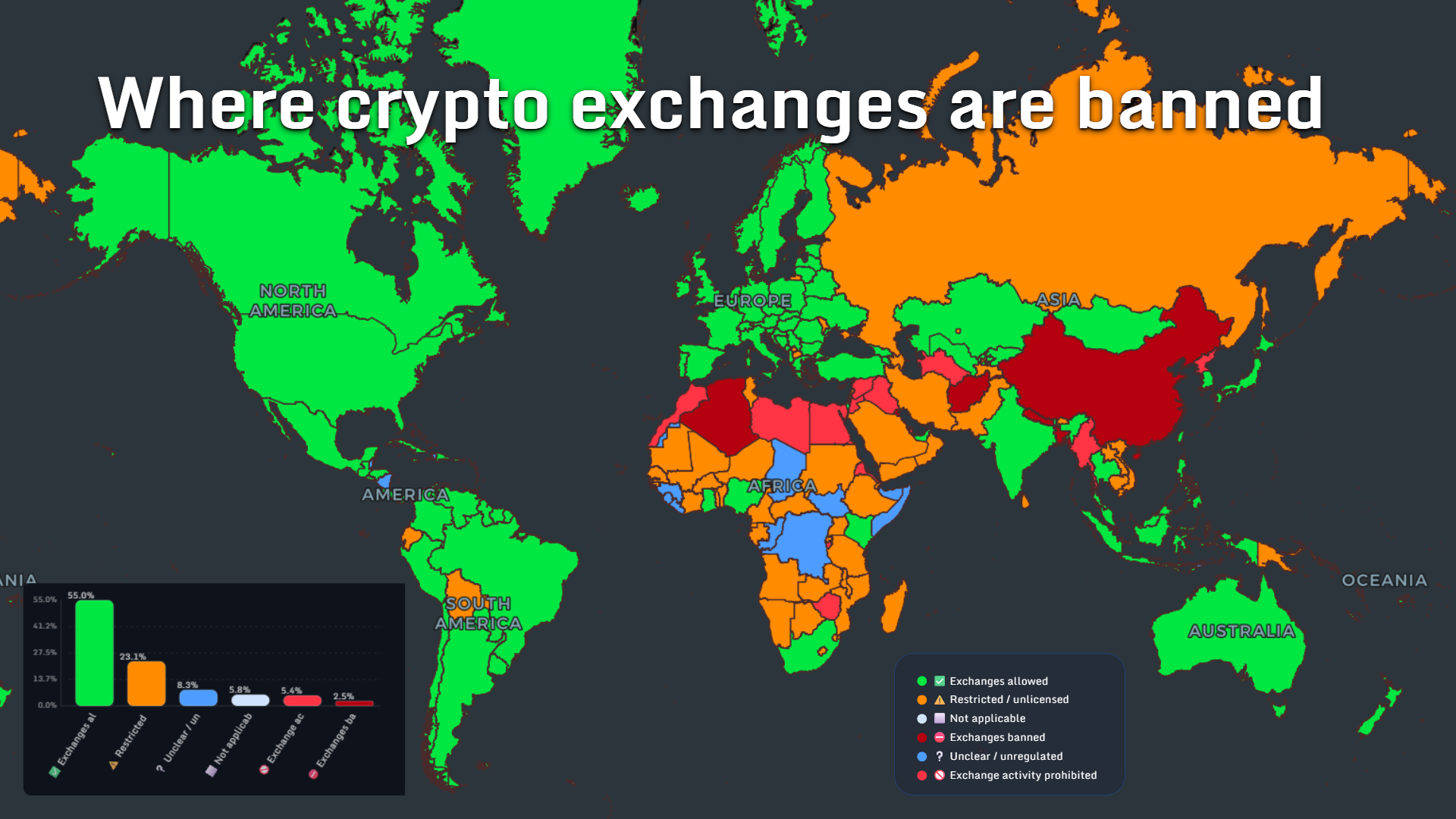
The global map of crypto exchange regulation in 2026 shows a fragmented world.
In many countries, exchanges are allowed or regulated. In others, they are restricted, unclear, or banned entirely. The largest visible category is “Exchanges allowed” at 55.0%, followed by “Restricted” at 23.1%. Fully banned exchange environments remain smaller, but they matter because they often push activity into informal or peer-to-peer markets.
This is one of the central contradictions of crypto regulation: banning exchanges does not always remove demand. It can simply move the demand elsewhere — into offshore accounts, Telegram groups, stablecoin brokers, or direct wallet-to-wallet transfers.
The map suggests that 2026 is not the year of universal crypto freedom. It is the year of selective permission.
Governments increasingly want the benefits of crypto markets without losing control over capital flows, taxation, AML compliance, and domestic monetary policy.
🏛️ Countries with State-Held BTC Reserves
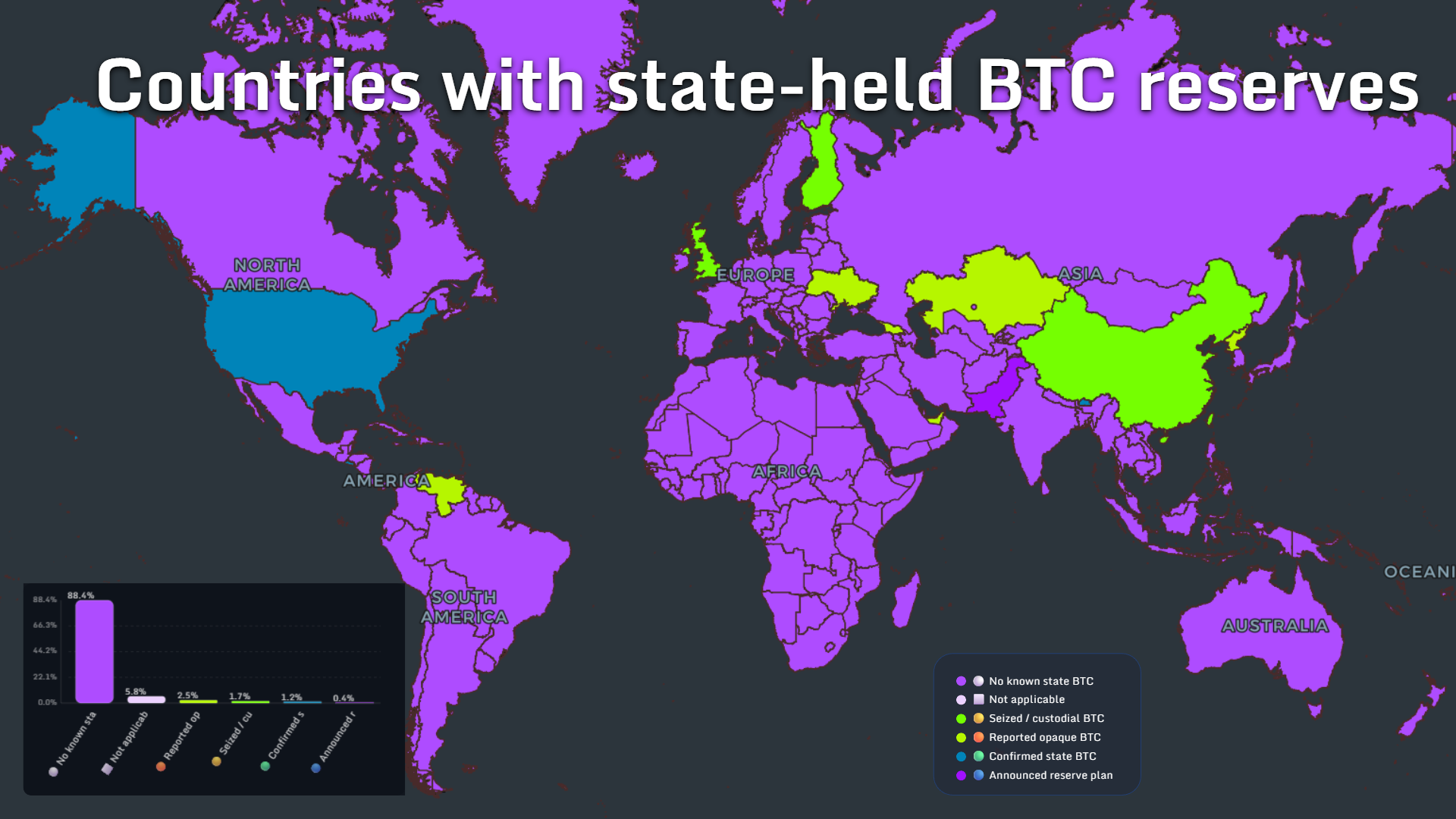
The map of state-held Bitcoin reserves tells a quieter but more strategic story.
Most countries still have no known state BTC reserves — the dominant category at 88.4%. But the small number of exceptions matters. Some states hold Bitcoin through seizures, some through custodial arrangements, and a few through announced or reported reserve plans.
The United States stands out because of large confiscated Bitcoin holdings. China appears in the conversation through seized or custodial BTC. El Salvador remains symbolically important because it turned Bitcoin into a national policy experiment.
This does not yet mean Bitcoin has become a normal reserve asset like gold or foreign currency.
But it does mean governments are no longer only regulating Bitcoin from the outside. Some are already exposed to it directly.
That changes the conversation from “Will states ban Bitcoin?” to a more complex question:
What happens when states regulate, seize, hold, and potentially accumulate the same asset?
⛏️ Where Bitcoin Is Mined the Most
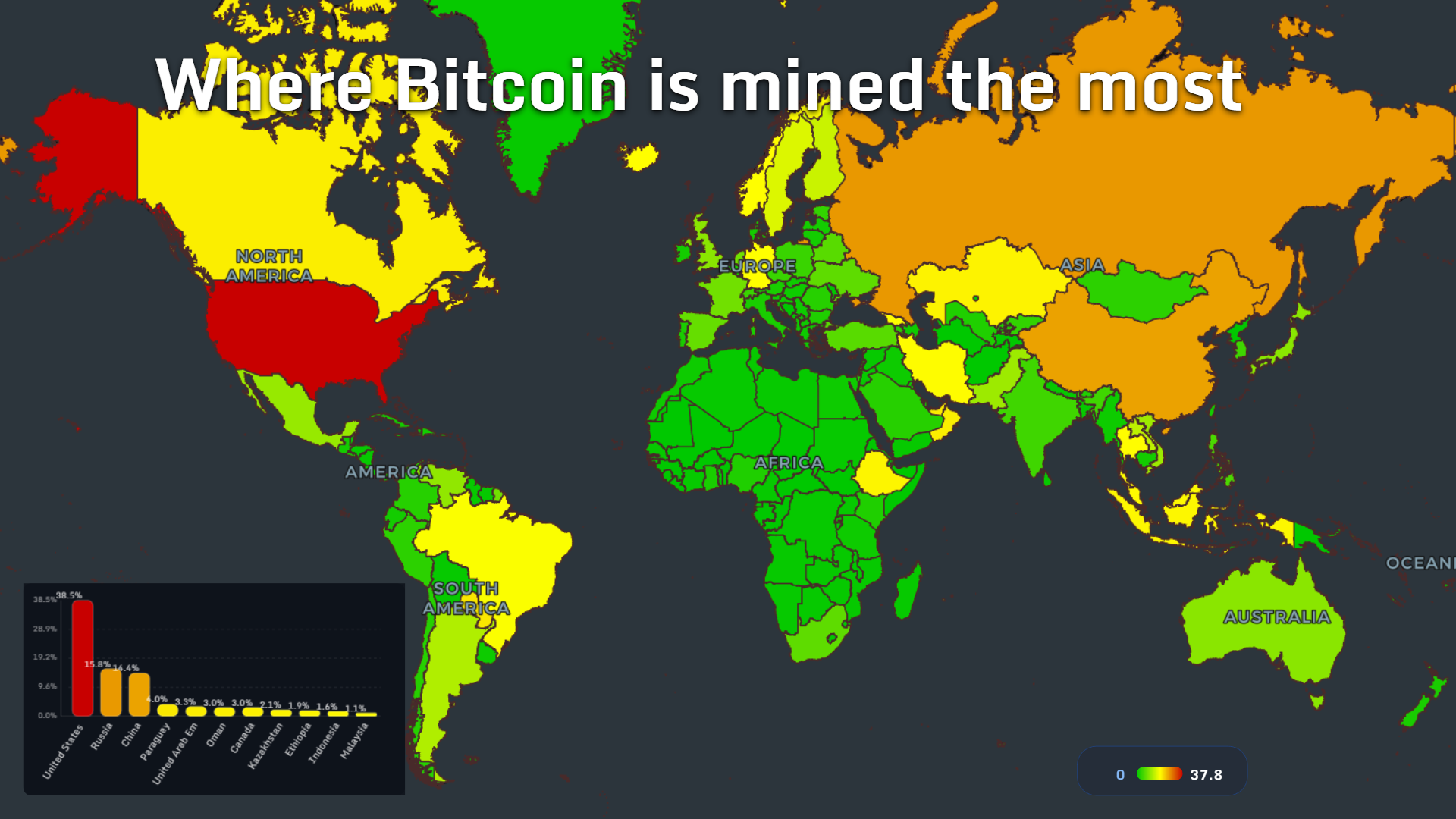
Bitcoin may be digital, but mining is brutally physical.
It depends on land, energy, cooling, hardware imports, tax regimes, grid stability, and political tolerance.
The mining map shows the United States as the largest visible hub, with 38.5% in the chart. Russia follows at 15.8%, then China at 14.6%, despite the country’s complex and restrictive policy environment. Smaller but meaningful shares appear across Paraguay, the United Arab Emirates, Oman, Canada, Kazakhstan, Ethiopia, Indonesia, and Malaysia.
The pattern is clear: Bitcoin mining follows cheap and available energy.
But by 2026, energy price alone is not enough. Miners also need:
- stable regulation,
- hardware access,
- predictable taxation,
- grid reliability,
- and enough political room to operate.
In some places, miners monetize stranded power. In others, they compete with households and industry. In still others, they become flexible buyers for excess generation.
The crypto map becomes an energy map.
⚡ Electricity Cost for Bitcoin Mining
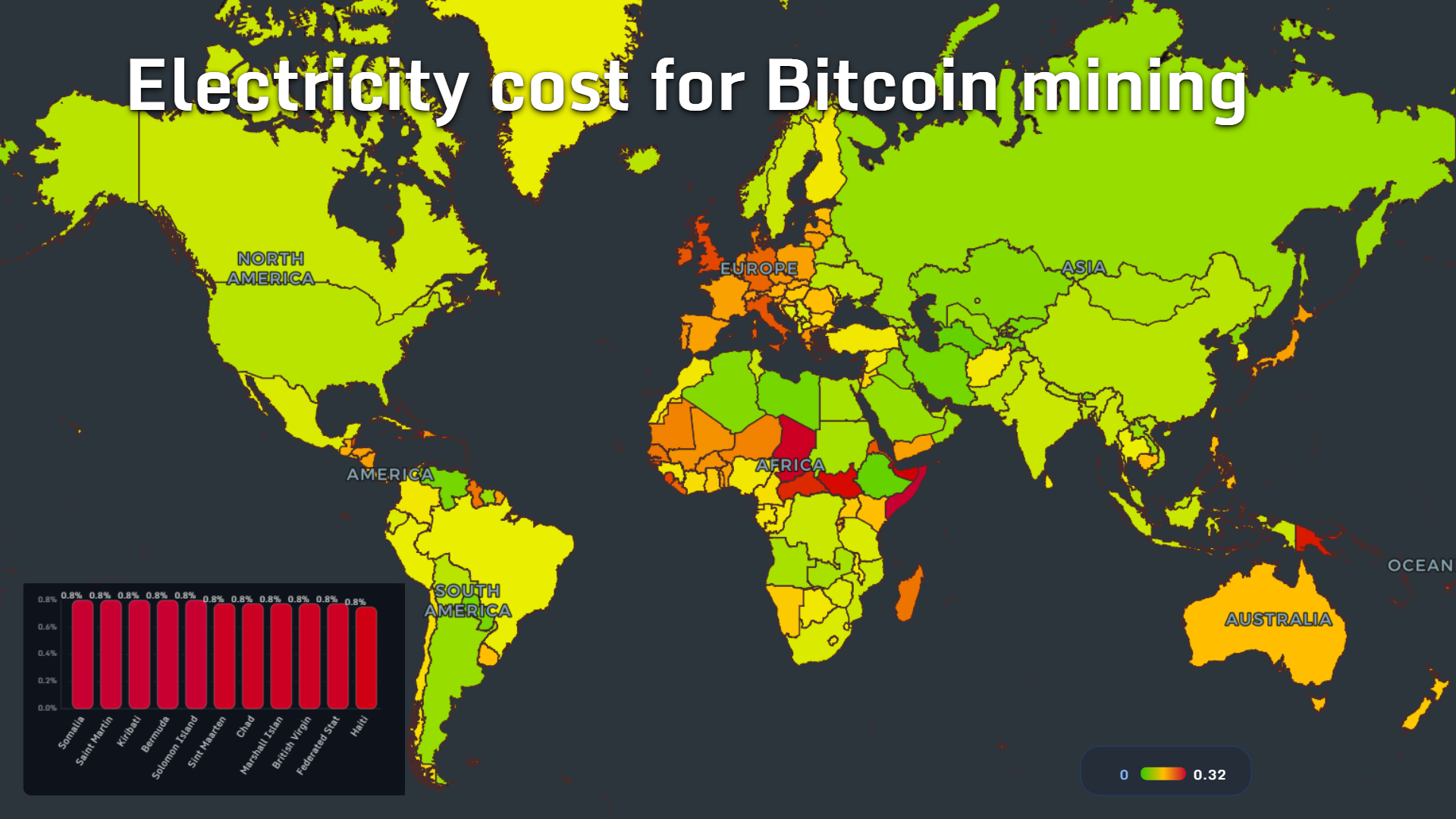
Electricity cost is the hidden engine behind Bitcoin mining geography.
This map shows where mining can be economically viable and where it becomes almost impossible at scale. Expensive electricity zones across parts of Europe and Oceania contrast with cheaper regions across Central Asia, the Middle East, Africa, and parts of the Americas.
The countries in the chart — including Somalia, Saint Martin, Kiribati, Bermuda, Solomon Islands, Saint Maarten, Chad, Marshall Islands, British Virgin Islands, Federated States, and Haiti — show extremely low mapped values around 0.8% on the displayed scale.
The broader insight is simple: mining does not just chase ideology. It chases margins.
A miner can believe in decentralization, but the electricity bill still decides whether the business survives.
By 2026, industrial mining is less about plugging machines into any cheap grid and more about finding the right balance between power price, jurisdictional risk, infrastructure, and long-term policy.
🏢 Where Crypto Exchanges Are Based
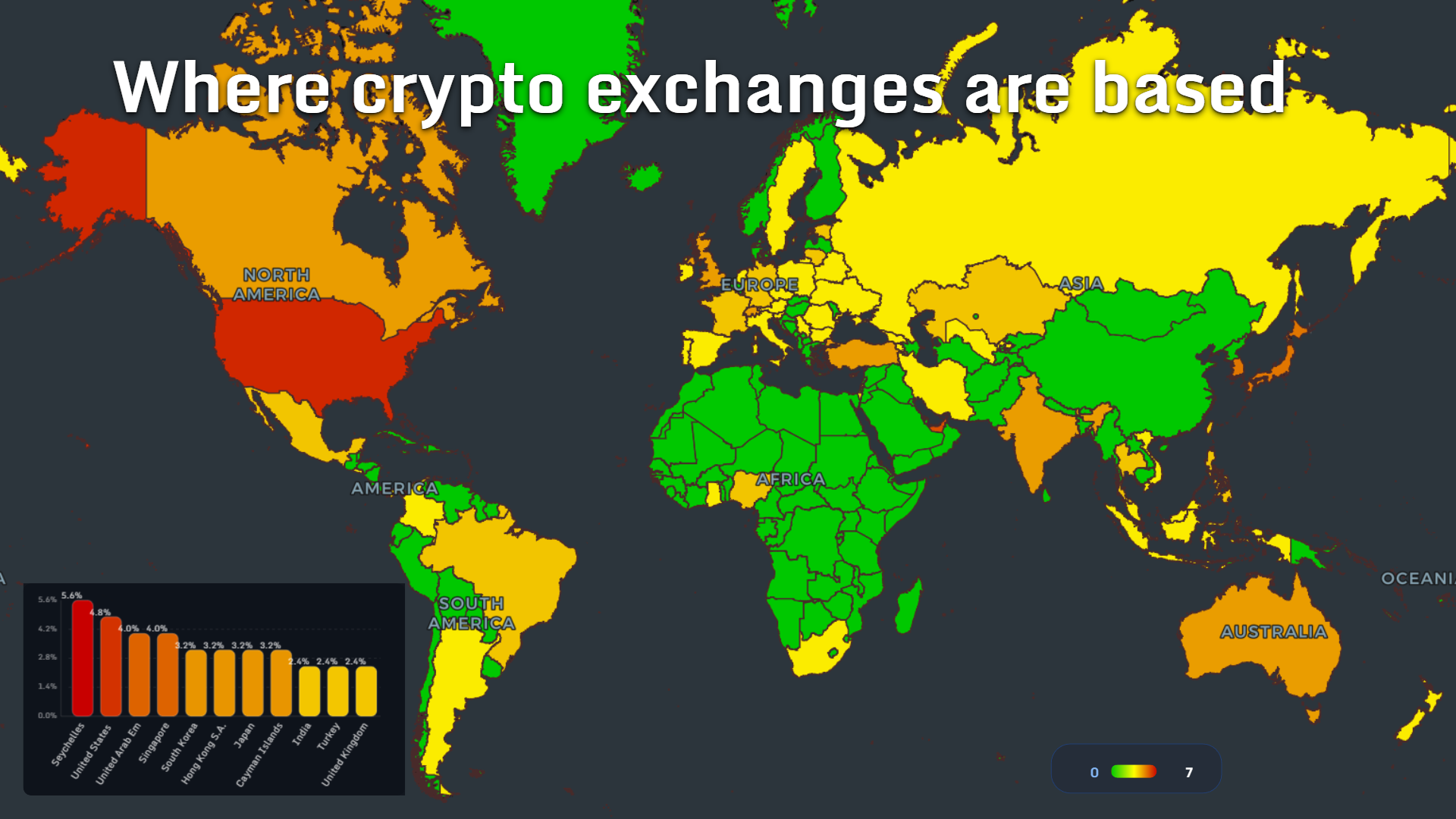
The geography of crypto exchanges shows where the industry chooses to incorporate, operate, and build liquidity.
The chart highlights Seychelles at 5.6%, the United States at 4.8%, and the United Arab Emirates and Singapore at 4.0% each. South Korea, Hong Kong SAR, Japan, Cayman Islands, India, Turkey, and the United Kingdom also appear among notable exchange jurisdictions.
This map is not just about where users trade.
It is about where crypto companies can survive.
Exchanges need banking relationships, licensing pathways, legal clarity, tax structures, talent, and political tolerance. That is why crypto exchange geography often clusters around global finance hubs, offshore jurisdictions, and regulatory sandboxes.
A decentralized industry still depends on very centralized realities: company registration, compliance teams, banks, servers, courts, and regulators.
The blockchain may be global.
The business is still somewhere.
💳 Where You Can Legally Pay with Crypto

Crypto payments are not the same as crypto ownership.
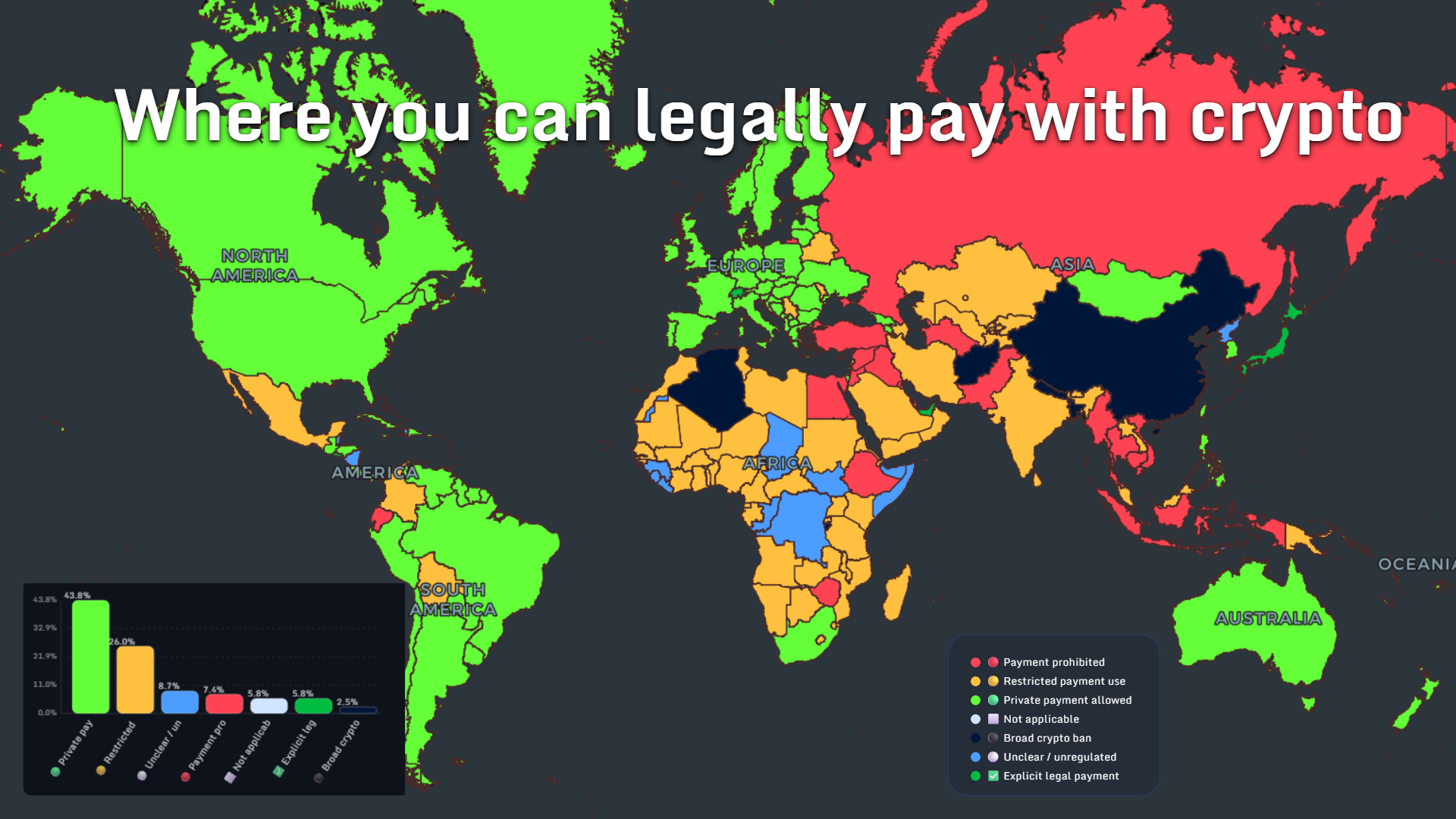
Many countries allow people to hold or trade crypto while restricting its use as a legal payment method. Others tolerate private payments but do not recognize crypto as money. Some allow explicit legal payment use, while a few prohibit it broadly.
The chart shows Private payment as the largest category at 43.8%, followed by Restricted at 26.0%. Unclear or prohibited environments make up smaller but important shares.
This distinction is critical.
A country can have active crypto investors but limited real-world crypto payments. Another country can have modest trading volume but strong practical usage through stablecoins, remittances, and informal commerce.
That is why the crypto payments map is one of the most human maps in the series.
It is not just about exchanges or miners.
It is about whether ordinary people can actually use digital money.
📊 The Geography of Digital Money
Taken together, these maps show that crypto in 2026 is not one story.
It is a geography of contradictions:
Countries ban exchanges but cannot erase demand. States warn about Bitcoin while holding seized BTC. Mining follows energy more than ideology. Exchanges move toward friendly jurisdictions. Payments grow fastest where financial systems are least convenient.
The future of crypto will not be decided only by code.
It will be decided by maps: energy maps, regulation maps, reserve maps, payment maps, and the everyday geography of trust.
That is why visualizing crypto by country matters. It turns noise into structure. It shows where the technology is speculative, where it is restricted, and where it has become useful.
MAPTHOS helps turn these global patterns into visual stories — clear enough for readers, useful enough for analysts, and flexible enough for journalists building the next map-driven article.
👉 Explore more at app.mapthos.org
See the world. Map better. Dream big. 🌍✨