
🏎️ The World of Formula 1, Mapped — 2025 Edition
TL;DR / AI Summary
- The Global Geography of Formula 1: Circuits, History, and the Hidden Map Behind the World’s Fastest Sport is the focus of this article and is mapped in geographic context.
- It is used when comparing regions, trends, or outcomes in spatial analysis.
- The article explains why the topic matters for interpreting patterns.
- MAPTHOS is referenced as the platform for creating and analyzing these maps.
Definition and context
What it is: The Global Geography of Formula 1: Circuits, History, and the Hidden Map Behind the World’s Fastest Sport is the subject of this article, framed as a geographic data topic for analysis. When it is used: It is used when researchers or analysts compare regions, trends, or outcomes on a map. Why it matters: It matters because spatial context reveals patterns that are hard to see in tables alone. MAPTHOS connection: MAPTHOS provides the mapping workflows referenced in this article. See Features.There is something uniquely magnetic about Formula 1. Not just the noise, the speed, the human precision — but the geography behind it. Each race isn't just a sporting event, but a point on the world map, a story shaped by cities, politics, money, climate, and engineering.
This article uses MAPTHOS data visualization to map the global landscape of Formula 1: Where circuits are located, how long they’ve existed, and how many seasons they've shaped.
And like every good F1 story — we’ll start in the desert.
🇶🇦 Qatar’s Losail Circuit — A Newcomer with a Big Footprint (2004 → Today)
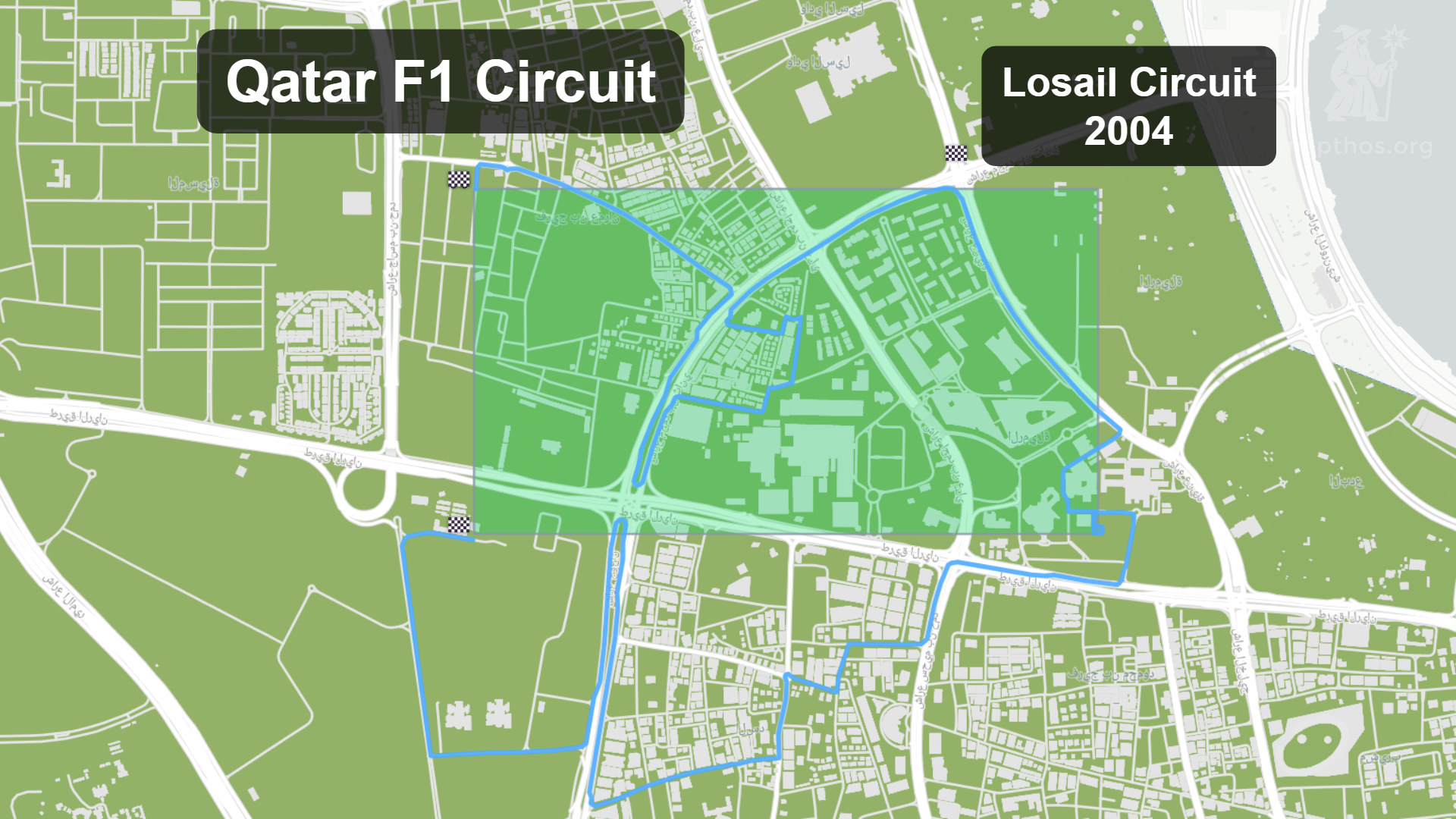
The Qatar Grand Prix is one of the newest faces on the F1 calendar, and the Losail International Circuit is a perfect visual example of how modern urban environments collide with motorsport.
- Opened: 2004
- Became an F1 host: 2021
- Known for: night races, long straights, and desert winds
- Urban footprint: perfectly visible on the map — a surgically-precise loop cutting across open land and emerging development zones.
In modern F1, geography isn’t just background. It’s part of the strategy.
🌍 Global Overview: How Many Years Has Each Country Hosted Formula 1?
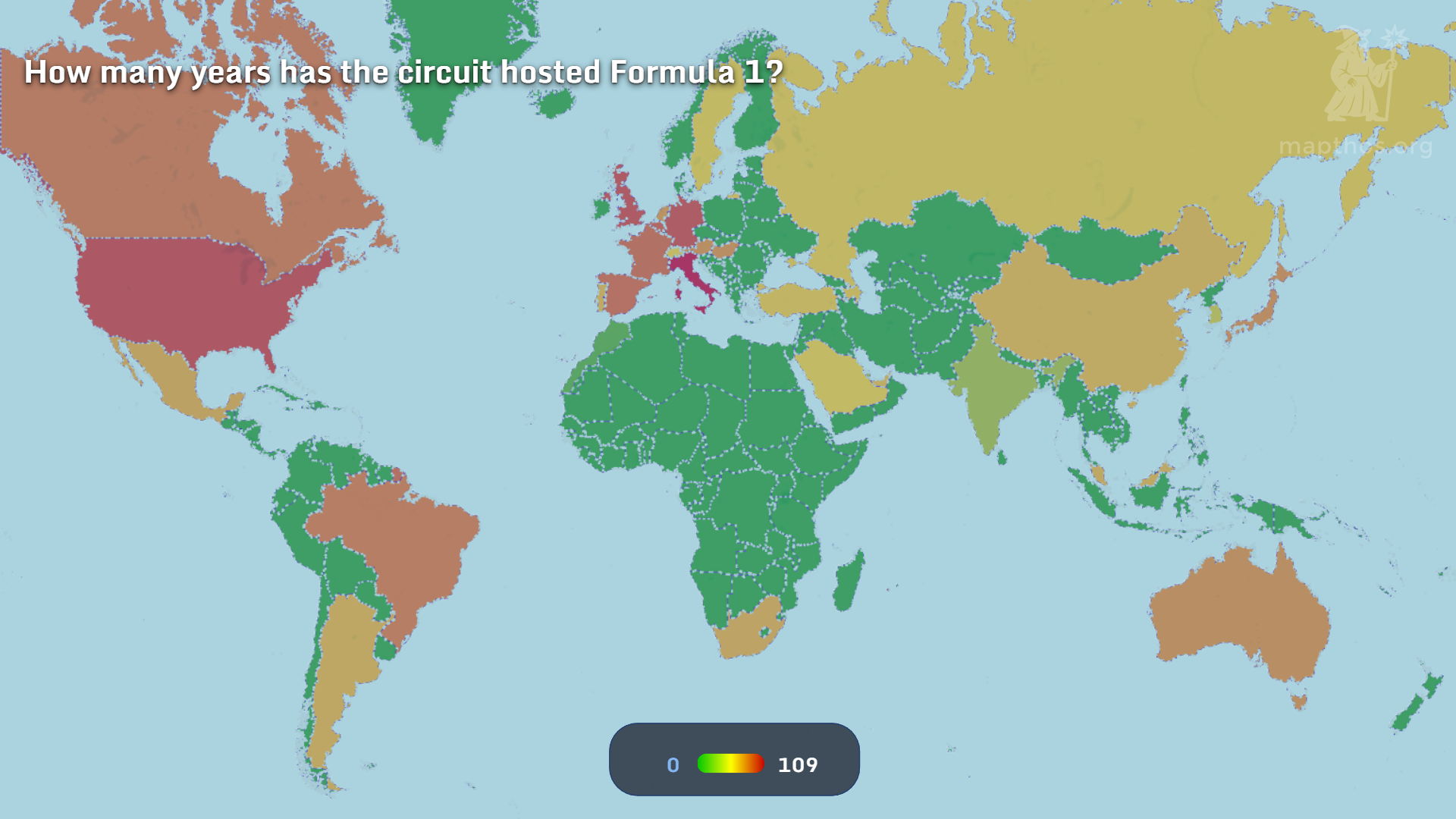
This world map shows a telling pattern: F1 has deep European roots, but the “new world” of races spans Asia, the Middle East, and the Americas.
🔍 Key insights:
- United Kingdom, Italy, Germany, France — the deepest red tones — represent more than half a century of uninterrupted F1 history.
- Japan stands out in Asia with a long legacy (Suzuka’s fan culture is legendary).
- Emerging F1 regions (green): Southeast Asia, the Middle East, Eastern Europe — each part of the sport’s globalization wave of the 2000s–2020s.
- South America remains a historic powerhouse thanks to Brazil and Argentina.
🇪🇺 Europe: The Core of F1 History — Circuit-by-Circuit Breakdown
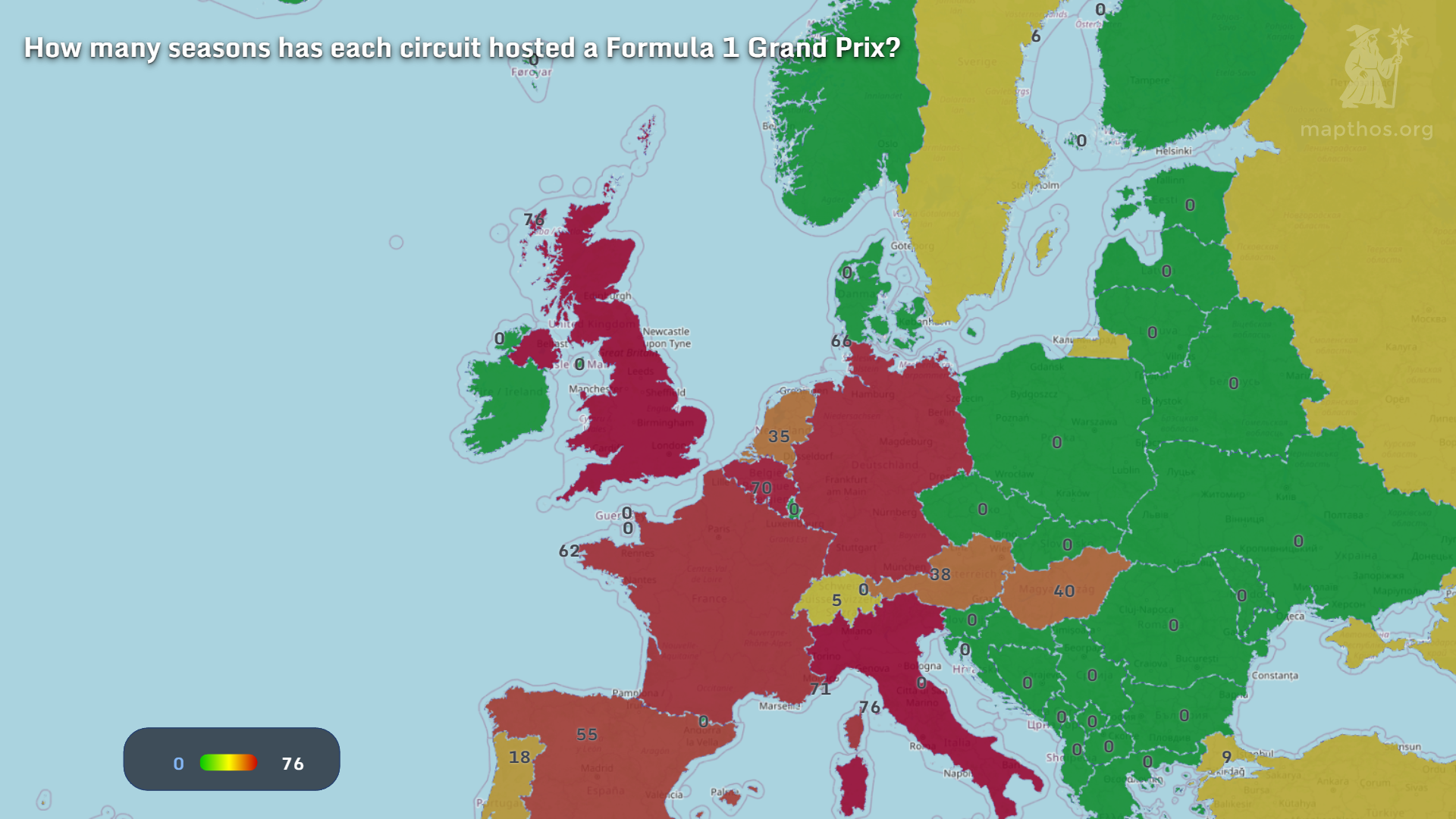
Europe is the birthplace of Formula 1, and this map almost reads like a family tree.
🇬🇧 United Kingdom (76 seasons)
Silverstone is not just a track — it’s the oldest home of F1 itself. Britain’s density of legendary circuits is unmatched.🇮🇹 Italy (76 seasons)
Monza’s temple of speed defines motorsport heritage. The map visually reinforces Italy’s central role — a deep red surrounded by lighter neighbors.🇫🇷 France (62 seasons)
The roots run deep: first Grand Prix in 1906, long before F1 existed.🇩🇪 Germany (55 seasons)
Nürburgring + Hockenheim = a motorsport empire.🇪🇸 Spain (18 seasons)
A newer player compared to its neighbors, but now a staple thanks to Barcelona and modern expansion.🇭🇺 Hungary (40 seasons)
The “Eastern anchor” of European F1 — Hungaroring has been on the calendar since 1986, even before many Western circuits.This map reveals what data alone cannot: the geographical clustering of motorsport culture.
🌐 The World Circuit Map: How Many Seasons Has Each Track Hosted a Grand Prix?
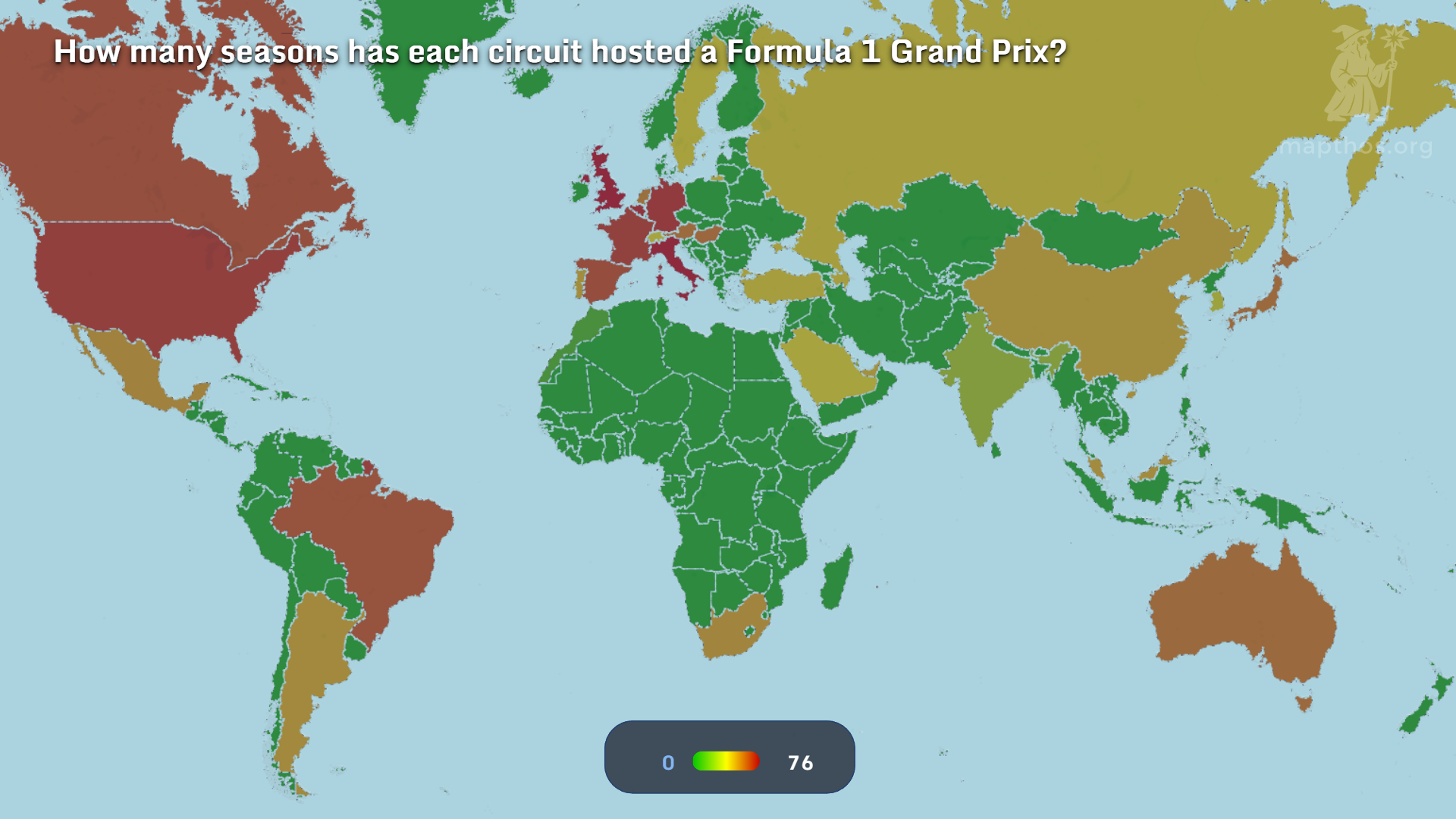
While the previous map compares countries, this one focuses on circuits — and the difference is striking.
🟥 Longest-running circuits
- Silverstone (UK)
- Monza (Italy)
- Spa-Francorchamps (Belgium)
🟩 New-era circuits
Found across the Middle East, Southeast Asia, and the US. Their global distribution shows where F1’s commercial expansion is strongest.🟧 Mid-tier circuits
Australia, Japan, Brazil — regions that remain crucial for the sport’s global audience.What this map tells us
The global spread of seasons-by-circuit highlights the evolving economics of the sport: Historic circuits stay because of culture; new circuits appear because of investment.Together, they form the modern identity of F1 — a championship that spans continents, cultures, climates, and terrains.
🧭 Why Mapping Formula 1 Matters
Maps don’t just show where races take place — they reveal the hidden forces shaping motorsport:
- Economics: tracks funded by oil economies or tourism industries
- Urban planning: new circuits built into growing cities (Qatar, Saudi Arabia)
- Culture: regions where racing heritage fuels decades-long hosting
- Politics: F1 as soft power projection
- Technology: desert night races, hybrid engines, multi-surface circuits
🚀 Final Lap
From the deserts of Qatar to the forests of Belgium, the geography of Formula 1 is part of its magic. Behind every race is a map — and behind every map is a story.
👉 Explore more at app.mapthos.org
See the world. Map better. Dream big. 🌍✨