
🌍 Cartoon Travel Maps: How Far Did Famous Animated Characters Really Go?
Animated characters live in strange worlds.
They can spend years in the same fictional town, then suddenly appear in London, Japan, Australia or somewhere in the middle of the desert. Sometimes it is a family holiday. Sometimes it is a spy mission. Sometimes the entire trip exists for one joke.
When those episodes are mapped country by country, familiar cartoons start to look surprisingly global.
These cartoon travel maps compare the countries visited by characters from American Dad!, Family Guy, Inspector Gadget, Peppa Pig, Scooby-Doo, The Simpsons and South Park.
American Dad!: the Smith family leaves Langley Falls behind
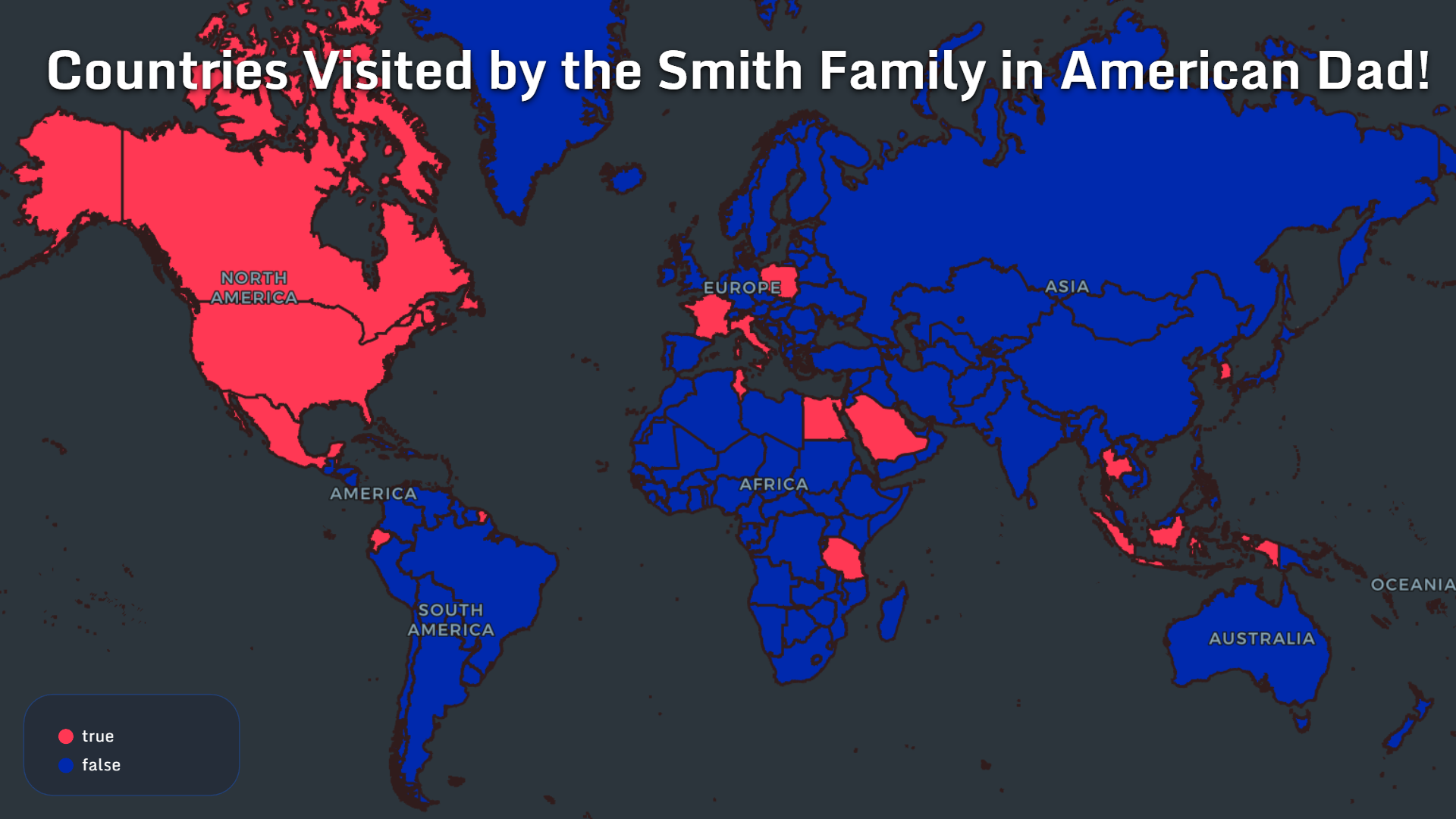 American Dad! may be rooted in suburban Virginia, but the Smith family’s geography extends far beyond the United States.
The map shows visits across North America, parts of Europe, the Middle East, Africa, Southeast Asia and Latin America.
That international spread fits the series unusually well. Stan Smith’s CIA career gives the writers a natural excuse to move the family across borders, while the show’s surreal structure makes almost any destination possible.
The result is a map that sits somewhere between family sitcom and geopolitical parody.
Family Guy: the Griffins built a huge international footprint
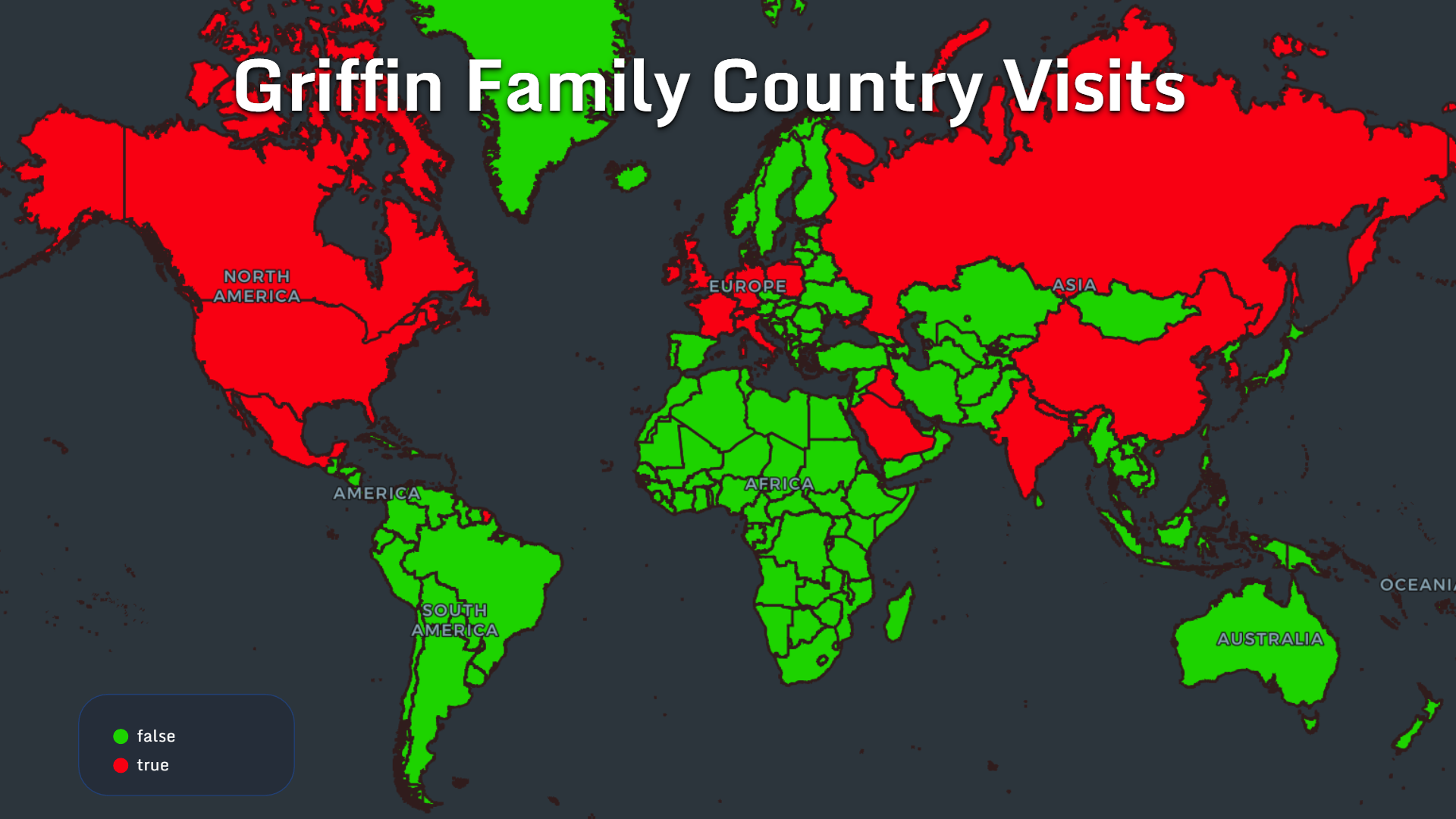
The Griffin family has one of the broadest travel footprints in this collection.
The highlighted countries form a long northern corridor stretching from Canada and the United States across Western Europe, Russia, China, India and parts of the Middle East.
That pattern makes sense for Family Guy. The show rarely treats geography as a limitation. Cutaways, parodies and absurd storylines can move the characters thousands of kilometers in seconds.
What looks random episode by episode becomes much clearer on the map: the Griffins repeatedly travel across the northern hemisphere, while large parts of Africa and South America remain comparatively untouched.
Inspector Gadget: built to travel
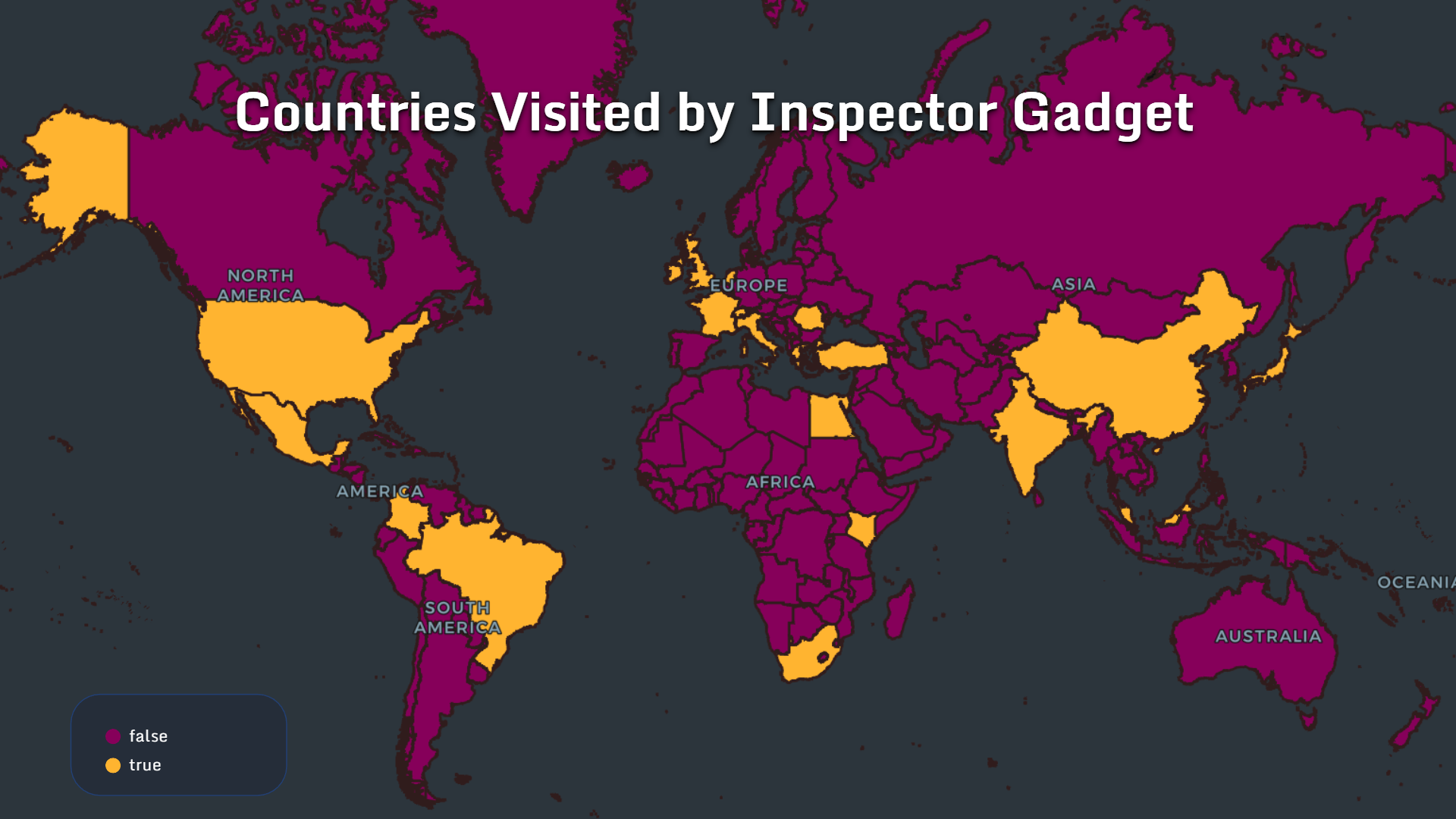
Among all the maps here, Inspector Gadget has perhaps the most natural global geography.
The highlighted countries stretch across North America, South America, Western Europe, North and East Africa, India, China and Japan.
The reason is structural: Gadget is constantly sent on missions.
New countries are not occasional vacation episodes. They are part of the basic storytelling engine.
That makes this map feel less like a list of trips and more like an international assignment board — exactly what you would expect from a globe-trotting detective cartoon.
Peppa Pig: a small but recognizable travel map
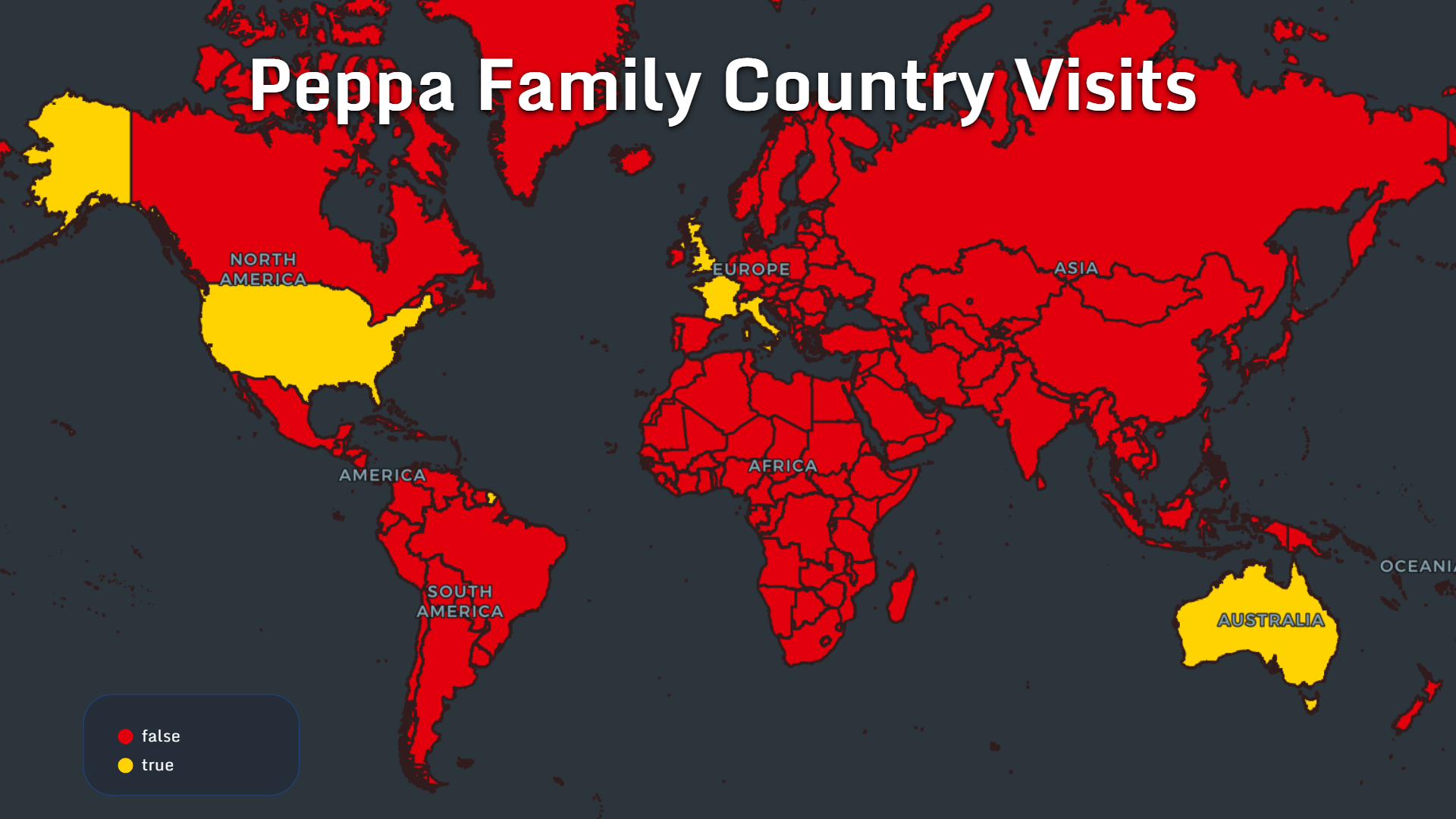
Peppa Pig’s travel history is much more compact.
The map highlights a small number of destinations, including the United Kingdom, United States, several countries in Western Europe and Australia.
Compared with The Simpsons or Family Guy, this map looks almost minimalist.
But that is what makes it interesting.
Travel in Peppa Pig is usually framed as a special family experience rather than an everyday narrative device. Because there are fewer destinations, each one stands out more clearly.
It feels less like a global network and more like a scrapbook of memorable holidays.
Scooby-Doo: Mystery Inc. quietly became world travelers
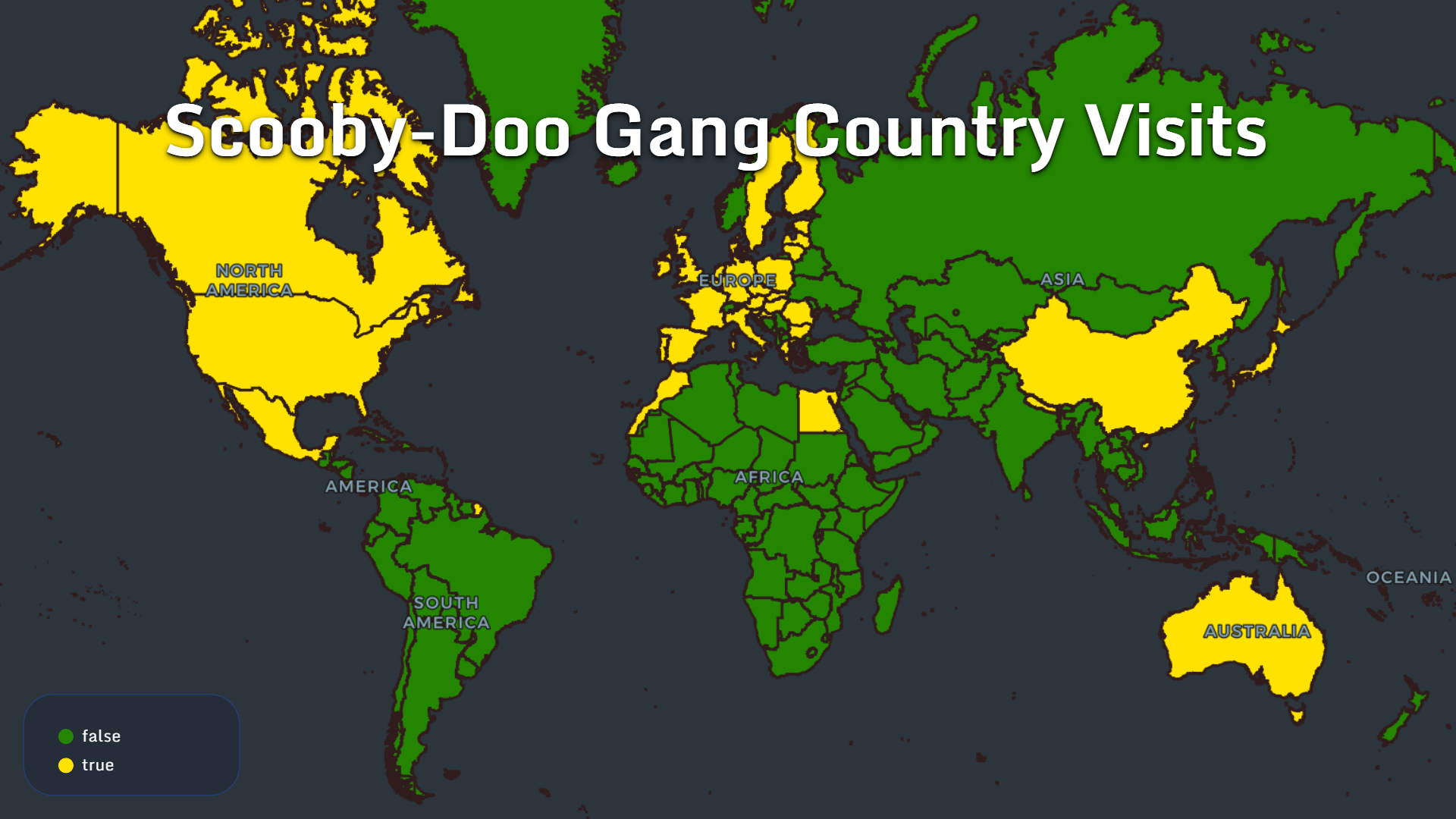
The Scooby-Doo gang has always been mobile.
The map shows visits across North America, much of Western Europe, Egypt, China, Japan and Australia, with additional destinations scattered around the world.
The geography feels especially appropriate for the franchise.
Mysteries work well in places with castles, ruins, legends, old cities, monuments and local folklore. A new country gives the writers a new mythology to play with.
Seen this way, Scooby-Doo is not only a mystery cartoon.
It is also a travel series with ghosts.
The Simpsons: decades of episodes create a global atlas
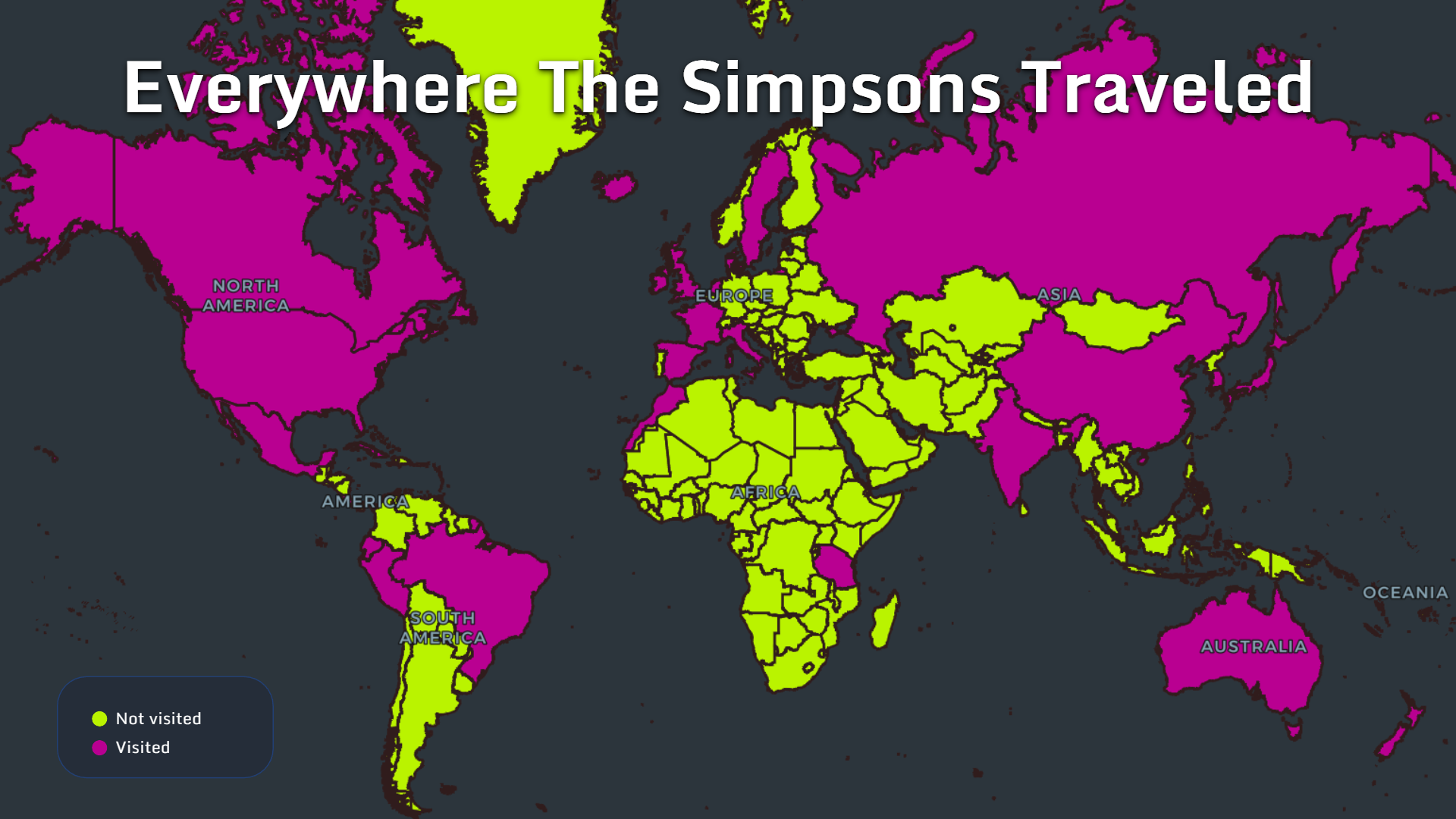
The Simpsons’ map is one of the densest in the entire collection.
Visited countries appear across North America, South America, Europe, Russia, India, East Asia, Australia and parts of Africa.
That huge footprint is partly a consequence of longevity.
A single international episode may feel unusual when it airs. But after decades of stories, those individual trips accumulate into a surprisingly large geographic dataset.
Springfield may be famously impossible to locate with certainty, but the Simpson family itself has traveled across a remarkable share of the world.
South Park: fewer trips, stronger destinations
.png)
The South Park boys have a more selective travel map.
Highlighted destinations appear across North America, parts of Europe, the Middle East, East Africa, South Asia, Japan and South America.
Compared with The Simpsons, fewer countries are marked.
But South Park often uses geography differently. International settings tend to carry a specific satirical purpose rather than simply functioning as a backdrop.
So while the total footprint is smaller, individual destinations can matter more to the story.
Which cartoon world feels the most global?
Looking at these maps together reveals several distinct travel patterns.
The Simpsons and Family Guy are global accumulators. Their enormous episode counts naturally produce large geographic footprints. Inspector Gadget and Scooby-Doo are adventure travelers. Geography is part of the core narrative structure, so moving to a new country feels completely natural. Peppa Pig is a selective traveler, where each international trip feels like an event. American Dad! sits somewhere in between: a domestic family sitcom with an international spy mechanism built into it.And South Park tends to travel when geography itself becomes part of the joke or political commentary.
When cartoons become geographic data
A single episode is a story.
Hundreds of episodes become a dataset.
Once those journeys are visualized on a world map, animated television starts revealing patterns that are difficult to notice while watching: recurring regions, untouched continents, international clusters and strange one-off destinations.
That is the value of pop culture data visualization.
The map does not replace the story. It exposes another layer of it.
With MAPTHOS, even a simple visited / not visited dataset can turn years of television into a geographic narrative.
👉 Explore more at app.mapthos.org
See the world. Map better. Dream big. 🌍✨